Apgujeong-dong, Yeouido-dong, Mok-dong, and Seongsu-dong Areas Require Land Transaction Permits from the 27th
High Potential for Price Increases Due to Reconstruction Expectations
"Speculative Demand Will Be Strictly Blocked, Housing Supply Will Proceed Without Delay"
[Asia Economy Reporters Kim Hyemin and Lim Onyu] The areas of Apgujeong-dong, Yeouido-dong, Mok-dong, and Seongsu-dong in Seoul will be designated as land transaction permission zones starting from the 27th. These are all regions where housing prices have overheated due to increased expectations for reconstruction and redevelopment around the time of Mayor Oh Se-hoon's inauguration. However, Mayor Oh aims to steadily proceed with housing supply through the normalization of reconstruction and redevelopment, separate from the designation of land transaction permission zones.
Apgujeong-dong, Yeouido-dong, Mok-dong, Seongsu-dong Designated as Land Transaction Permission Zones for One Year Starting April 27
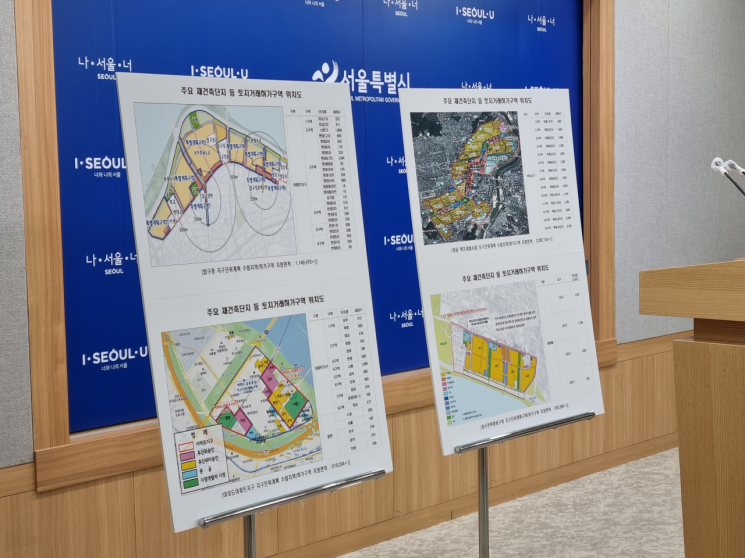
On the 21st, Seoul Mayor Oh Se-hoon held a briefing at Seoul City Hall and announced the designation of four major large-scale reconstruction and redevelopment project areas as land transaction permission zones. Earlier, the Seoul Metropolitan Government held the 5th Urban Planning Committee meeting to review this agenda.
The designated areas are ▲Apgujeong Apartment District (24 complexes) ▲Yeouido Apartment District and nearby complexes (16 complexes) ▲Mok-dong Housing Development Project District (14 complexes) ▲Seongsu Strategic Maintenance District (4 districts). The total area is 4.57㎢, effective from the 27th. The designation period is one year.
With this, the total land transaction permission zones in Seoul have expanded to 50.27㎢, including Jamsil-dong, Samseong-dong, Cheongdam-dong, and Daechi-dong designated last year. In June last year, the city designated four neighborhoods near the ‘International Exchange Complex District’ being developed around Jamsil to COEX as land transaction permission zones.
The Seoul Metropolitan Government explained the rationale for this decision as "taking preemptive measures due to concerns about speculative demand inflow, as abnormal transactions have been detected in some reconstruction complexes and redevelopment areas along the Han River, with listings being exhausted and asking prices soaring."
The four areas and 54 complexes designated as land transaction permission zones this time are reconstruction and redevelopment project promotion areas where speculative demand inflow and transaction price increases are a concern.
All 24 complexes densely located around Apgujeong Station in the Apgujeong Apartment District have been designated. In the Mok-dong district, all 14 complexes are designated, but commercial areas are excluded to minimize regulatory impact. In the Yeouido district, nearby apartments including Sujeong, Gongjak, Seoul, Jinju, and Chowon Apartments are included as land transaction permission zones to prevent balloon effects. In the Seongsu Strategic Maintenance District, all types of housing and land within the maintenance district, including apartments, villas, and commercial buildings, are subject to land transaction permission.
Permission from District Mayor Required for Apartment Sales in Land Transaction Permission Zones
Once designated as a land transaction permission zone, transactions of housing, commercial buildings, and land above a certain size require permission from the respective district mayor. If a land transaction contract is concluded without permission, the offender may face imprisonment of up to two years or a fine of up to 30% of the land price. In particular, residential land must be used only for actual residence for two years, and sales or leases are prohibited.
The city has lowered the land area requiring permission to about 10% of the legal standard area. For residential areas, transactions exceeding 18㎡ and for commercial areas, exceeding 20㎡ are subject to permission. Seoul will continuously monitor real estate market trends and consider additional designations. The city also plans to comprehensively review whether to extend the designation period upon expiration.
 Seoul Mayor Oh Se-hoon is speaking at the "Official Land Price Related Meeting" held at Seoul City Hall on the afternoon of the 18th. Photo by Moon Ho-nam munonam@
Seoul City: "Mayor Oh Se-hoon's Reconstruction Normalization Will Proceed as Planned"
The city aims to thoroughly block speculative demand under the principle of ‘speedy but cautious’ while steadily promoting housing supply to stabilize the real estate market. Lee Jung-hwa, Director of Seoul City Urban Planning Bureau, said, "Analysis of transaction status in existing land transaction permission zones shows that housing prices stabilized and speculation prevention effects were observed after designation," adding, "This system is very effective in restructuring the market around actual residents."
It was also clarified that this decision does not contradict Mayor Oh’s policy to expand housing supply through the normalization of reconstruction and redevelopment. Some concerns have been raised that the expansion of land transaction permission zones might slow down reconstruction projects. Director Lee said, "The designation of land transaction permission zones is not directly related to housing supply procedures," and "It is an important measure to prevent speculation."
After designating Jamsil-dong, Samseong-dong, Cheongdam-dong, and Daechi-dong as land transaction permission zones last year, a balloon effect occurred with housing prices surging in nearby areas. The city intends to closely monitor neighboring areas to prevent such phenomena from recurring. Director Lee explained, "There are significant concerns about balloon effects, and we will monitor frequently. If market instability arises or speculative demand inflows, those areas can also be designated as land transaction permission zones."
He also emphasized continuous monitoring of major reconstruction complexes not included in the new land transaction permission zones. Kim Seong-bo, Head of Seoul City Housing and Architecture Headquarters, said, "If prices rise by 10% in one year or 20% in two years in a specific area, it is read as a speculative signal," adding, "We will strictly respond to illegal speculative demand to stabilize the real estate market."
© The Asia Business Daily(www.asiae.co.kr). All rights reserved.


















