Graduate Schools of Artificial Intelligence and Software-Centered Universities Selected for Expansion
Supporting the Acquisition of High-Level and Specialized Talent Lacking in the Industry
[Asia Economy Reporter Eunmo Koo] The government has additionally selected software-centered universities and artificial intelligence graduate schools to cultivate specialized talent leading the Digital New Deal.
On the 21st, the Ministry of Science and ICT announced the newly selected universities for software-centered universities, artificial intelligence (AI) graduate schools, and Star Labs aimed at nurturing talent in AI and software (SW) fields. As part of the Korean New Deal, the Ministry is investing 1 trillion won from this year through 2025 to train 100,000 core talents in AI and software. Among them, 25,000 bachelor-level students will be trained at software-centered universities, and 1,820 master’s and doctoral-level students will be trained at AI graduate schools.
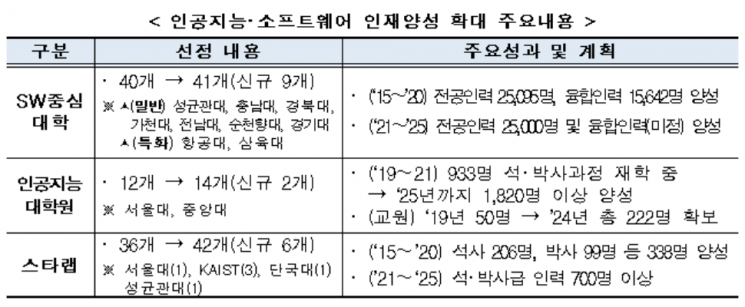
First, software-centered universities have been newly selected this year with a division into general tracks and specialized tracks, totaling nine universities: seven general and two specialized. The general track maintains the same application requirements (SW admission quota of 100 or more) and support (2 billion won annually) as existing software-centered universities. A total of 28 universities applied this year, with Gachon University, Kyonggi University, Kyungpook National University, Sungkyunkwan University, Soonchunhyang University, Chonnam National University, and Chungnam National University being selected. The specialized track, which provides 1 billion won annually, aims to spread SW innovation education to small and medium-sized universities; among 11 applicants, Samyook University and Korea Aerospace University were selected.
Since its inception in 2015, the software-centered university program has led the cultivation of SW professionals by revising industry-demand-based SW curricula, expanding SW major quotas, and fostering SW convergence talent. Over six years until last year, it has produced a total of 25,095 SW major personnel and 15,642 convergence personnel, making it a core project for nurturing AI and SW experts. Notably, from this year, a second phase project begins to advance the SW education system by strengthening education in new technologies such as AI and preparing differentiated SW curricula by department and level.
For AI graduate schools, two universities were newly selected this year from a total of 11 applicants, with Seoul National University and Chung-Ang University being chosen. AI graduate schools receive support of 1 billion won in the first year and 2 billion won annually from the second year onward, up to a maximum of 19 billion won over 10 years. The two selected universities presented differentiated operational plans regarding securing a quota of more than 40 AI master’s and doctoral students, expanding AI faculty, and opening advanced and specialized AI curricula.
Seoul National University plans to secure 80 master’s and doctoral students and 36 full-time faculty members by 2025, while opening and operating specialized curricula in AI core technologies, semiconductors, health & bio, autonomous driving, and robotics. Additionally, it will promote AI research expansion through close collaboration with the AI Research Institute, which has over 300 faculty members, and the AI Valley industrial cluster being developed in the Nakseongdae area. Chung-Ang University plans to secure 50 students and 18 full-time faculty members by 2025 and will open and operate specialized curricula in three core AI fields (Trustworthy AI, Automated AI, General-purpose AI) and six AI application fields (medical, security, vehicles, robotics, language, content).
The AI graduate school program started in 2019 and has selected a total of 12 universities. As of 2021, 933 master’s and doctoral students are enrolled. Full-time faculty composed of AI experts are also being continuously secured.
Lastly, six research labs were newly selected for the SW Star Lab program. The SW Star Lab project supports securing foundational and original technologies in five core SW technology areas and nurturing master’s and doctoral-level SW talents who will lead SW innovation. This year, 34 labs applied, and the selected labs include Seoul National University’s System Software and Architecture Lab, Sungkyunkwan University’s Automation Lab, KAIST’s Artificial Intelligence and Machine Learning Lab, KAIST’s Software Security Lab, Dankook University’s Embedded Systems Lab, and KAIST’s Interaction Lab.
Since its start in 2015, the SW Star Lab has produced world-class results in AI and big data fields and has contributed to strengthening the SW industry’s competitiveness by producing a total of 338 top-level talents over six years, including 206 master’s and 99 doctoral graduates.
Cho Kyung-sik, the 2nd Vice Minister of the Ministry of Science and ICT, said, “Recently, voices from the industry about the difficulty of finding people are growing louder, so it is urgent for newly selected universities such as software-centered universities and AI graduate schools to quickly establish themselves to meet this demand. The government will also expand support for talent cultivation in line with industry needs and each university’s efforts to innovate SW education.”
© The Asia Business Daily(www.asiae.co.kr). All rights reserved.
![Clutching a Stolen Dior Bag, Saying "I Hate Being Poor but Real"... The Grotesque Con of a "Human Knockoff" [Slate]](https://cwcontent.asiae.co.kr/asiaresize/183/2026021902243444107_1771435474.jpg)

















