Competition for Stockpiling Extends to Relatively Ample Memory Semiconductors
Inventory Cycle is 5-6 Weeks, but Global IT Companies Hold Over 3 Months
Experts Say "If Appropriate Inventory Levels Rise, Prices May Not Fall Easily"
[Asia Economy Reporter Su-yeon Woo] Global IT companies, feeling anxious about the prolonged semiconductor supply shortage, are actively stockpiling inventory. Not only non-memory semiconductors, which are currently facing supply blockages, but also memory semiconductors, which have relatively more availability, are joining the 'panic buying' trend, creating an atmosphere where the supply shortage originating in the non-memory sector is spreading to the memory sector.
According to Samsung Securities and industry sources on the 21st, global IT companies operating large-scale data centers such as Amazon, Google, and Microsoft have recently extended their memory semiconductor inventory cycles beyond three months. Considering that the usual inventory cycle is around 5 to 6 weeks and even during the 2018 'super cycle' it was maintained at a maximum of three months, these companies are engaging in the most aggressive inventory accumulation ever.
This stockpiling is due to concerns that the supply shortage, which began in non-memory semiconductors, could spread to the memory semiconductor market. Among these, server DRAM has shown a noticeable price increase since the third quarter of last year, as global IT companies resumed investments in data centers. As of the end of March, the average fixed transaction price for 32GB server DRAM rose 5% month-on-month to $125. Compared to the recent sideways movement in fixed prices for other PC DRAM (8GB) or NAND flash, this is a significant increase.
Choi Do-yeon, a researcher at Shinhan Financial Investment, said, "Front-end companies are proactively stockpiling memory semiconductors until the third quarter of this year, taking the non-memory supply shortage as a mirror," adding, "If the appropriate inventory level rises, memory semiconductor prices may not fall easily."
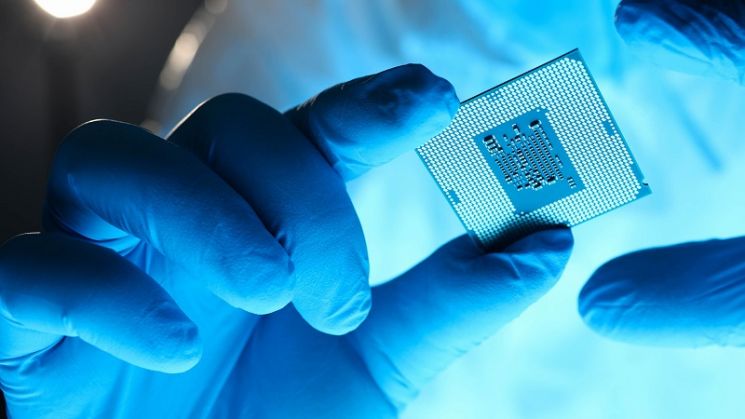
Industry insiders view semiconductor inventory stockpiling as a trend to prepare for supply uncertainties. The previous supply shortage of non-memory semiconductors such as automotive and smartphone APs (applications) is also interpreted as largely influenced by China's panic buying due to U.S. sanctions last year.
Earlier on the 13th, Eric Xi, Huawei's rotating chairman, pointed out, "U.S. sanctions were the main reason why major semiconductor companies worldwide fell into panic regarding semiconductor inventory," adding, "U.S. sanctions against Chinese companies have destroyed trust in the industry and dealt a blow to the global semiconductor industry." In fact, Huawei purchased large quantities of smartphone APs and other components just before the Trump administration placed Huawei on the export sanction blacklist in September last year.
Chairman Xi added, "Recently, Chinese companies have been stockpiling semiconductors for 1 to 3 months, even up to 6 months, disrupting the entire system." China's semiconductor imports surged more than 15% last year and reached a record high of $35.9 billion in March this year. Looking only at China's memory semiconductor imports last year ($2.614 billion), it was double that of the previous year.
The all-around semiconductor supply shortage is expected to be difficult to resolve in the short term. Increasing supply requires large-scale facility investments, and securing the reliability of products produced with new processes is also expected to take considerable time. As long as supply instability continues, if companies competitively increase their inventory levels, this could become another variable in the supply chain.
Wendell Huang, CFO of TSMC, the world's number one foundry company, said, "As customer anxiety rises, they want to maintain high inventory levels, so demand and utilization rates are expected to remain high next year," adding, "However, the supply shortage may continue until 2022."
© The Asia Business Daily(www.asiae.co.kr). All rights reserved.

















