Reaffirming the Justification and Value of Private Designation through the Academic Advisory Meeting
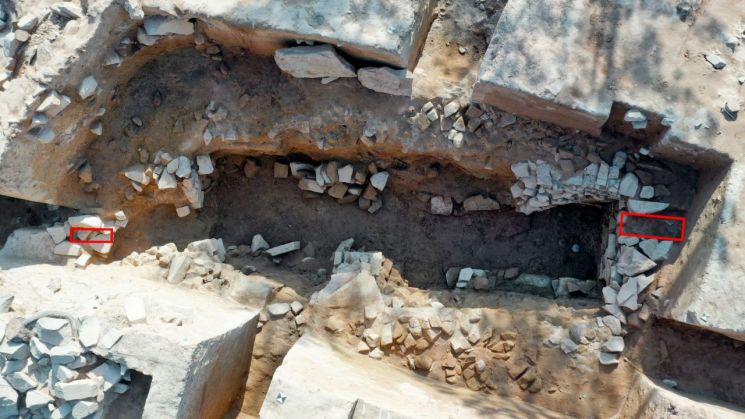 Sincerely, Burial Chamber No. G-52 Main Burial Structure Wooden Furniture Facility [Image Source=Hapcheon-gun]
[Asia Economy Yeongnam Reporting Headquarters Reporter Choi Soon-kyung] Hapcheon-gun, Gyeongnam Province, is conducting investigations on burial mounds including Gajigu Tomb No. 52, Dajigu Tombs No. 69 and 70, and Dajigu Tomb No. 24 together with the Gyeongnam Research Institute to elevate the Hapcheon Samga Burial Mounds, Gyeongsangnam-do Monument No. 8, to a national historic site.
Investigation of Gajigu Tomb No. 52 began in October last year and has continued through this month, with the results disclosed at academic advisory meetings held on the 15th and 20th.
Through the disclosed academic advisory meetings, the justification and value for designating the Hapcheon Samga Burial Mounds as a historic site were confirmed.
Gajigu Tomb No. 52 is a large ancient mound tomb with a diameter of 28.5 meters and a maximum height of 6.0 meters, ranking among the largest within the Samga Burial Mounds.
Located at the summit with a vantage point overlooking the entire Samga-myeon area, Tomb No. 52 is presumed to be the grave of a top ruler. However, most artifacts were removed due to looting through the southern wall, leaving some regret.
Investigation of the mound revealed five partition stone rows, and during the plan and cross-section surveys, more than four partition embankments were identified, suggesting that the mound was constructed by partitioning and embanking at least around ten sections.
Additionally, a facility presumed to have been used for ancestral rites inside the mound before its final completion was identified.
While ancestral rites within Gaya burial mound embankments have been recognized, no examples with established facilities for performing rituals have been confirmed, making this finding particularly noteworthy. This excavation also reconfirmed the wooden furniture facility found in 2019 at Gajigu Tomb No. 24.
The wooden furniture facility, primarily identified in the Haman Malyisan Burial Mounds, consists of ridge beams and supporting beams, designed to distribute the heavy stone slabs and mound weight to protect the burial chamber and the principal occupant. This type of facility is found in the highest-ranking tombs, i.e., royal-level graves, within the Haman Malyisan Burial Mounds.
Moreover, despite severe looting, a bird-shaped decorative rivet (a shaped iron plate rivet) was discovered, providing valuable data for studying the connection with the Ara Gaya power that constructed the Haman Malyisan Burial Mounds.
Summarizing the excavation results so far, large mound tombs are located on ridges and have a single-chamber stone coffin structure with one stone coffin per mound.
Medium and small mound tombs have multi-chamber structures and are mostly situated on slopes. This difference is interpreted as reflecting hierarchical distinctions, applied to the burial mound construction process between the highest-ranking and lower-ranking classes within the Samga Burial Mounds.
A county official stated, “As part of the national agenda project ‘Gaya Cultural Area Survey, Research, and Maintenance,’ we are conducting academic excavations on the Samga Burial Mounds with financial support from Gyeongsangnam-do. We will organize the results of the three academic excavations and the academic conference held earlier this year to ensure the smooth designation of the Hapcheon Samga Burial Mounds as a historic site.”
© The Asia Business Daily(www.asiae.co.kr). All rights reserved.

















