Labor Public Interest Committee Demands Replacement... "This Year's Record Low 1.5%+ Wage Increase Causes Low-Wage Workers' Hardship"
Company: "Stable Trend Next Year... Small Business COVID-19 Damage Not Over"
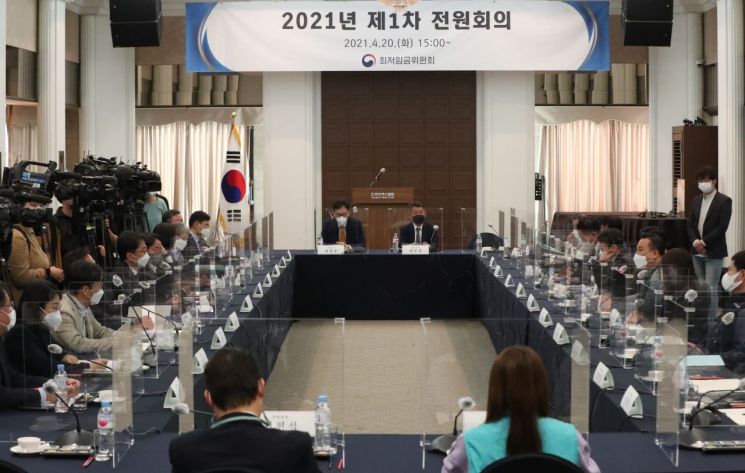 A meeting for the final minimum wage review under the Moon Jae-in administration was held on the 20th. The first plenary session of the Minimum Wage Commission took place at 3 p.m. at the Korea Press Center in Jung-gu, Seoul. The Minimum Wage Commission consists of 27 members, with 9 each from the workers' representatives, employers' representatives, and public interest members. Although this meeting served as an introductory session for next year's minimum wage review, the labor and management sides showed clear disagreements over the rate of increase from the very first day. (Image source=Yonhap News)
[Sejong=Asia Economy Reporter Moon Chaeseok] From the very first meeting of the Minimum Wage Commission (MWC) for the final minimum wage deliberation under the Moon Jae-in administration, the labor and management sectors clashed head-on. The labor side insists on significantly raising the minimum wage beyond this year's 1.5% increase to achieve the national agenda of "10,000 won," while the management side argues that the increase should be limited considering the ongoing COVID-19 crisis, resulting in a stalemate.
The MWC, the deliberation and decision-making body for the minimum wage, held its first plenary meeting of the year at 3 p.m. on the 20th at the Press Center in Jung-gu, Seoul. Although the first meeting mainly served as an introductory session for next year's minimum wage deliberations, both sides showed clear differences in perspective. Considering the procedural deadline of August 5, when the Ministry of Employment and Labor officially announces the wage, and the objection process, the realistic "deadline" is mid-July. It is expected that both sides will fiercely confront each other through about ten plenary meetings by then.
Labor: "This year's record-low 1.5% increase... Unacceptable next year"
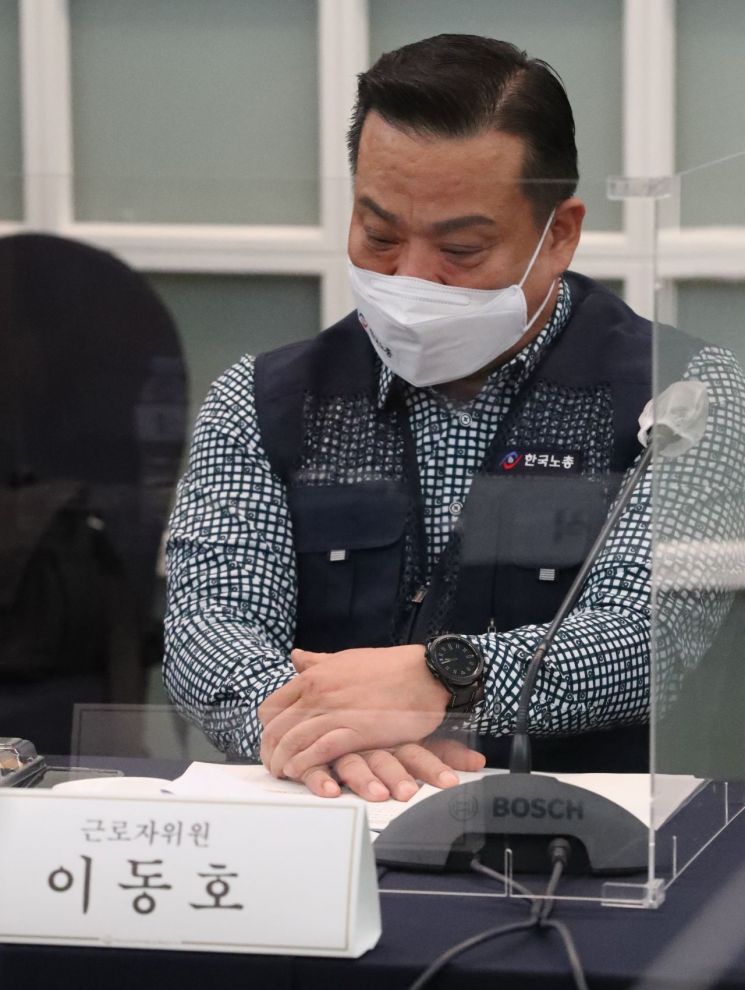 Lee Dong-ho, Secretary General of the Federation of Korean Trade Unions (FKTU) and a worker member of the Minimum Wage Commission, is seen with his hands clasped, listening attentively during the first plenary meeting of the Minimum Wage Commission held at 3 p.m. on the 20th at the Korea Press Center in Jung-gu, Seoul. The Minimum Wage Commission is composed of 27 members in total, with 9 worker members, 9 employer members, and 9 public interest members. (Photo by Yonhap News)
The labor sector emphasized that the minimum wage increase rates for last year and this year (based on the applicable year) were 2.9% and 1.5%, respectively, the lowest in history. They clearly conveyed the message that such a trend must not be repeated next year. In particular, they maintained their existing stance that the minimum wage must inevitably be raised above a certain level to support the livelihoods of low-wage workers.
Lee Dong-ho, Secretary General of the Federation of Korean Trade Unions (FKTU) and a worker representative, mentioned the minimum wage increase rates for last year and this year in his opening remarks, pointing out that "it has made life even harder for low-wage, low-income worker households who live on the minimum wage." He emphasized, "Since this year's minimum wage is the last decision of the Moon administration, the promise made to the public regarding the minimum wage increase must be kept."
The MWC consists of 27 members: nine worker representatives, nine employer representatives, and nine public interest members. Eight of the nine public interest members, excluding the standing member at the director level of the Ministry of Employment and Labor, will have their terms expire on the 13th of next month. Some speculate that they may be reappointed. In response, Park Hee-eun, Vice Chairperson of the Korean Confederation of Trade Unions (KCTU), publicly demanded the replacement of the public interest members who led the minimum wage decisions last year and this year. Park stated, "The public interest members who led the historically lowest increases last year and this year and ignored the voices of low-wage workers have no reason to remain in their positions," and added, "In particular, Chairman Park Joon-sik and Secretary Kwon Soon-won should be held accountable and excluded from the recommendation of the 12th public interest members."
Park also demanded, "Do not turn a blind eye to the structure of social inequality and polarization, and do not frame the minimum wage deliberation process as a competition between small business owners, self-employed individuals, and low-wage workers, or as a conflict between 'the weak and the weak.' Hold large corporations and conglomerates accountable."
Management: "COVID-19 crisis persists... No significant increase next year"
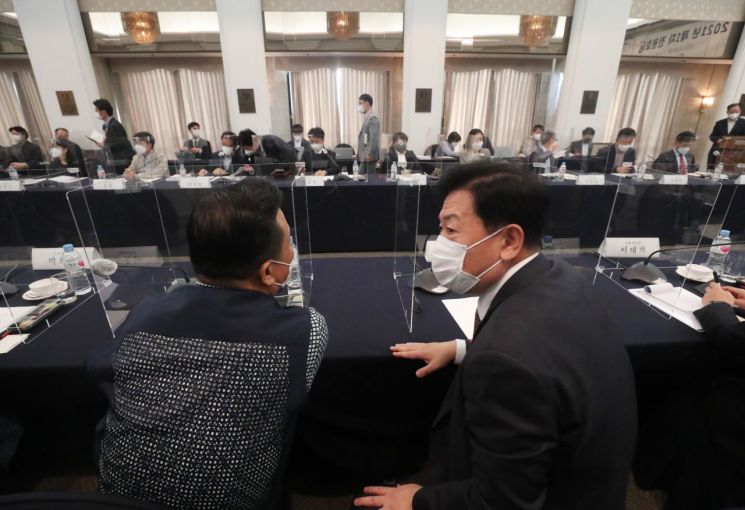 At 3 p.m. on the 20th, at the first plenary meeting of the Minimum Wage Commission held at the Korea Press Center in Jung-gu, Seoul, Lee Dong-ho, Secretary General of the Federation of Korean Trade Unions (FKTU) and worker representative (left), and Ryu Ki-jung, Executive Director of the Korea Employers Federation (KEF) (right), are seen conversing. The Minimum Wage Commission consists of 27 members in total, with 9 worker representatives, 9 employer representatives, and 9 public interest representatives. (Image source=Yonhap News)
The management sector expressed that the minimum wage should not be significantly raised as the COVID-19 crisis continues. They particularly emphasized the ongoing heavy labor cost burden on small business owners and micro self-employed individuals due to the pandemic.
Ryu Ki-jung, Executive Director of the Korea Employers Federation (KEF) and an employer representative, stressed, "Since the COVID-19 outbreak, the economy has polarized in a K-shaped recovery depending on industry and business size, and small business owners, self-employed individuals, and small and medium-sized enterprises, who bear the burden of the minimum wage, continue to be affected by the pandemic." He proposed, "It would be good if labor and management could work together to reach a conclusion so that this year's minimum wage can be decided reasonably under a stable trend."
Lee Tae-hee, Head of the Smart Job Division at the Korea Federation of SMEs, said, "Many people are suffering due to COVID-19, but I believe the pain and difficulties faced by low-wage workers and small business owners are greater than anyone else's," adding, "We have serious concerns and worries."
The deliberation process for next year's minimum wage began at the end of last month when Minister Lee Jae-gap of the Ministry of Employment and Labor requested the MWC to start deliberations. Since next year's minimum wage will be the last to be decided during the Moon Jae-in administration, neither labor nor management is willing to compromise. According to the Minimum Wage Act, the MWC must decide the minimum wage and submit it to the Minister of Employment and Labor within 90 days of the request, but it is rare for the deadline to be met.
According to regulations, the Minister of Employment and Labor must announce the minimum wage by August 5. Considering the objection procedures just before the announcement, the MWC must decide on next year's minimum wage by mid-July at the latest.
© The Asia Business Daily(www.asiae.co.kr). All rights reserved.



















