Government-ILO, Core Convention Ratification Deposit Ceremony
Effective in 1 Year... "Resolving Trade Risks"
Business Community Dissatisfaction Over 'Non-Employee Workers' Union Activities Allowed
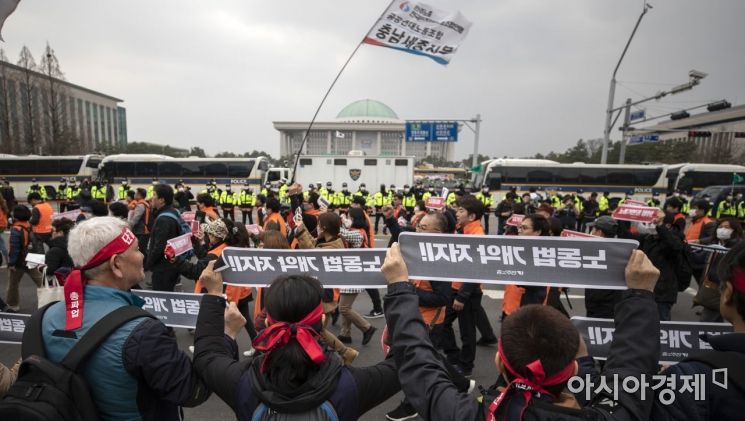 At the end of March 2019, members of the Korean Confederation of Trade Unions marched in front of the National Assembly, shouting slogans such as "Ratify the International Labour Organization (ILO) Core Conventions and Secure Basic Labor Rights." More than two years later, on the 20th, the government announced that it held a deposit ceremony for the ratification documents of the ILO Core Conventions and declared that all related procedures had been completed. Photo by Yoon Dong-joo doso7@
[Sejong=Asia Economy Reporter Moon Chaeseok] The government announced that it deposited the ratification documents for three core International Labour Organization (ILO) conventions with the ILO on the 20th. This completes the ratification process for the core conventions.
On the same day, the government held a virtual "ILO Core Conventions Ratification Document Deposit Ceremony" with the ILO. Minister of Employment and Labor Lee Jae-gap and ILO Director-General Guy Ryder attended the ceremony. This event officially conveyed the Korean government's intention to ratify the core conventions to the ILO. The ILO core conventions will come into effect one year after the deposit date, on April 20 of next year.
The conventions ratified and deposited by South Korea this time are Convention No. 29 on Forced Labour, Convention No. 87 on Freedom of Association, and Convention No. 98 on the Right to Organize and Collective Bargaining. Convention No. 29 prohibits all forms of forced labor. Convention No. 87 guarantees the voluntary establishment and membership of labor unions and their free activities. Convention No. 98 focuses on providing sufficient protection for workers exercising the right to organize and encouraging autonomous collective bargaining.
With this, the number of ILO core conventions ratified by South Korea has increased from four to seven, and the total number of ILO conventions ratified has risen from 27 to 30. This is more than the two ratified by the United States, four by China, and six by Japan, but fewer than the eight ratified by Germany and the United Kingdom. The only core convention South Korea has yet to ratify is Convention No. 105, which concerns the prohibition of forced labor. The government maintains that ratification is not possible due to domestic circumstances such as the division of the Korean Peninsula.
The government explained that to ratify the core conventions, social dialogue was conducted, and after the amendments to the Trade Union Act, Public Officials Trade Union Act, and Teachers' Trade Union Act passed the National Assembly in December last year, the ratification consent bill for the three ILO core conventions also passed the National Assembly in February. A government official said, "This ratification is expected to have positive effects externally, such as enhancing national prestige and credibility," adding, "It will also help reduce potential disputes related to labor provisions in free trade agreements (FTAs) such as the Korea-European Union (EU) FTA, thereby mitigating trade risks." He further stated, "Labor relations laws reflecting the spirit of the core conventions will strongly protect the freedom of association for labor and management in the industrial field and further enhance the autonomy of labor-management relations."
From 2023, the government will be obligated to submit regular reports on the implementation status of the conventions to the ILO every three years. The ILO Committee of Experts will review these reports to check for any violations of the conventions by South Korea. On the day, ILO Director-General Guy Ryder said, "We welcome South Korea's ratification of the core conventions," and added, "This ratification proves the Korean people's belief that continuous cooperation among labor, management, and government is essential for social justice, democracy, and the pursuit of peace." Minister Lee Jae-gap also said, "I am sincerely pleased and honored to finally ratify the ILO core conventions," and added, "We will continue to work with labor and management to ensure that fundamental labor rights are fully guaranteed and that a healthy labor-management relationship based on autonomy and responsibility can be established."
The government reiterated its position that the Trade Union Act, amended in December last year, was revised in accordance with the principle of freedom of association essential for ratifying the ILO core conventions and does not violate the ILO core conventions.
Additionally, regarding the principle allowing 'non-working workers' who are union members to engage in union activities within the workplace?a point of dissatisfaction among business circles?the government explained that this principle accepts the "employer's facilitation of the performance of duties by worker representatives" as stipulated in ILO Convention No. 135. This means that as long as they do not interfere with management, union members who are not currently working at the company may conduct union activities within the workplace.
© The Asia Business Daily(www.asiae.co.kr). All rights reserved.

















