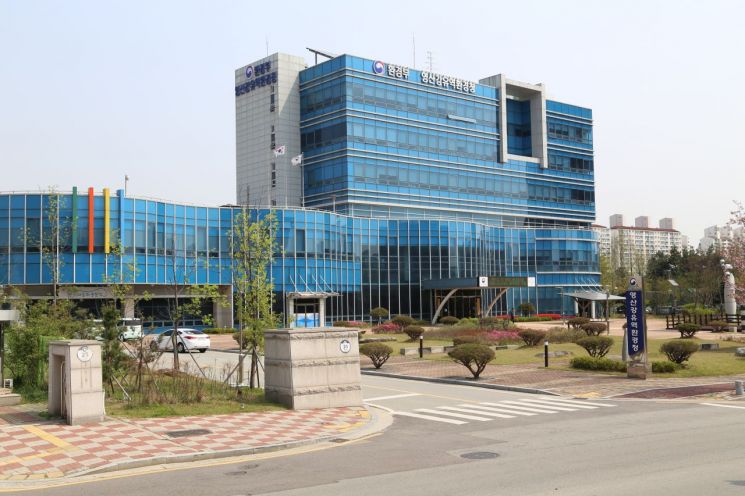
[Asia Economy Honam Reporting Headquarters Reporter Lee Gwan-woo] The Yeongsangang River Basin Environmental Office announced on the 20th that it will inspect whether emission facilities and automatic stack monitoring devices at total emission management sites are being properly operated to prevent illegal emissions of air pollutants and improve the reliability of emission calculations.
Since the enactment and promulgation of the Special Act on Air Quality Improvement in Air Management Zones in April 2019, total emission management sites within the southern air management zone have been calculating and submitting monthly emission amounts since last year.
The inspection targets are sites located throughout Gwangju Metropolitan City and some cities and counties in Jeollanam-do (Mokpo-si, Yeosu-si, Suncheon-si, Naju-si, Gwangyang-si, Yeongam-gun) that emit 4 tons or more annually of nitrogen oxides (NOx) and sulfur oxides (SOx) each, and 0.2 tons or more of total suspended particulates (TSP).
As of the end of last month, a total of 104 total emission management sites with high air pollutant emissions were identified in the southern region, and among them, 66 sites with frequent exceedances of emission permit standards or large fluctuations in emission amounts based on TMS measurements are subject to inspection.
The key inspection items include ▲whether emission and prevention facilities are operating normally ▲whether emission amounts are properly calculated ▲compliance with operation and management standards of automatic stack monitoring devices ▲and activity details (fuel and raw material usage).
The Yeongsangang Office plans to notify local governments of any violations of environmental laws found at the sites along with the details and corrective measures, and will also provide technical support with the Korea Environment Corporation for emission reduction and calculation at total emission management sites.
Additionally, to strengthen communication with businesses following the implementation of the total air emission system, a public-private consultative body will be operated. The council will introduce related systems and discuss developmental cooperation measures including listening to corporate suggestions.
Director Ryu Yeon-gi said, “We will continuously strengthen follow-up management to prevent illegal emissions of air pollutants and improve the reliability of emission calculations,” and added, “We hope that total emission management sites will also properly operate emission facilities and comply with permitted total emission amounts through self-inspection and management.”
© The Asia Business Daily(www.asiae.co.kr). All rights reserved.
![User Who Sold Erroneously Deposited Bitcoins to Repay Debt and Fund Entertainment... What Did the Supreme Court Decide in 2021? [Legal Issue Check]](https://cwcontent.asiae.co.kr/asiaresize/183/2026020910431234020_1770601391.png)
















