Non-Performing Loans Below Fixed Rate in Secondary Financial Sector Reach 11.4129 Trillion
Delinquent Debt Also Hits 8.7258 Trillion
Rep. Yoon Chang-hyun Warns "Crisis if Interest Rate Hikes Coincide"
[Asia Economy Reporter Song Seung-seop] Amid the sharp increase in loans from the secondary financial sector, the scale of non-performing loans has been found to have increased by approximately 900 billion KRW over the past year. Considering that loans for which the government has extended maturities were classified as ‘normal credit,’ it is analyzed that the actual scale of non-performing loans is even larger. There are concerns that the ‘debt bomb’ crisis in the secondary financial sector could become a reality from September, when the government’s COVID-19 financial support grace period ends, coinciding with interest rate hikes.
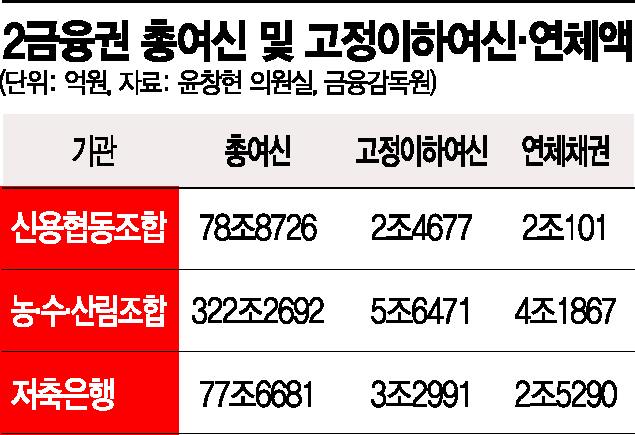
According to the Financial Supervisory Service and the office of Yoon Chang-hyun of the People Power Party on the 20th, as of the end of last year, the fixed non-performing loans of savings banks, credit cooperatives, and agricultural, fishery, and forestry cooperatives totaled 11.4129 trillion KRW. This is an increase of 896.3 billion KRW compared to the previous year. By sector, agricultural, fishery, and forestry cooperatives had the largest amount at 5.6471 trillion KRW, followed by the savings bank industry with 3.2991 trillion KRW. Credit cooperatives recorded a total of 2.4677 trillion KRW.
Fixed non-performing loans refer to loans that are highly unlikely to be recovered. They include loans classified as ‘fixed’ where interest has not been received for over three months, ‘doubtful collection’ where interest has not been received for six months, and ‘estimated loss’ where recovery is impossible and loss processing is inevitable.
Fixed non-performing loans have also been increasing in relatively sound large savings banks. The fixed non-performing loans of the top five savings banks by assets (SBI, OK, Korea Investment, Welcome, Pepper) amounted to 1.2898 trillion KRW last year, an increase of 157.1 billion KRW compared to the previous year.
As the scale of loans in the secondary financial sector rapidly increases, the number of borrowers unable to pay interest for over three months has also risen sharply. Currently, the vulnerable population is increasing due to COVID-19, and with the government tightening loans from commercial banks, loans in the secondary financial sector are rapidly expanding.
According to the Bank of Korea, as of February, total loans in the secondary financial sector, including Saemaeul Geumgo, increased by 71.3848 trillion KRW over one year, reaching 619.8706 trillion KRW. At the beginning of last January, loans had only increased by 1.5726 trillion KRW, but since then, they have increased by an average of 5.4584 trillion KRW per month.
The amount of delinquent loans, including installment repayments that were not received on the agreed date, also increased by 49.5 billion KRW from the previous year to 8.7258 trillion KRW. Compared to three years ago, this represents a 42.17% (2.5884 trillion KRW) increase.
Rapid Increase in Non-Performing Loans Despite 4th Supplementary Budget and Policy Finance... "Crisis if Coupled with Interest Rate Hikes"
Among the secondary financial sector, delinquent loans of cooperatives accounted for 6.1968 trillion KRW, representing 71.01% of the total. Compared to 2017, savings banks increased by only 7.92%, but credit cooperatives and other cooperatives grew by 90.51% and 52.85%, respectively.
Some in the industry argue that although the scale of fixed non-performing loans has increased, their proportion of total loans has decreased, and soundness indicators such as the BIS ratio have improved. In fact, major savings banks and large cooperatives have recorded good performance, significantly improving their fixed non-performing loan ratios.
However, there is criticism that despite the government’s large-scale financial support through the 4th supplementary budget and the financial authorities’ release of low-interest policy financial products, the number of non-performing borrowers has surged, making it impossible to be complacent. In particular, loan products whose maturities were extended and interest payments deferred by government order are classified as ‘normal.’ The delinquency rate is also a lagging indicator that rises after a crisis, and the delinquent amount remains unchanged due to repayment deferrals, which may create an ‘optical illusion’ effect.
Assemblyman Yoon Chang-hyun warned, “The debt risk has not decreased; it has been suppressed by government intervention. If combined with interest rate hikes, the crisis due to debt could become a reality from September when the grace period ends.”
He advised, “Despite government measures, policy efforts should focus on the debt problems of the secondary financial sector, where delinquencies and non-performing loans are increasing, and customized debt adjustment work should begin.”
© The Asia Business Daily(www.asiae.co.kr). All rights reserved.

















