Medical Innovation Council Hosts 'Public Hearing on Expanding Healthcare Workforce'
[Asia Economy Honam Reporting Headquarters Reporter Yoon Jamin] It has been argued that to truly eliminate regional medical disparities, establishing medical schools in areas without them should take precedence over simply expanding medical school quotas.
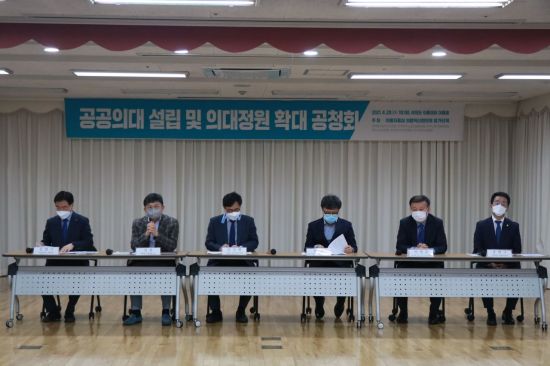
According to Jeonnam Province on the 20th, a public hearing on the "Establishment of Public Medical Schools and Expansion of Medical School Quotas" was held at the Seoul Irum Center, hosted by the "User-Centered Medical Innovation Council."
At the event, challenges and measures for policies to train medical personnel contributing to strengthening public healthcare were discussed.
Jinhyun Kim, Chair of the Health and Medical Committee of the Citizens' Coalition for Economic Justice, delivered the presentation, and discussants included Younggu Kang, Director of Health and Welfare Bureau of Jeonnam Province, Changjun Lee, Health and Medical Policy Officer of the Ministry of Health and Welfare, and Hyunki Kim, Director of Planning at Andong University.
Director Kang expressed, "Jeonnam has the highest proportion of vulnerable medical groups such as the elderly and disabled nationwide, but it is the only metropolitan local government without a medical school," adding, "There is also no tertiary general hospital for severe and emergency patients."
He then highlighted the difficulties faced by regional emergency medical institutions due to the shortage of doctors and appealed that healthcare for Jeonnam residents is a matter of survival, not just a service issue, garnering empathy from attendees.
Director Kang stated, "The current government is promoting measures such as expanding medical school quotas to reduce medical disparities between metropolitan and non-metropolitan areas, but areas without medical schools cannot benefit from these policies," and argued, "Medical schools must first be established in areas without them, and only then can quota expansions help eliminate regional medical disparities."
Chair Kim, who presented, also pointed out the limitations of last year's ruling party and government plan to expand medical school quotas and establish public medical schools, mentioning the reality where even essential departments in public hospitals are closing due to doctor shortages.
The public hearing concluded with consensus on the need for the government’s active efforts to expand medical personnel.
Representing the government, Policy Officer Lee Changjun said, "The government is also considering ways to provide high-quality medical care regardless of region or social class," adding, "We will listen to various opinions through councils and create measures that gain public consensus."
Meanwhile, the "User-Centered Medical Innovation Council" is a council formed by the Ministry of Health and Welfare to identify necessary improvements in the healthcare system from the perspective of medical service users. Participants include the Citizens' Coalition for Economic Justice, Korean Confederation of Trade Unions, Federation of Korean Trade Unions, Korea YWCA Federation, Korea Consumer Union, and Korea Patient Organization Federation.
© The Asia Business Daily(www.asiae.co.kr). All rights reserved.

















