Chairman Son Conveys Business Community's Position on Government's Ratification of Core ILO Conventions to ILO Secretary-General
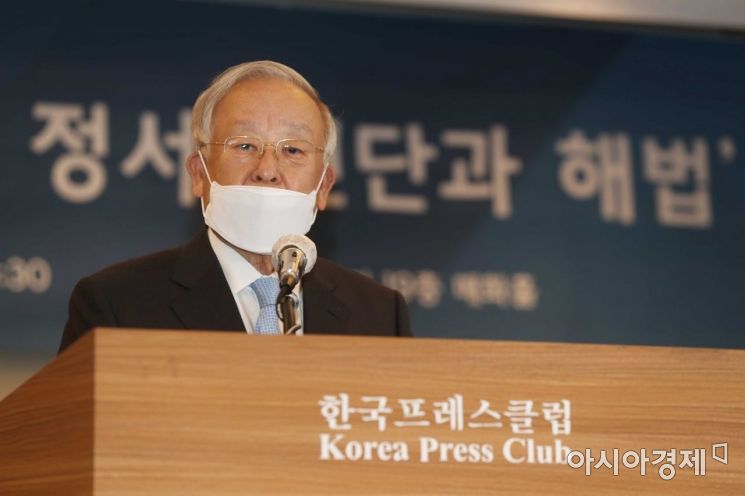 Son Kyung-sik, Chairman of the Korea Employers Federation, is delivering the opening address at the symposium "Anti-Business Sentiment in Korea: Diagnosis of Causes and Improvement Measures," held on the 1st at the Press Center in Jung-gu, Seoul. Photo by Moon Ho-nam munonam@
[Asia Economy Reporter Changhwan Lee] On the 20th, as the government deposited the ratification documents for three core conventions to the International Labour Organization (ILO), Sohn Kyung-shik, Chairman of the Korea Employers Federation (KEF), delivered a letter expressing the Korean business community's position to Guy Ryder, ILO Director-General, KEF announced on the same day.
Chairman Sohn Kyung-shik stated, "The business community has actively expressed the position that, prior to ratifying the ILO core conventions, legislative and institutional improvements that can modernize Korea's labor-management relations must be made together during social dialogue and the law amendment process, but it is regrettable that this was not accepted."
He expressed concern, saying, "In 2019, Korea ranked 130th out of 141 countries in the World Economic Forum (WEF) evaluation, indicating unstable labor-management relations. If the core conventions come into effect without sufficient coordination and agreement among labor, management, and government, it will become an obstacle during the implementation process of the conventions and result in further deterioration of domestic labor relations and the business environment."
Chairman Sohn pointed out the revised Trade Union Act and the imbalance of power between labor and management, emphasizing, "During the one year until the core conventions come into effect, complementary legislation such as improving the one-sided criminal punishment system for unfair labor practices against employers, allowing replacement labor during strikes, and prohibiting workplace occupation should be enacted to ensure that employers' rights are guaranteed in proportion to the strengthened labor rights."
He also stressed that, in response to industrial and labor market changes accelerated by the COVID-19 pandemic, "Labor, management, and government must relinquish vested interests and flexibly and future-orientedly improve regulations created in the past to create jobs."
© The Asia Business Daily(www.asiae.co.kr). All rights reserved.

















