'Heobeoheobeo' and Other Internet Neologisms Spark 'Gender Conflict'
Some Slang Terms Criticized for Being Used to Express Gender Hate
Internet Slang Quickly Gains and Loses Popularity
Unclear Etymology Makes It Difficult to Identify Hate Speech
Experts Say "Hate Words" May Be Defined Through Social Context
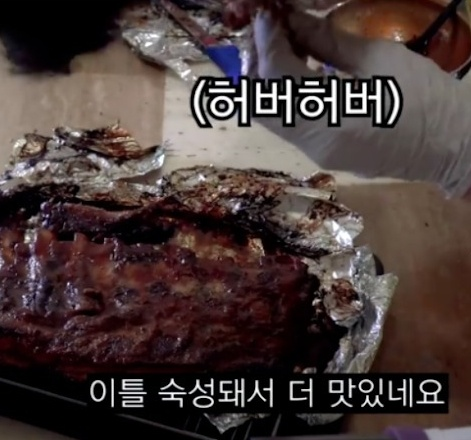 Famous cooking YouTuber 'Goginamja' recently used the onomatopoeia 'Heobeoheobeo' in his videos and became embroiled in a 'misandry controversy.' / Photo by YouTube video capture
[Asia Economy Reporter Lim Juhyung] Recently, 'Heobeoheobeo' and 'Ojoocheonga' have sparked 'gender conflicts' surrounding internet neologisms. Netizens raising concerns claim that such words are used in some online communities to disparage a specific gender. There are criticisms that the gender conflicts, such as misandry and misogyny, occurring in online spaces resemble a 'language war.'
The problem lies in the unclear origins of the controversial words and the difficulty of monitoring every internet slang term. To avoid controversy, one must either use all slang cautiously or avoid mentioning them altogether. Consequently, some worry that the language war caused by gender conflicts might even infringe upon freedom of expression.
On the 13th of last month, a famous YouTuber named 'Goginamja,' with 990,000 subscribers, faced harsh criticism from some netizens for using the onomatopoeia "Heobeoheobeo" in a video.
At that time, Goginamja posted a video of himself eating food and included the subtitle 'Heobeoheobeo.' Heobeoheobeo is a recently popular internet neologism expressing the act of hastily eating hot food.
However, some netizens judged 'Heobeoheobeo' as a so-called 'misandry term.' They claimed that some male-hating online communities use this word to disparage men.
As the controversy grew, Goginamja issued an apology, stating, "I used the word that came to my mind to wittily express myself eating hastily. I never imagined it was used as such a (misandry) term."
 YouTuber 'Jungnyeon Gamer Kim Siljang,' who creates game introduction videos, sparked controversy for using the expression 'Ojoocheonbeon' while explaining an online game. / Photo by YouTube video capture
This is not the first time a specific internet neologism has been caught up in a 'hate controversy.' On the 9th, the gaming YouTuber 'Jungnyeon Gamer Kim Siljang' (Kim Siljang) was criticized for using the expression "Ojoocheonbeon" while explaining an online game.
'Ojoocheon,' 'Ojooeok,' and similar terms are internet neologisms used to emphasize very large numbers, but some netizens claim these words are used in female-dominated communities to mock men by referring to the quantity of male sperm.
In response, Kim Siljang posted a clarification, saying, "The 'Ojoocheonbeon' I mentioned was a meaningless number said without any thought. I don't think I was wrong. Nevertheless, since my YouTube channel targets a broad audience, I will avoid using that expression in the future."
It is known that internet neologisms like 'Heobeoheobeo' and 'Ojoocheon' are difficult to trace precisely. These words usually start from trivial posts or videos, quickly gain popularity, and then fade away. Therefore, it is hard to verify whether they spread from communities with specific gender-hate tendencies.
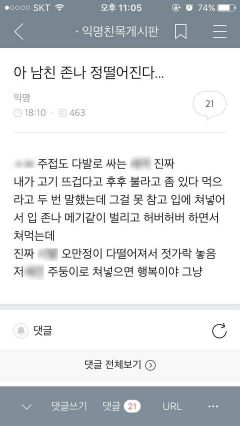 A post on an online community presumed to have been the main catalyst for the widespread use of the internet slang term 'Heobeoheobeo'. / Photo by Internet homepage capture
For example, 'Heobeoheobeo' reportedly gained popularity through a post by a netizen presumed to be female, who lamented, "I lost all affection after seeing my boyfriend hastily shove hot meat into his mouth while making 'Heobeoheobeo' sounds." The expression 'Heobeoheobeo' fits well with the image of someone putting food into their mouth.
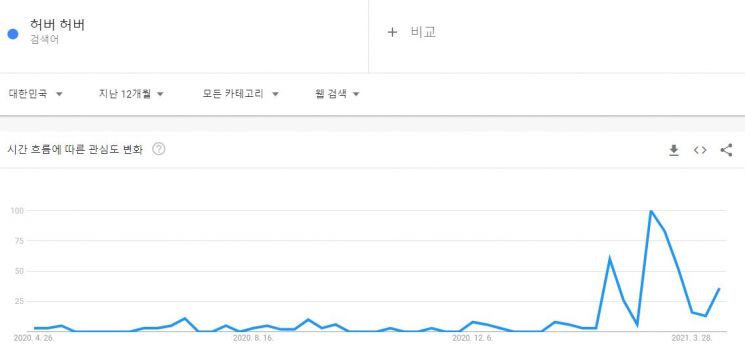 'Heobeoheobeo' has been gaining popularity among domestic internet users since February. / Photo by Google Trends capture
According to 'Google Trends,' which shows the frequency of specific word searches by netizens, 'Heobeoheobeo' began gaining popularity in the Korean internet from February. However, it is difficult to prove whether this onomatopoeia has recently transformed into a term expressing misandry or is genuinely used as a 'misandry slang' over the past two months.
Given this situation, citizens have expressed bewilderment. There are criticisms questioning whether one must be cautious even when using words whose origins cannot be properly understood.
A 26-year-old office worker A, who frequently uses social networking services (SNS), said, "Nowadays, saying 'Heobeoheobeo' on YouTube and elsewhere causes big trouble. It's really absurd. Popular slang that everyone has used well suddenly turns into misandry or misogyny terms, and I don't know which tune to follow."
Another office worker B (33) said, "It seems like a side effect arising from the intense gender conflicts in online communities. In the past, it was nice to write on the internet without much thought, but now we have to be careful with every single word. If this isn't a restriction on freedom of expression, then what is?" he complained.
Experts pointed out that 'hate words' can be perceived through social context rather than the word's original etymology.
Cultural critic Jung Deokhyun said, "Controversies over hate words in online spaces have continued steadily since the past. While in the past, words with clear targets and meanings of criticism like 'Doenjangnyeo' and 'Kimchineyo' were popular, now the trend seems to have shifted to more ambiguous terms."
He added, "Hate words are not defined by their dictionary meanings but can also be determined through social context. Depending on the situations and groups using the words, they may be perceived as hateful, so caution is necessary when using them."
© The Asia Business Daily(www.asiae.co.kr). All rights reserved.
![User Who Sold Erroneously Deposited Bitcoins to Repay Debt and Fund Entertainment... What Did the Supreme Court Decide in 2021? [Legal Issue Check]](https://cwcontent.asiae.co.kr/asiaresize/183/2026020910431234020_1770601391.png)


















