Mayor Lee Yong-seop: "Protecting the Ecological Environment While Providing Healing and Recovery Spaces for Citizens"
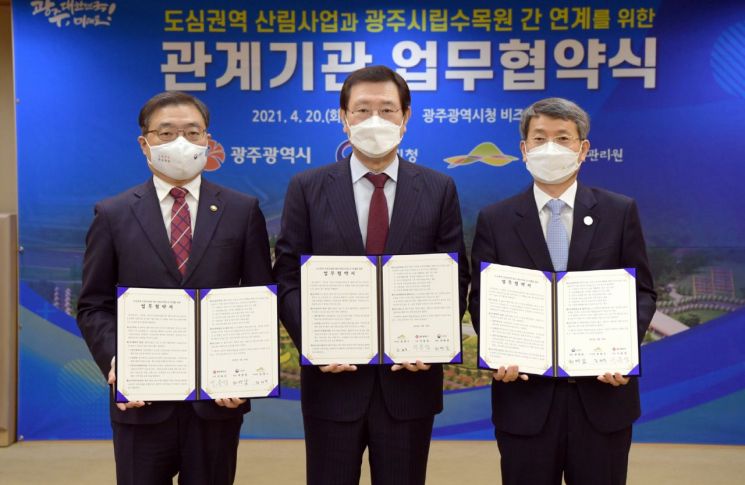 On the morning of the 20th, Lee Yong-seop, Mayor of Gwangju Metropolitan City, signed a business agreement with Choi Byung-am, Administrator of the Korea Forest Service, and Ryu Kwang-soo, Chairman of the Korea Arboretum Management Institute, at the City Hall Business Room to link urban forest projects and Gwangju Municipal Arboretum. They are posing for a commemorative photo. From left to right: Choi Byung-am, Administrator of the Korea Forest Service; Lee Yong-seop, Mayor of Gwangju Metropolitan City; Ryu Kwang-soo, Chairman of the Korea Arboretum Management Institute. Photo by Gwangju Metropolitan City.
[Asia Economy Honam Reporting Headquarters Reporter Park Seon-gang] Gwangju Metropolitan City, the Korea Forest Service, and the Korea Arboretum Management Institute have joined hands to create a premium forest culture and recreation space by linking the Gwangju Municipal Arboretum with urban forest projects.
On the morning of the 20th, Gwangju City signed a "Business Agreement for the Linkage between Urban Forest Projects and Gwangju Municipal Arboretum" at the City Hall Business Room, attended by Mayor Lee Yong-seop, Korea Forest Service Chief Choi Byung-am, and Korea Arboretum Management Institute Chairman Ryu Kwang-soo.
This agreement was promoted to organically link urban forest projects utilizing national forests and public/private forests within Gwangju City with the Gwangju Municipal Arboretum, providing citizens with a pleasant forest culture and recreation space.
The Gwangju Municipal Arboretum is a project that started construction in May last year, 11 years after the establishment plan was decided in 2009, and is an example of resolving another long-standing issue during the 7th elected administration.
Although the originally planned scale of the Gwangju Municipal Arboretum was reduced from 62 hectares to 24 hectares, this business agreement compensates for it by expanding the usage space linked with forest projects in the surrounding national forests, accelerating the creation of a premium arboretum that captures the four seasons of Namdo and Mudeung.
Also, as Gwangju City opens its first arboretum, it has become possible to collect and exchange plant genetic resources and receive technical support from the National Arboretum.
Through this agreement, the city will actively support all administrative matters necessary for the Korea Forest Service to promote urban forest projects, while the Korea Forest Service will support related policies and budgets to discover and promote various forest projects within Gwangju's urban area and actively work on institutional improvements.
The Korea Arboretum Management Institute, as an affiliate of the Korea Forest Service, manages three national arboretums: Baekdudaegan National Arboretum, Sejong National Arboretum, and Saemangeum National Arboretum, and will exchange and cooperate with the Gwangju Municipal Arboretum using accumulated know-how, technology, and information.
In particular, the Korea Forest Service will implement projects such as check dam installation, urban forest creation, forest road projects, and forest tending projects around the Gwangju Municipal Arboretum's surrounding national forests with a budget of 700 million KRW this year as part of the urban forest projects, promoting them as key projects of this agreement. Furthermore, all institutions will actively cooperate in each field with the common goal of improving the quality of life for citizens through the public benefits of forests.
The joint goals include cooperation in six areas: ▲strengthening urban forest functions to improve living environments such as fine dust reduction ▲active prevention of forest disasters (forest fires, landslides, pests, etc.) ▲providing services of national arboretums under the Korea Arboretum Management Institute ▲creating local jobs through the Korean-style Forest New Deal ▲expanding welfare services such as forest culture and recreation ▲securing the public functions of forests through the expansion of national forests.
Choi Byung-am, Chief of the Korea Forest Service, said, "Creating arboretums, gardens, and urban forests within the city is a core project for building future cities," and added, "We will actively cooperate so that Gwangju City can become a model for future cities."
Mayor Lee Yong-seop stated, "If forest projects within national forests are linked with the municipal arboretum and the abundant know-how, technology, and information of the national arboretum are incorporated, our arboretum will be able to protect the ecological environment under optimal conditions while providing citizens with a pleasant resting place as well as a space for healing and recovery," and added, "We will actively support and back the urban forest projects promoted by the Korea Forest Service so that they can lead to visible results at the city level."
© The Asia Business Daily(www.asiae.co.kr). All rights reserved.

















