Penalty Surcharge Premium Standards Set
2-3 Times Difference Even for Same Violation
Authorities to Revise Penalty Imposition System
[Asia Economy Reporter Oh Hyung-gil] Financial authorities are set to revise the criteria for fines imposed on insurance companies. This move comes amid fairness concerns raised over the current system, which bases fines on earned premiums rather than the intentionality of violations or the scale of damages. In practice, even for the same violations, the amount of fines imposed on insurance companies varies by two to three times.
According to financial authorities and the insurance industry on the 20th, some members raised issues regarding the fine imposition criteria for insurance companies during the third Financial Services Commission meeting held in February.
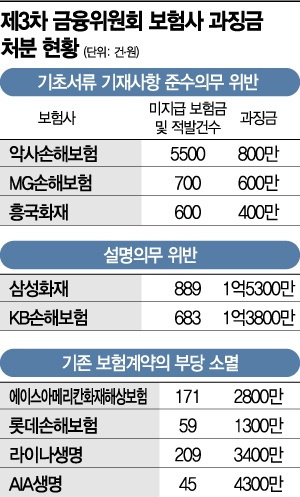
The issue originated from partial inspections conducted last year on AXA General Insurance, Heungkuk Fire & Marine Insurance, and MG Insurance. They were found to have improperly underpaid insurance claims for vehicle depreciation losses resulting from car accidents during the Financial Supervisory Service’s partial inspections and were fined accordingly.
According to automobile insurance terms, if the repair cost from an accident involving a vehicle less than five years old exceeds 20% of the vehicle’s value immediately before the accident, the insurance company is obligated to pay for the vehicle depreciation loss.
AXA General Insurance failed to pay KRW 55 million for 44 contracts, while MG Insurance and Heungkuk Fire & Marine Insurance reduced payments by KRW 7 million and KRW 6 million for 27 and 25 contracts, respectively. Consequently, the financial supervisory authorities imposed fines of KRW 8 million on AXA General Insurance, KRW 6 million on MG Insurance, and KRW 4 million on Heungkuk Fire & Marine Insurance.
During the deliberation of these sanctions, a Financial Services Commission member objected, stating, "AXA General Insurance’s failure to pay insurance claims is a serious offense, but the fine is relatively small compared to the scale of damages. The other two insurers paid less insurance money than AXA General Insurance, yet their fines are similar, which is unfair."
Additionally, Samsung Fire & Marine Insurance and KB Insurance were fined KRW 153 million and KRW 138 million, respectively, for violating disclosure obligations by omitting exemption clauses in their product explanation scripts while soliciting dental insurance contracts via telemarketing (TM). However, the number of violations detected was 889 and 683 cases, showing a significant discrepancy with the fines imposed.
Another Financial Services Commission member pointed out, "The calculation basis for fines is unbalanced. There are aspects related to intentionality and the economic impact on society, but the current sanctions are unbalanced in judging economic impact and intentionality."
In this regard, financial authorities acknowledge problems with the current fine imposition system and intend to improve it. A financial authority official stated, "The current fine system is based on earned premiums," adding, "There is an issue where fines are excessively calculated when small amounts of insurance claims are unpaid, and conversely, fines are low even when large amounts of claims are unpaid," expressing the intention to reform the system.
According to the Insurance Business Act, fines are based on annual earned premiums. For example, if there is a violation of the obligation to comply with basic document entries, a fine of up to 50% of the annual earned premium of the relevant insurance contract can be imposed, with adjustments made based on intentionality or negligence.
The insurance industry agrees with the principle that the more insurance sold through illegal means, the higher the fines should be, but there is a consensus that unreasonable aspects should be improved.
However, changing the fine imposition criteria requires approval from the National Assembly, so it is expected to take considerable time. If approval is not obtained, the fine criteria cannot be changed.
A financial authority official said, "All related organizations agree with the concerns raised by the commissioners," and added, "We plan to promptly push for amendments to the Insurance Business Act."
© The Asia Business Daily(www.asiae.co.kr). All rights reserved.


















