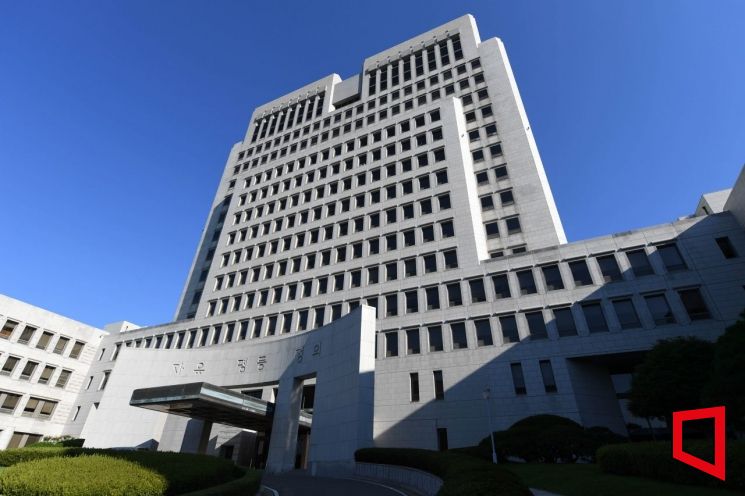
 Supreme Court in Seocho-dong, Seoul. Photo by Mun Ho-nam munonam@
[Asia Economy Reporter Kim Daehyun] The Supreme Court has ruled that the amended Industrial Location Act of 2018 should not be applied retroactively to cases that occurred before the enforcement of the revised law in a lawsuit filed by a local city corporation against a company owning part of the land within an industrial complex. When calculating facility charges prior to the enforcement date of the amended law, the 'former Industrial Location Act Article 33, Paragraph 3' should be applied as the corporation claimed.
On the 20th, the Supreme Court's First Division (Presiding Justice Park Jeonghwa) announced that it overturned the lower court's ruling which applied the amended Industrial Location Act retroactively in the appeal trial of a facility charge claim lawsuit filed by Daejeon Urban Corporation against Company A, and remanded the case to the Daejeon High Court.
In 2018, the corporation filed a lawsuit against Company A, which owned about 3,000㎡ of factory land within the 'Eco-friendly Industrial Complex Development Project' in the Daejeon area, demanding payment of facility charges and additional charges totaling about 80 million KRW according to the former Industrial Location Act. On the other hand, Company A argued that if the amended Industrial Location Act were applied, the facility charge would be set at about 31 million KRW, and therefore the amended law, which is more favorable to the payee, should be applied retroactively.
The first trial applied the former Industrial Location Act and ruled that Company A must pay about 80 million KRW, but the second trial applied the amended law and ruled that only about 31 million KRW needed to be paid. The second trial cited past Supreme Court precedents that allow exceptional retroactive application of amended laws when there are special circumstances such as no direct relation to the general public's understanding or when it rather promotes their interests.
Furthermore, the second trial court stated, "The amendment of the law aims to improve the situation where facility charges for development projects like this case are more than twice as heavy compared to other similar development projects such as housing sites." It added, "The time when the corporation imposed the facility charge in July 2018 was already more than one month after the amended law was revised and promulgated," and pointed out, "The corporation must have been well aware of the purpose and content of the amended law."
However, the Supreme Court ordered a retrial and reconsideration of the case. The court emphasized, "Facility charges under the Industrial Location Act also have the nature of partially recovering development profits from owners of existing facilities," and "The legislature stipulated in the supplementary provisions of the amended Industrial Location Act that 'the amended provisions of Article 33, Paragraph 3 shall apply only from the first imposition of facility charges after the enforcement of this law.'"
Additionally, it added, "If the amended law is applied retroactively, facility charges would be calculated and imposed at a lower level," and "This could lead to a situation where the project implementer ultimately passes the reduced amount on to the final buyers."
© The Asia Business Daily(www.asiae.co.kr). All rights reserved.
















