Korea Post Headquarters Celebrates the 53rd Science Day
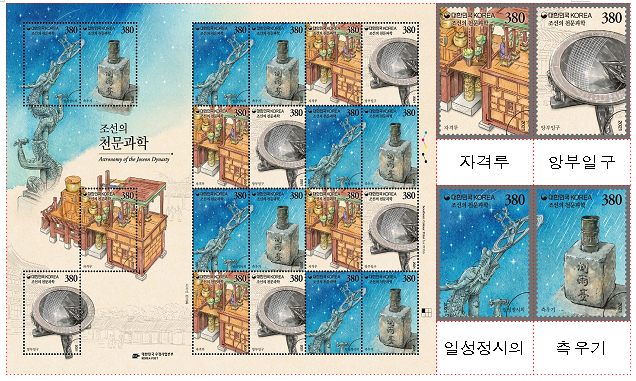
[Asia Economy Reporter Kim Bong-su] On the 21st, the Korea Post under the Ministry of Science and ICT will issue 920,000 commemorative stamps to reflect on Joseon's excellent astronomical science in celebration of the 54th Science Day.
The four types of astronomical instruments from the Joseon Dynasty?Jagyeokru, Angbuilgu, Ilseongjeongsui, and Cheugugi?demonstrate Joseon's determination to pursue an independent calendar and astronomical weather observation while reflecting Chinese astronomical knowledge.
is an astronomical instrument created in the 16th year of King Sejong's reign by scientists Jang Yeong-sil and Kim Bin. It is an automatic water clock that tells time by itself. It was installed at the Borugak pavilion south of Gyeonghoeru in Gyeongbokgung Palace, used as Joseon's standard clock, and is currently exhibited at the National Palace Museum of Korea.
is an astronomical instrument that measures time by the shadow of the sun and is Korea's first public sundial. It was installed at Hyejeonggyo Bridge in Seoul and on the street south of Jongmyo Shrine. Inside the concave pot-shaped Angbuilgu are scales and needles indicating time and seasons. When sunlight shines, the shadow cast on the needle points to the scale, allowing one to read the time and seasonal divisions.
is an independent astronomical instrument from King Sejong's era, installed not only in the palace and Seowoon-gwan but also in local areas. It is a day-and-night combined clock that observes the sun during the day and stars at night to tell time. By aligning it toward the North Pole and rotating it so that celestial bodies align with connected threads, one can determine the position of celestial bodies and thus the time.
was created to minimize agricultural damage caused by droughts and floods. It consists of three separate cylindrical sections, with the bottom section sealed to collect rainwater. When rainwater accumulates inside the Cheugugi cylinder, the depth was measured using a rod to determine precipitation amounts, which was 200 years ahead of similar rain gauges made in Europe.
You can purchase these by visiting a nearby post office or applying through the internet post office.
© The Asia Business Daily(www.asiae.co.kr). All rights reserved.