US Defense Production Act Controls Export of Vaccine Raw Materials and Equipment
Serum Institute Chairman "Respectfully Requests Ban on Raw Material Exports"
India Faces Domestic Vaccine Shortage... COVAX Deliveries Suspended for Two Months
[Asia Economy Reporter Hyunwoo Lee] As India, the world's largest vaccine producer, faces a shortage of COVID-19 vaccines mainly due to the United States' ban on vaccine raw material exports, concerns over a global vaccine supply crisis are growing. The U.S. is reportedly applying the Defense Production Act, a wartime military supply control law, to vaccine raw materials, strongly regulating their export.
India, struggling with domestic vaccine supply, has suspended vaccine deliveries to the COVAX facility for two months, directly impacting countries heavily dependent on COVAX, including South Korea. South Korean quarantine authorities and industry are closely monitoring the effects of the U.S. export restrictions on vaccine raw materials on the country.
According to foreign media such as the Associated Press on the 19th (local time), India, which accounts for more than 60% of the world's vaccine production, is reportedly facing a severe vaccine shortage. The Indian Ministry of Health warned that the vaccine stock in the country is about 27 million doses and will be completely depleted after approximately nine days of nationwide vaccinations. Although the Indian government began controlling vaccine exports on the 18th of last month, the vaccine supply crisis is attributed to a decrease in production by vaccine manufacturers.
◇ India, once called the 'World Vaccine Factory,' now has "only 9 days' worth of domestic vaccine surplus"
The reason India, once called the world's vaccine factory, is facing a vaccine shortage is reportedly due to the U.S. controlling exports of vaccine raw materials. According to the British daily The Guardian, on the 17th, Cyrus Poonawalla, CEO of Serum Institute of India (SII), the country's largest vaccine manufacturer, posted on his Twitter account a polite request asking the U.S. government to lift the ban on vaccine raw material exports to increase vaccine production. SII is the world's largest vaccine manufacturer and currently produces about half of the global supply of AstraZeneca's COVID-19 vaccine.
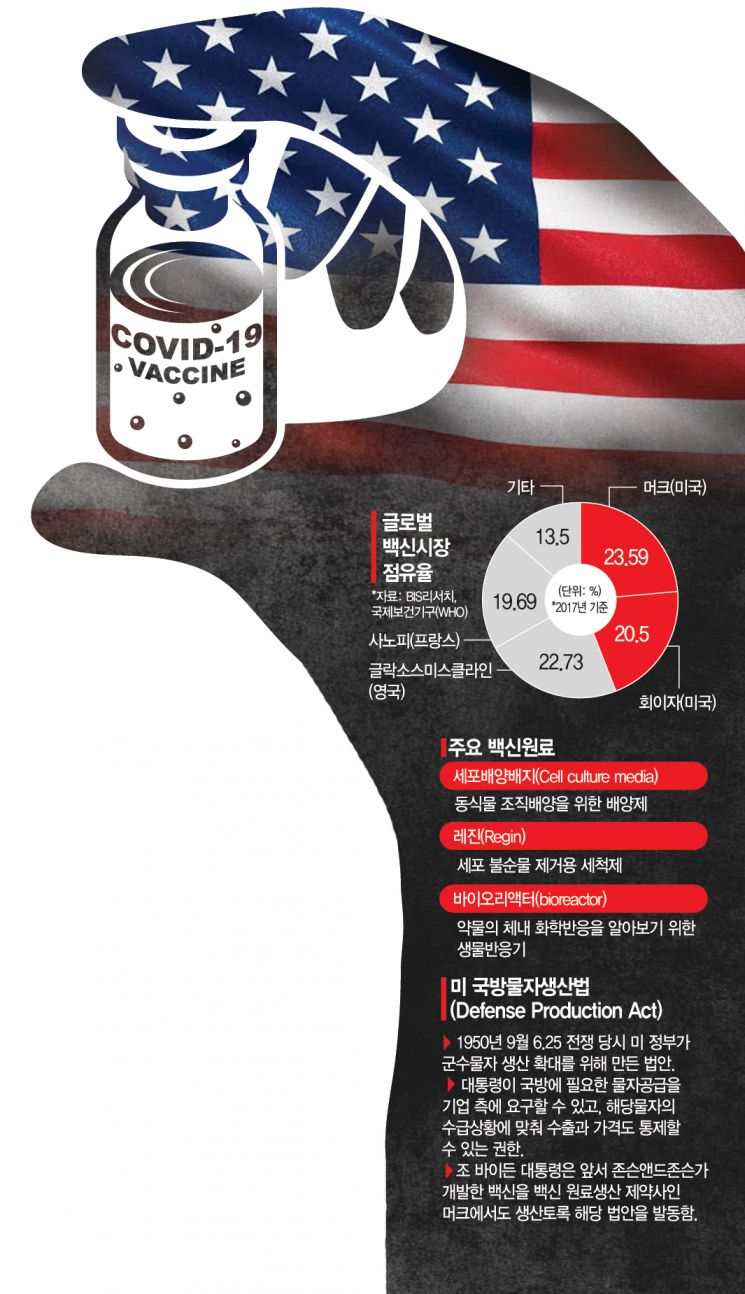
In the global vaccine market, India is the world's largest contract manufacturing organization (CMO) country, but most of the essential raw materials and equipment for production, such as cell culture media and bioreactors, are produced by U.S. pharmaceutical companies. According to international market research firm BIS Research and the World Health Organization (WHO), as of 2017, U.S. and European pharmaceutical companies dominate over 80% of the global vaccine market share, including Merck (23.59%) and Pfizer (20.5%) from the U.S., GlaxoSmithKline (22.73%) from the U.K., and Sanofi (19.69%) from France.
In particular, the U.S. government, following the previous Donald Trump administration, continues under the Joe Biden administration to strongly control exports of vaccine raw materials by invoking the Defense Production Act, a wartime material control law. The Defense Production Act, enacted on September 6, 1950, during the Korean War, aims to expand military supply production and stabilize prices. It allows the president to request production increases, control prices, or ban exports of designated materials from companies as an emergency wartime measure.
Under these U.S. raw material export controls, India, struggling to meet domestic supply, has suspended vaccine deliveries promised to COVAX for two months. India pledged to provide 200 million doses to COVAX this year and delivered 28 million doses by February, but has not supplied 90 million doses scheduled for March (40 million) and this month (50 million).
◇ South Korea's AZ vaccine import delayed by 3 weeks... When will 20 million doses arrive?
As a result, concerns are rising that vaccine supply will become difficult for countries worldwide, including South Korea, which heavily depends on COVAX supply volumes. Previously, 690,000 doses of AstraZeneca vaccine scheduled to arrive through COVAX at the end of last month were delayed by three weeks, and the quantity was reduced to 430,000 doses, raising supply concerns. The South Korean government plans to import 20 million doses of AstraZeneca vaccine through COVAX, enough to vaccinate 10 million people.
© The Asia Business Daily(www.asiae.co.kr). All rights reserved.



















