Resumption of Short Selling for KOSPI 200 and KOSDAQ 150 Stocks
Mixed Market Reactions at Previous Short Selling Resumptions
Overall Index Impact Limited...Increased Price Volatility in Stocks
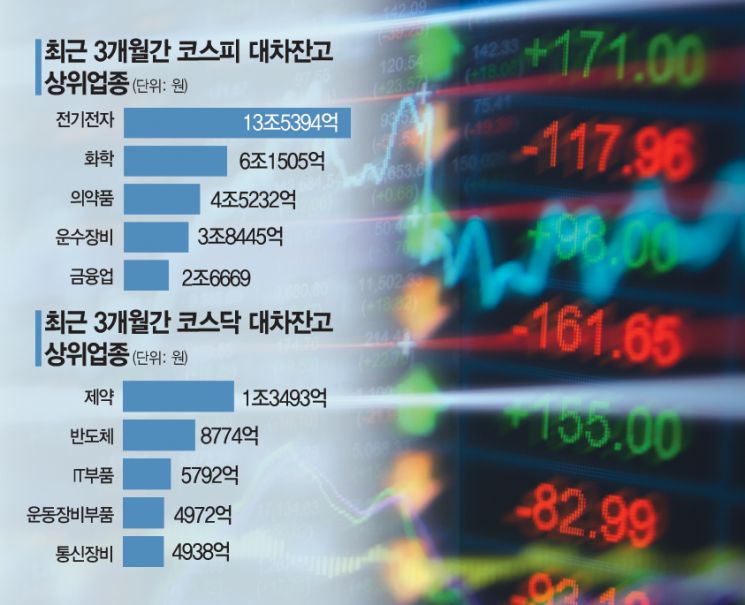
[Asia Economy Reporter Ji Yeon-jin] The standby funds available for short selling have been steadily increasing since the beginning of this month. With short selling set to resume on the 3rd of next month, attention is focused on whether the scale of short selling by individual investors will significantly increase and impact the domestic stock market.
The Korea Financial Investment Association (KOFIA) will conduct preliminary education for individual investors wishing to engage in short selling starting from the 20th, and the Korea Exchange will begin simulated trading. This is in line with the implementation of the expanded individual lending system for individual investors on the 3rd of next month, when short selling resumes.
According to KOFIA, as of the previous day, the balance of securities lending transactions was recorded at 53.9328 trillion KRW. The lending balance had exceeded 72 trillion KRW in March last year, just before short selling was banned due to the COVID-19 pandemic, but it shrank to the 40 trillion KRW range at the beginning of this year and has been steadily increasing since last month. On the 16th, it reached 54.2931 trillion KRW, marking the highest level this year. Securities lending involves borrowers paying a certain fee and collateral to institutional investors or others to borrow stocks, then returning the same stocks to the lender later. Since lent stocks can also be used for short selling, the lending balance is considered a leading indicator of short selling.
As of the 5th, the Financial Services Commission reported that the lending scale by 17 securities firms for all stocks included in the KOSPI 200 and KOSDAQ 150, where short selling is permitted, was 2.4 trillion KRW. Considering the current lending balance, this means that over 56 trillion KRW could be utilized for short selling starting from the 3rd of next month. However, a Financial Services Commission official stated, "Typically, only about 20% of the lending balance is used for short selling." In this case, the short selling funds would be around 13 trillion KRW, which corresponds to 46% of the total trading volume as of the previous day.
The securities industry expects the overall market impact to be limited since short selling will only be allowed for certain stocks. Looking at past cases of short selling resumption, on November 10, 2011, when short selling resumed, the KOSPI dropped by -4.9% in one day, but in 2009, there was no shock to the stock market. Min-gyu Kim, a researcher at KB Securities, said, "In 2011, sectors with high lending balances before the short selling ban experienced short-term declines after the resumption but later recovered." He pointed out stocks that had high lending balances and short selling ratios and whose prices had risen significantly compared to domestic and international peers, making them expensive. These include SK Innovation, Amorepacific, HMM, Korea Financial Group, SKC, Pearl Abyss, Iljin Materials, Korea Aerospace Industries, and Hansol Chemical.
There are also concerns that stocks with large outstanding amounts of convertible bonds and other hybrid capital securities may see increased short selling due to arbitrage demand. Furthermore, price volatility is expected to increase for companies facing negative factors. Jin-woo Lee, head of investment strategy at Meritz Securities, said, "Since futures trading on stocks affected by short selling has continued, the overall market impact will not be significant," adding, "However, for individual stocks that are overvalued relative to earnings or have recently faced negative news, price declines could be more pronounced, and price volatility may intensify."
© The Asia Business Daily(www.asiae.co.kr). All rights reserved.

















