Ministry of Land, Infrastructure and Transport: "Advanced Technology Enables More Harmonious and Safer Navigation"
[Asia Economy Reporter Kangwook Cho] The Ministry of Land, Infrastructure and Transport announced on the 20th that it has established a development strategy for air navigation safety facilities to proactively respond to the post-COVID-19 era.
Since the 1990s, domestic air traffic demand has continuously grown in line with the advancement of cutting-edge air navigation safety facilities, increasing by an average of about 1.8 times every decade. However, in 2020, due to the impact of COVID-19, air traffic volume dropped sharply by 50% to around 400,000 flights compared to the previous year (excluding overflights), dealing a severe blow to the air transportation industry. Nevertheless, with the start of vaccine administration to end COVID-19, travel demand is expected to recover as early as mid-2022.
Air navigation safety facilities have been exclusively supplied by the US and Europe. Accordingly, South Korea has relied mostly on imports, but since 2009, some facilities such as instrument landing systems and omnidirectional beacons have been successfully domestically produced due to R&D activation policies, achieving about $100 million (1.258 billion KRW) in exports and import substitution to 15 countries worldwide, including Turkey.
Air navigation safety facilities are core infrastructure for aircraft takeoff, landing, and flight safety. They are strictly managed by setting replacement cycles to modernize performance and conducting regular performance inspections using aircraft according to international standards.
The US and Europe are making significant efforts to secure system development and technical standards for future air traffic demand increases, including precise positioning services via satellites, high-speed and large-capacity communication environments, advanced navigation systems, and harmonious flight environments through the integration of manned and unmanned aircraft. It is now necessary for South Korea to establish concrete basic plans to strengthen connectivity across various sectors.
Accordingly, the government prepared the "Mid- to Long-Term Development Roadmap for Air Navigation Safety Facilities (Draft)" and submitted it to the statutory Aviation Policy Committee, which completed its review this month. The government will cooperate and promote the plan with related ministries.
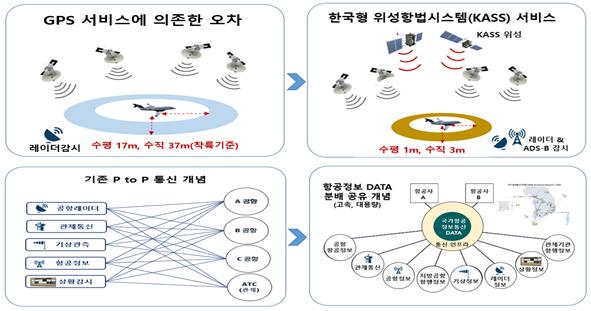
The main contents of the development roadmap include the development of the Korean Precision Augmentation Satellite Navigation System (KASS), which will provide precise positioning services correcting GPS locations within 1 to 3 meters nationwide starting next year. It also includes plans to develop remote control system technologies using advanced domestic ICT such as augmented reality, and to participate in the International Civil Aviation Organization (ICAO) Navigation System Panel to lead the establishment of international technical standards for unmanned remote control systems that can operate unmanned aerial vehicles from the ground.
Furthermore, to support the modernization of existing systems, nationwide deployment of next-generation surveillance systems, and export support for domestically produced systems, the strategy aims to increase strategic selectivity by presenting domestically developed navigation systems and operational technologies as packages in overseas airport development projects. In fact, South Korea won the project management office (PMO) contract for the new Chinchero Airport project in Peru in 2019 and is currently pursuing nine contracts including advisory services for a new airport in Poland.
Location information provided by these advanced navigation systems enables precise landing and performance-based flight for aircraft, assists ground controllers with precise surveillance to prevent aircraft collisions, increases capacity, and contributes to harmonious navigation with unmanned aerial vehicles.
Song Si-hwa, Director of the Air Navigation Facilities Division at the Ministry of Land, Infrastructure and Transport, said, "This year, we will establish a basic development plan for air navigation safety facilities to prepare concrete implementation measures, enabling coexistence between manned and unmanned aircraft and drones in the future environment." He added, "By developing international standard technologies for advanced navigation systems and introducing them domestically, we plan to create a harmonious and safe flight environment and ensure thorough preparation for increased air traffic demand in limited airspace after the end of COVID-19."
© The Asia Business Daily(www.asiae.co.kr). All rights reserved.

















