'8 Billion Record High' Including Hyundai 7th Complex
Largest Scale Among 6 Districts
Avoided '2-Year Actual Residence' in Apgujeong Area
But Accelerating Despite Government Regulations Seems Difficult
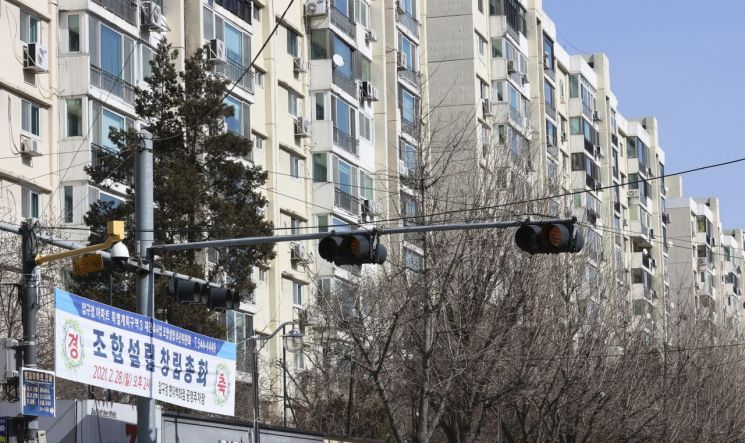
[Asia Economy Reporter Kim Hyemin] The redevelopment efforts in Apgujeong-dong, Gangnam-gu, Seoul, which is gaining attention as the biggest beneficiary of Seoul Mayor Oh Se-hoon's deregulation policies, are accelerating. Following Apgujeong Districts 2, 4, and 5, the largest district in the area, District 3, has also succeeded in establishing a union.
According to industry sources on the 20th, Apgujeong District 3 received notification of union establishment approval from Gangnam-gu Office yesterday. This comes 2 years and 7 months after the formation of the union establishment promotion committee. District 3 consists of a total of 4,065 households, making it the largest among the six districts within the Apgujeong area. It includes Hyundai 1 to 7th phases, 10th, 13th, and 14th phases, as well as Daelim Villart. It also includes Hyundai 7th phase apartments, which recently set a new record price, ushering in the '8 billion KRW' era for Apgujeong apartments.
The Apgujeong area is currently the most active among mid-rise redevelopment projects in Seoul. Earlier in February, District 4 (Hyundai 8th phase, Hanyang 3rd, 4th, and 6th phases) and District 5 (Hanyang 1st and 2nd phases) received union establishment approval, and District 2 (Hyundai 9th, 11th, and 12th phases) also joined the union establishment ranks this month. Districts 1 and 6, which are still at the promotion committee stage, are also hastening their union establishment efforts.
The acceleration of redevelopment in the Apgujeong apartment complexes is widely seen as a paradox of regulation. The government announced last June that only owners who have resided for more than two years in speculative overheated zones would be eligible for new apartment occupancy rights in redevelopment projects. This regulation, however, became a driving force for project advancement. A grace period was set so that the regulation would apply only to redevelopment unions established three months after the law's amendment, prompting each complex to rush union establishment to avoid the regulation.
However, there are also forecasts that progress after union establishment may be slower than expected. Yeokyunghee, Senior Researcher at Real Estate 114, said, "The successive union establishments in the Apgujeong area largely reflect an attempt to avoid the two-year residency regulation for now," adding, "Since government regulatory policies such as the redevelopment excess profit recovery system and the price ceiling system remain in place, it will not be easy to speed up the project."
© The Asia Business Daily(www.asiae.co.kr). All rights reserved.

















