Ministry of Science and ICT Holds Expert Meeting on 20th...Dismisses Some Opinions Saying 'No Risk'
Vice Minister Yong Hong-taek Announces Plan to Introduce Radiation Testing Method 10 Times Faster Than Existing One
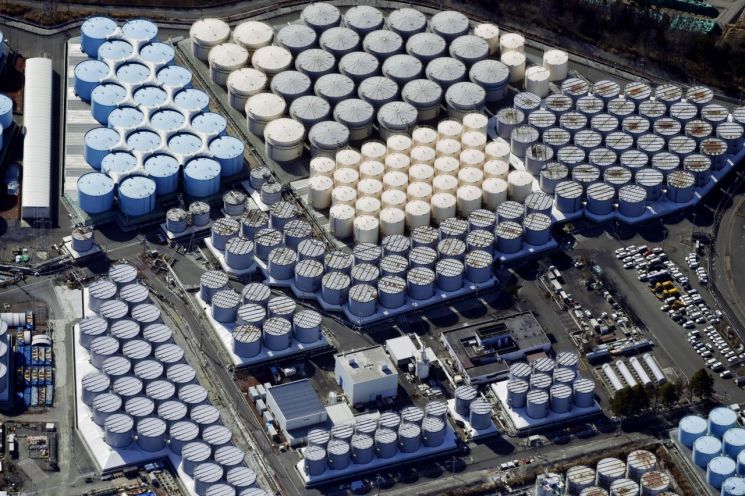
[Asia Economy Reporter Kim Bong-su] Nuclear and radiation experts have called the Japanese government's plan to discharge contaminated water from the Fukushima Daiichi Nuclear Power Plant irresponsible and urged its complete withdrawal. They also pointed out the need for a full investigation of the contaminated water and transparent information disclosure.
This has attracted attention amid controversy as some experts recently made claims that seemed to side with the Japanese government, stating that "claims of danger are scientifically exaggerated."
In this regard, the Ministry of Science and ICT held an expert meeting on the morning of the 20th at the Korea Atomic Energy Research Institute in Daejeon, chaired by First Vice Minister Yong Hong-taek. Attendees included Seo Kyung-seok, head of the Environmental Safety Evaluation Research Department at the Korea Atomic Energy Research Institute, officials from national research institutes, and Professor Cho Yang-gi from the Department of Earth and Environmental Sciences at Seoul National University, who shared their opinions on the Japanese government's contaminated water discharge policy.
According to the Ministry of Science and ICT, participants criticized, "The Japanese government has not provided scientifically proven specific information about the contaminated water to the international community, including South Korea, and merely claims verbally that the contaminated water is safe, which is not the attitude of a responsible member of the international community." They also urged, "The plan for marine discharge should be withdrawn, and above all, a full investigation of all storage tanks containing approximately 1.26 million tons of contaminated water must be conducted."
Specifically, Dr. Song Jin-ho of the Korea Atomic Energy Research Institute expressed concern, saying, "The Advanced Liquid Processing System (ALPS) used to purify Fukushima nuclear power plant contaminated water did not function properly at times over the past decade," and "In some contaminated water storage tanks, radionuclide concentrations were found to be 5 to 100 times higher than the legal limits."
They also recommended to the government, "To scientifically predict when and how much domestic impact the marine discharge of Fukushima nuclear power plant contaminated water will have, it is crucial to urgently obtain internationally verified data on the nuclear power plant contaminated water."
In response, Vice Minister Yong said, "When Japan establishes detailed plans for the marine discharge of nuclear power plant contaminated water in the future, we will strive to immediately obtain specific data such as radiation concentration and discharge period," adding, "We will thoroughly analyze and verify through marine radiation dispersion evaluation models whether there is any impact on our environment and public health."
Our government completed the development of a marine dispersion evaluation model through the Korea Atomic Energy Research Institute in 2017. This model was commissioned and developed by the Ministry of Science and ICT after the 2011 Fukushima nuclear accident, when radioactive contaminants began spreading through the ocean. It participated in the International Atomic Energy Agency (IAEA)-led international modeling research on radiation impact assessment (involving nine countries) and was evaluated as excellent.
Meanwhile, Vice Minister Yong also announced at the meeting a plan to apply the 'Rapid Radiation Material Testing Method' developed by the Korea Atomic Energy Research Institute last year to marine environmental monitoring for quick surveillance and tracking of marine radioactive contamination. This testing method is known to analyze the amount of 'Strontium-90,' a radioactive material produced only in reactors, ten times faster (in 2 days) than the existing method (3 weeks).
© The Asia Business Daily(www.asiae.co.kr). All rights reserved.
![Clutching a Stolen Dior Bag, Saying "I Hate Being Poor but Real"... The Grotesque Con of a "Human Knockoff" [Slate]](https://cwcontent.asiae.co.kr/asiaresize/183/2026021902243444107_1771435474.jpg)
















