No Need to Purchase Separate Quantum Communication Terminals
Increased Economic Efficiency
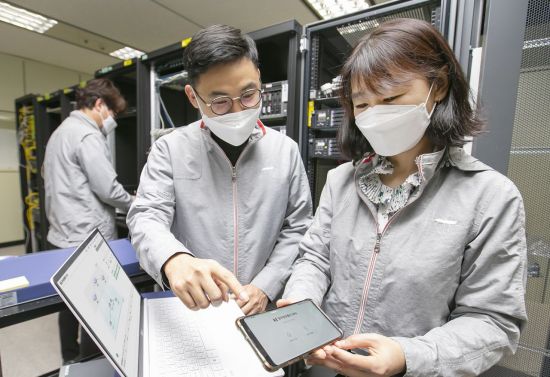 KT announced on the 20th that it has developed quantum hybrid technology capable of implementing quantum cryptography communication technology through a smartphone app. Photo by researchers demonstrating quantum hybrid technology at the KT Daedeok 2nd Research Center in Daejeon.
[Asia Economy Reporter Cha Min-young] A technology has been developed that allows quantum cryptography communication to be applied with just a smartphone app, without the need for a dedicated quantum cryptography communication terminal.
On the 20th, KT announced that it has developed a quantum hybrid technology that can implement quantum cryptography communication technology through a smartphone app.
Previously, quantum secure communication could only be used if there was a quantum security terminal equipped with a quantum random number generator chipset (QRNG) or a separate quantum communication terminal. By applying the technology developed by KT this time, there is no need to purchase an additional dedicated terminal, making it economically efficient.
The quantum hybrid technology can be applied to currently used smartphones with just one installation of the QS-VPN app. By combining quantum key distribution (QKD) technology and post-quantum cryptography (PQC) algorithms, it fundamentally blocks hacking threats to 5G virtual private networks (VPNs).
When the app is launched, a quantum cryptography communication environment is implemented across the entire network segment. QKD uses the physical properties of quantum mechanics, which are impossible to hack, to create quantum cryptographic keys and distribute them in a wide area network (WAN) construction environment. The cryptographic keys are stored in the quantum key management system (QKMS). PQC protects the network segment between the app and QKMS to ensure that the cryptographic keys are safely delivered to the app.
KT enhanced security by applying PQC, which is likely to be selected as the standard specification for post-quantum cryptography algorithms by the U.S. National Institute of Standards and Technology (NIST). PQC is an algorithm that provides cryptographic technology with safe resistance against all attacks using quantum computers in the network segment.
Additionally, KT strengthened user authentication security by combining blockchain-based decentralized identity verification technology (DID) with PQC authentication procedures without linking to a third-party certification authority. With DID technology, personal information-containing certificates are stored on an individual's smartphone terminal to prevent the risk of personal information leakage, and identity authentication technology based on PQC verifies the certificates containing personal information to identify user identity and terminal access rights.
KT plans to expand the application of this quantum hybrid technology to 5G application services such as finance and connected cars. Lee Jong-sik, Executive Director of KT Infrastructure Research Institute, said, “Taking this quantum hybrid technology development as an opportunity, we will continuously research and commercialize a quantum security platform that customers can use with confidence in the digital transformation era.”
© The Asia Business Daily(www.asiae.co.kr). All rights reserved.
![User Who Sold Erroneously Deposited Bitcoins to Repay Debt and Fund Entertainment... What Did the Supreme Court Decide in 2021? [Legal Issue Check]](https://cwcontent.asiae.co.kr/asiaresize/183/2026020910431234020_1770601391.png)
















