Foreign Media: "Korea Succeeded in Early Quarantine but Lags Behind in Vaccination"
1.5 Million First Vaccine Doses, 2.91% of Population
Slow Vaccination Draws Criticism from Opposition: "People Are Tired of the 'Fizzle-Out Show'"
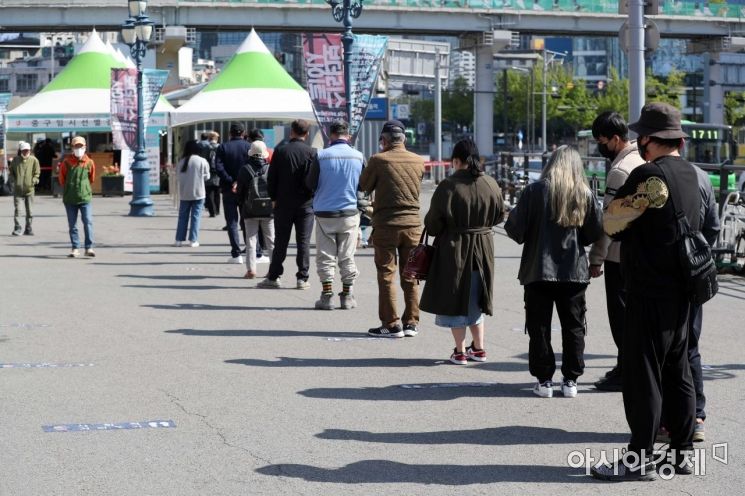 On the 18th, citizens are lining up to get tested at the temporary COVID-19 screening site set up at Seoul Station Plaza. Photo by Mun Ho-nam munonam@
[Asia Economy Reporter Heo Midam] "When will we be able to take off our masks?"
Concerns among citizens are growing as the COVID-19 vaccine supply schedule faces setbacks. Initially, South Korea was highly praised worldwide for its creative quarantine measures such as 'drive-through' testing during the early spread of COVID-19, earning the nickname 'K-Quarantine.' However, with the current vaccination rate falling below 3% and a series of negative developments related to vaccines, there are worries that achieving 'herd immunity by November' will be difficult. Experts predict that vaccine supply issues will be resolved after the first half of the year and emphasize the need to proceed with vaccinations quickly once vaccines are secured.
Recently, countries that performed well in the initial COVID-19 response, including South Korea, have been evaluated as falling significantly behind in vaccine administration. On the 17th (local time), The New York Times (NYT) pointed out that countries such as South Korea, Japan, Australia, and New Zealand, which had slower spread in the early stages of COVID-19, are lagging in vaccination speed. The situation has reversed compared to the U.S. and Europe, where confirmed cases and deaths surged early on.
Currently, the U.S. and Europe are showing strength in vaccination rates. Nearly a quarter of the U.S. population has completed vaccination, and almost half of the UK population has received the first dose. In contrast, Australia and South Korea have vaccinated less than 3% of their total populations, and Japan and New Zealand have vaccinated less than 1%.
Earlier, CNN also reported similar content on the 16th. The media pointed out that New Zealand, Japan, Taiwan, Thailand, and South Korea successfully prevented large-scale outbreaks but all have vaccination rates below 4%. The media criticized these countries' cautious approach, stating, "They delayed contracts or observed foreign situations to review vaccine efficacy and side effects."
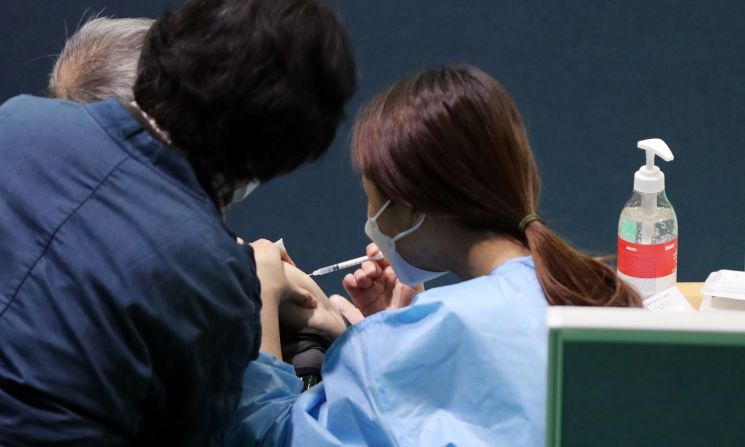 On the 15th, elderly people aged 75 and over are receiving vaccinations at the Gwangju Buk-gu Vaccination Center. [Image source=Yonhap News]
Previously, the government planned to complete vaccinations for more than 12 million people in the first half of this year and increase vaccinations in the third and fourth quarters to achieve 'herd immunity' with over 70% of the population having antibodies by November. However, due to ongoing negative vaccine-related developments, there are predictions that achieving this goal will be difficult.
South Korea is one of the latecomers in vaccine administration. Since vaccinations began domestically on February 26, as of the 17th, a total of 1,512,503 people have completed the first dose, representing a vaccination rate of 2.91% of the domestic population (52 million). In other words, fewer than 3 out of every 100 citizens have completed the first dose.
As a result, citizens are criticizing the slow pace of vaccination. Office worker Kim (28) said, "Israel took off masks within a year. I don’t know when we will be able to take off masks here." He added, "I thought herd immunity would form quickly once vaccinations started. But there seem to be more side effects and considerations than expected, so progress is slow."
University student Jung (24) said, "I’m worried because there are problems with vaccines like AstraZeneca and Janssen that our country purchased." He added, "If there are problems with vaccines, doesn’t that mean COVID-19 will end later? In the U.S., half of adults have already received at least one COVID-19 vaccine dose. I don’t know when we will reach that point."
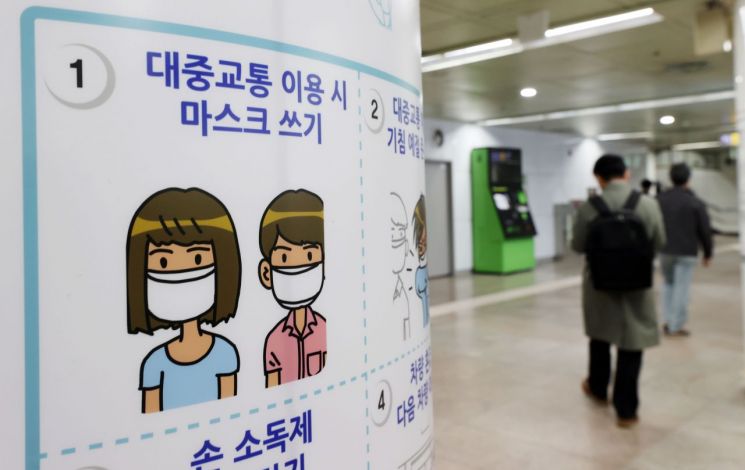 A mask-wearing notice is posted on the platform of Gwanghwamun Station on Seoul Subway Line 5. [Image source=Yonhap News]
Concerns about COVID-19 vaccination are also emerging within the political sphere. Bae Junyoung, spokesperson for the People Power Party, released a statement on the 18th saying, "South Korea’s current COVID-19 vaccination rate is below 3%, ranking at the bottom among OECD countries," and criticized, "Herd immunity by November is far-fetched, and there are forecasts it could take as long as six years."
Park Daechul, a member of the same party, pointed out on Facebook, "Unsafe 'quality,' insufficient 'quantity,' syringes contaminated with foreign substances, and an 'ideology-driven' quarantine planning officer. K-Quarantine is going from bad to worse." He added, "They still talk about 'herd immunity by November.' It’s frustrating to become 'vaccine beggars' and then be subjected to secondary false hope," and said, "It’s just a 'say anything' approach. The public is tired of this 'anticlimactic show.'"
Despite these concerns, the government maintains its original goal of achieving herd immunity by November. Acting Prime Minister Hong Namgi presided over the Central Disaster and Safety Countermeasure Headquarters meeting at the Government Seoul Office on the 18th, stating, "The goal is to vaccinate 3 million people by April and 12 million people by the first half of the year."
He continued, "The government is mobilizing all diplomatic efforts to secure vaccine supplies early, make additional contracts, and expand domestic contract manufacturing," adding, "We will devote all the capabilities of the cabinet."
Experts predict that vaccine supply and distribution issues will naturally be resolved after the first half of the year.
Professor Eom Jung-sik of the Department of Infectious Diseases at Gachon University Gil Medical Center said on KBS Radio's 'Choi Kyung-young's Strong Current Affairs,' "There are issues with vaccine supply and distribution, but I believe these will naturally be resolved after the first half of the year." He added, "There are about three months left in the first half. During these three months, if strong social distancing is maintained to prevent COVID-19 spread and vaccinations proceed widely and quickly once vaccines are secured, conditions could improve significantly from the second half."
He further noted, "Regarding the Novavax vaccine, contract manufacturing will begin in South Korea starting this month. Also, as other vaccines become available in the second half, supply and procurement issues are very likely to be resolved, so how well the expiration dates are managed will be crucial."
© The Asia Business Daily(www.asiae.co.kr). All rights reserved.
![Clutching a Stolen Dior Bag, Saying "I Hate Being Poor but Real"... The Grotesque Con of a "Human Knockoff" [Slate]](https://cwcontent.asiae.co.kr/asiaresize/183/2026021902243444107_1771435474.jpg)


















