[Asia Economy Reporter Yoo In-ho] The United States has reaffirmed its support for Japan's decision to discharge contaminated water from the Fukushima nuclear power plant, making the South Korean government's diplomatic front more challenging.
The government finds it difficult to gain support from the United States but plans to request continuous attention and cooperation while strengthening diplomatic efforts toward Pacific coastal countries that may suffer direct damage from the discharge.
According to the Ministry of Foreign Affairs on the 19th, the government plans to pressure Japan through cooperative relationships with countries opposing Japan's contaminated water discharge decision, such as China and Russia, as well as Pacific coastal countries like Australia that are concerned about direct damage.
The government is also reportedly continuing persuasion efforts toward the United States, which maintains a supportive stance toward Japan. It plans to convey its opinions through various channels, including working-level and high-level talks, and to raise this issue at the Korea-US summit.
As part of these efforts, Foreign Minister Chung Eui-yong invited US Special Presidential Envoy for Climate John Kerry, who visited Korea on the 17th to discuss cooperation on climate change response, to the minister's residence in Hannam-dong, Seoul, to convey the government's and the public's serious concerns about the discharge decision.
Minister Chung urged the US side to take an interest and cooperate so that Japan can provide more transparent and prompt information to the international community. Earlier, on the 13th, following Japan's decision, the government conveyed its position through the US Embassy in Korea and the Korean Embassy in the US.
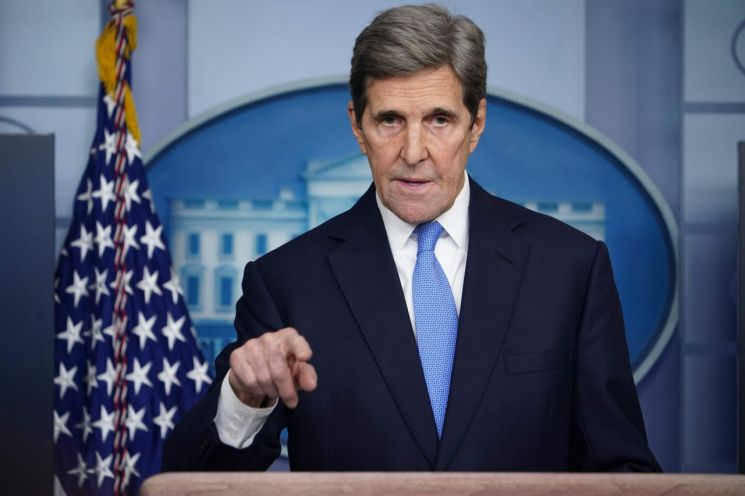
However, Special Envoy Kerry expressed a negative stance on US involvement at a press conference with domestic and foreign reporters in Seoul the very next day, the 18th.
When asked whether the US could play a role in ensuring that Korea receives the requested information, Kerry said, "We are already underway, and we believe it is not appropriate for the US to intervene in a process that has very clear regulations and expectations." He added, "The key is Japan's continued cooperation while the IAEA monitors the (discharge) process," and said, "Japan has cooperated very closely with the IAEA and I am confident it will continue to do so."
This implies that safety verification will follow the IAEA's judgment, and since Japan is believed to cooperate faithfully with the IAEA's verification, the US will not intervene directly. In this regard, the IAEA has already evaluated the ocean discharge as "technically feasible and in accordance with international practices."
Professor Kim Hyun-wook of the Korea National Diplomatic Academy said, "The US not intervening in the Korea-Japan issue is largely due to the close US-Japan ties," and added, "If Korea hopes for US involvement or assistance, it needs to participate to some extent in the US-led efforts to contain China."
© The Asia Business Daily(www.asiae.co.kr). All rights reserved.
![Clutching a Stolen Dior Bag, Saying "I Hate Being Poor but Real"... The Grotesque Con of a "Human Knockoff" [Slate]](https://cwcontent.asiae.co.kr/asiaresize/183/2026021902243444107_1771435474.jpg)
















