'Smart Single-Unit' Strategy
Large Gains in Bull Market
Mid-to-Large Units Also Popular in Subscription
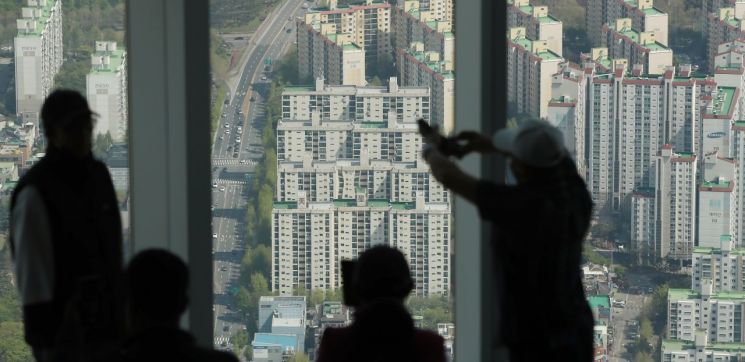 Apartment complexes in Seoul as seen from the Lotte World Tower observation deck in Songpa-gu, Seoul on the 18th
 After a period of stagnation, apartment prices have recently started to stir again, with the preference for medium-to-large apartments becoming even more pronounced. This situation is the exact opposite of the government's analysis, which attributed the rise in apartment prices to household diversification and the increase in single-person households driving demand.
According to the KB Kookmin Bank Monthly Housing Price Trend report on the 19th, as of last month, the nationwide sales price index for large apartments with an exclusive area of 135㎡ or more recorded 117.0. The sales price index for medium-to-large apartments (95.9㎡ or more but less than 135.0㎡) stood at 119.5. Both indices rose by 4.88% and 5.71%, respectively, compared to the end of last year.
An index above 100 indicates a price increase, while below 100 indicates a decrease. In the case of small-to-medium and small apartments, the rate of increase was particularly low. For small-to-medium apartments (40.0㎡ or more but less than 62.8㎡), the sales price index was 112.9, marking a 4.81% increase compared to the end of last year. The index for small apartments recorded 109.1, increasing by only 3.85% during the same period.
In fact, it is the large apartments, especially those in recent reconstruction complexes, that are leading the surge in apartment prices. Last month, the average sales price of large apartments in Seoul was recorded at 2,211.06 million KRW, surpassing 2.2 billion KRW for the first time. This is the highest price since the related statistics began in January 2016. Compared to one year ago (1,952.14 million KRW), it rose by 258.93 million KRW, and compared to two years ago (1,809.81 million KRW), it increased by 401.25 million KRW.
The government's strong real estate regulations are considered to have caused this phenomenon. Typically, medium-to-large apartments experience greater price increases than small-to-medium ones, and due to regulations such as increased capital gains tax, demand has concentrated more on owning a 'smart single property.'
The popularity of medium-to-large apartment sizes is also high in the pre-sale market. According to RealToday, a real estate research firm, an analysis of the first-priority subscription competition rates by area for nationwide pre-sale complexes (excluding public sales) from January to February this year showed that medium-to-large apartments over 85㎡ recorded an average competition rate of 48.09 to 1. Particularly in provincial areas, the competition rate reached a high triple-digit figure of 108.39 to 1.
The fierce enthusiasm for medium-to-large apartment subscriptions is also influenced by supply shortages. Among the 18,547 households supplied to the general public nationwide from January to February this year, only about 2,300 households were medium-to-large sized, accounting for about 12% of the total. An industry insider explained, "Since a lottery system is applied to medium-to-large apartments over 85㎡, it seems that applicants with low scores have also flocked to these units."
© The Asia Business Daily(www.asiae.co.kr). All rights reserved.

















