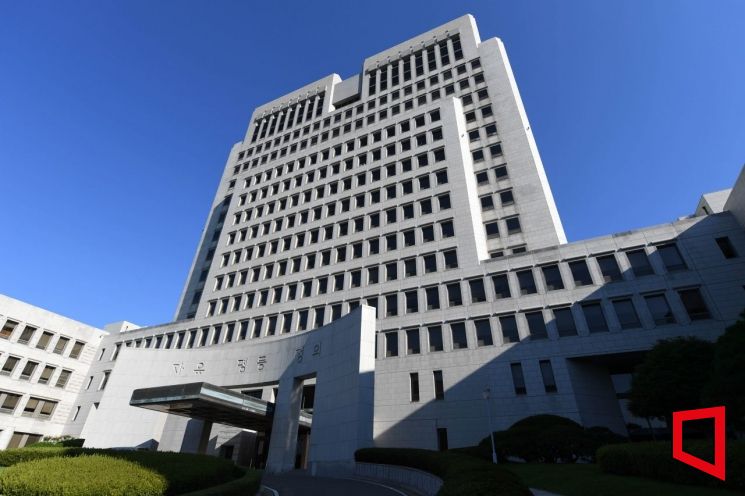
 Supreme Court, Seocho-dong, Seoul. Photo by Honam Moon munonam@
[Asia Economy Reporter Kim Daehyun] The in-house employee welfare fund was ruled by the Supreme Court to be a "protected investor" under the Capital Markets Act as a general investor.
On the 19th, the Supreme Court Division 1 (Presiding Justice Park Jeonghwa) announced that it upheld the appellate court’s partial ruling in favor of the plaintiff in the unjust enrichment refund lawsuit filed by the Korea Expressway Corporation’s in-house employee welfare fund against Mirae Asset Securities and Eugene Asset Management.
In January 2013, Mirae Asset Securities recommended a fund managed by Eugene Asset Management in response to the Expressway Corporation fund’s request for a "stable investment product." This fund was a product that indirectly invested in the U.S. life insurance securities fund (TP fund). Although the UK Financial Services Authority (FSA) had warned that "there is liquidity risk that could cause losses upon redemption," Mirae Asset Securities described it as a "stable fund like a fixed deposit."
Eugene Asset Management also did not inform Mirae Asset Securities about the fund redemption suspension incident that occurred in April 2013, and only disclosed this fact after the Expressway Corporation fund made an additional investment in the fund four months later.
Ultimately, the Expressway Corporation fund invested a total of 14.2 billion KRW in four funds, suffering losses of 5.6 billion KRW. It filed a lawsuit demanding compensation from Mirae Asset Securities and Eugene Asset Management.
The first trial court ruled that "if the plaintiff had known the risk factors of each fund, it would not have entered into the contract," and ordered Mirae Asset Securities to compensate for the principal loss. However, it judged that Eugene Asset Management, which created the fund, had no compensation liability as it did not have a direct contract with the Expressway Corporation fund.
On the other hand, the appellate court ruled that Eugene Asset Management should jointly compensate with Mirae Asset Securities. The appellate court stated, "Eugene Asset Management can be considered to have 'solicited investment' by preparing and providing product brochures and other materials," and "it bears investor protection obligations under the Capital Markets Act toward the plaintiff as an investor." It also recognized a 30% negligence ratio for the Expressway Corporation fund, stating, "According to the principle of self-responsibility, it should have carefully reviewed the concept of investment trust, the contents of the investment product, profit and loss structure, and investment risks before investing, but neglected to do so."
The Supreme Court also agreed with this judgment. The court stated, "The plaintiff is a corporation established with the approval of the Minister of Employment and Labor for the purpose of stabilizing the lives and promoting the welfare of Korea Expressway Corporation employees, and it is difficult to regard it as a professional investor under the Capital Markets Act," dismissing Mirae Asset Securities’ appeal. This means the court did not accept Mirae Asset Securities’ claim that the Expressway Corporation fund was a professional investor, not a general investor subject to protection obligations.
Furthermore, the court said, "The appellate court did not err in its legal reasoning regarding contributory negligence and the duty of explanation under the Capital Markets Act," and dismissed the appeals of both the Expressway Corporation fund and Eugene Asset Management.
© The Asia Business Daily(www.asiae.co.kr). All rights reserved.
![User Who Sold Erroneously Deposited Bitcoins to Repay Debt and Fund Entertainment... What Did the Supreme Court Decide in 2021? [Legal Issue Check]](https://cwcontent.asiae.co.kr/asiaresize/183/2026020910431234020_1770601391.png)