First Compensation Claim Filed After Enforcement of the Forced Quarantine Victims Family Compensation Act
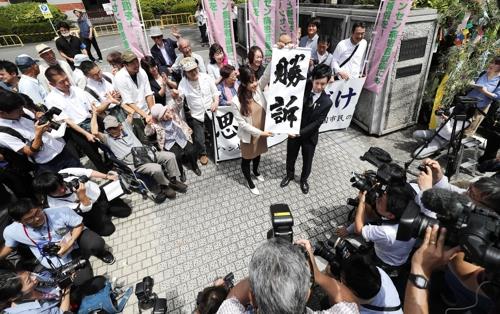 Families of former Hansen's disease patients are celebrating while holding a banner that reads "Victory" in front of the Kumamoto District Court on June 28, 2019.
 [Photo by Yonhap News]
[Asia Economy Reporter Kim Suhwan] It has been reported that about 60 family members of Korean victims who suffered under the forced isolation policy for Hansen's disease patients during the Japanese colonial period are soon expected to apply for compensation from the Japanese government.
On the 18th, Kyodo News reported, "This is the first time that families of Korean victims are collectively applying for compensation since the Hansen's Disease Forced Isolation Victims Family Compensation Act was enacted," adding, "It has been confirmed that six family members of Taiwanese victims have already applied."
Previously, Japan implemented the "Leprosy Prevention Law" in 1931, designating all Hansen's disease patients for isolation, and maintained this isolation policy until the law was abolished in the 1990s. Under this policy, Hansen's disease patients were isolated in Korea and Taiwan, which were Japanese colonies at the time. It is known that approximately 6,000 patients were forcibly confined at Sorokdo Rehabilitation Center in Korea as of just before the end of the Pacific War in 1945.
On May 11, 2001, the Kumamoto District Court (local court) ruled the isolation policy unconstitutional in a damages lawsuit filed by Hansen's disease patients themselves and ordered the Japanese government to pay compensation.
However, when implementing the Hansen's disease compensation law based on this ruling, the Japanese government excluded former colonies from the compensation targets. Victims from Korea and Taiwan claimed discrimination and filed lawsuits demanding compensation payments at the Tokyo District Court.
In these cases, Korean victims lost while Taiwanese victims won, resulting in conflicting rulings. After political controversy, a new compensation law including victims from the colonial era was enacted in 2006, settling the compensation issue for the parties involved.
In 2016, families of former patients who had been excluded from compensation filed a lawsuit at the Kumamoto District Court, claiming that their right to live peacefully had been violated. In June 2019, the Kumamoto District Court issued its first ruling recognizing the Japanese government's responsibility for damages caused by discrimination against families of former patients and ordered compensation.
In November of the same year, the Family Compensation Act was enacted, stipulating compensation payments as consolation money to all eligible parties, including families of patients from the colonial era. Under this law, 1.8 million yen is to be paid to parents and spouses, and 1.3 million yen to siblings, cohabiting grandchildren, and nephews/nieces.
Attorney Yasuyuki Tokuda, who has led the movement to aid Hansen's disease victims, said, "Realizing compensation for acts committed during the colonial era by the Japanese government is an extremely exceptional case."
He added, "Although the state relations between Korea and Japan have deteriorated, this achievement was made through close cooperation with Korean personnel to realize compensation for human rights violations. I hope people consider the significance of this compensation."
Kyodo News reported, "Since the 2019 Kumamoto District Court ruling, Korean lawyers working in cooperation with the Japanese legal team have conducted hearings and investigations related to isolation damages at Sorokdo Rehabilitation Center," and "Although there were many difficulties in the investigation process due to COVID-19, related materials were eventually prepared, enabling a collective compensation application."
The legal teams from Japan and Korea plan to hold an online joint press conference regarding this matter soon.
© The Asia Business Daily(www.asiae.co.kr). All rights reserved.

















