Financial Research Institute "Must Prepare for Potential Deterioration of Asset Soundness"
[Asia Economy Reporter Park Sun-mi] Although the asset soundness of domestic banks appears to be very favorable based on indicators, it has been pointed out that they are exposed to various risk factors.
On the 18th, Kwon Heung-jin, a research fellow at the Korea Institute of Finance, stated, "Despite the very favorable asset soundness indicators, domestic banks face risk factors such as the potential future impact of the normalization of temporary measures taken due to COVID-19 and the very rapid loan growth over the past few years."
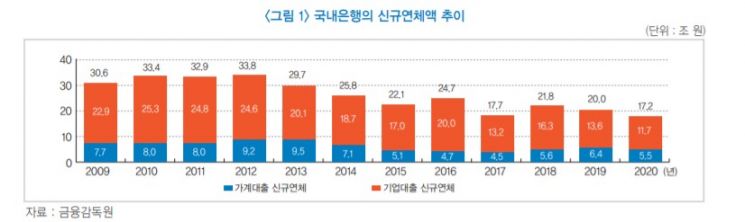
The asset soundness of domestic banks, based on indicators, shows that new delinquencies on household and corporate loans in 2020 were 5.5 trillion KRW and 11.7 trillion KRW respectively, lower than the previous year's 6.4 trillion KRW and 13.6 trillion KRW, marking the lowest level since 2009. While new delinquencies decreased, the outstanding won-denominated loans at the end of 2020 increased by 11.7% to 1,894.2 trillion KRW.
Research fellow Kwon pointed out that latent defaults may surface during the normalization process of temporary measures such as maturity extensions or interest payment deferrals applied due to COVID-19.
He explained, "Financial authorities extended the maturity extension and interest payment deferral measures until September this year and implemented a plan allowing borrowers to choose repayment methods and periods to induce a soft landing of loans. However, for borrowers who were already in poor business conditions before COVID-19 and are subject to these measures, the soft landing plan that only adjusts repayment methods and periods may only delay defaults."
He added, "Loans issued during periods of rapid loan growth are relatively more likely to have higher default probabilities. On the supply side, competition to expand loans intensifies, potentially increasing loans to high-risk borrowers. On the demand side, it is likely a period when the loan demand of potentially vulnerable borrowers facing liquidity constraints is relatively better met." As the elapsed time of loans that rapidly increased since 2018 grows, defaults or delinquencies may occur more frequently, raising concerns about the overall deterioration of the credit portfolio's asset soundness.
Research fellow Kwon emphasized that domestic banks should pursue a strategy of expanding high-quality assets at an appropriate pace to prepare for potential deterioration in asset soundness. He argued that it is necessary to adopt a high-quality asset expansion strategy that actively markets and expands loans at a proper pace to customer groups expected to benefit from the activation of the non-face-to-face economy or those with low ESG (Environmental, Social, Governance) risks, high future growth potential, and low default risk.
He also stated that financial authorities should consider reinforcing credit through temporary special guarantees to prevent excessive shocks to bank asset soundness as COVID-19-related loans undergo a soft landing. He advised, "For example, if a borrower who was not in poor business condition before COVID-19 needs long-term loans more than two to three times the interest payment deferral period to normalize their business, providing special guarantees with relatively low guarantee fees and high guarantee ratios can reduce the borrower's financial costs, supporting business normalization while mitigating shocks to financial institutions' asset soundness."
© The Asia Business Daily(www.asiae.co.kr). All rights reserved.
![User Who Sold Erroneously Deposited Bitcoins to Repay Debt and Fund Entertainment... What Did the Supreme Court Decide in 2021? [Legal Issue Check]](https://cwcontent.asiae.co.kr/asiaresize/183/2026020910431234020_1770601391.png)















