Best Efforts to Install Elevators Securing '1 Station 1 Route'... Current Installation Rate 92.2%
All Newly Introduced Electric Vehicles Must Obtain BF Certification to Ensure No Barriers
[Asia Economy Reporter Lim Cheol-young] The ‘Ttota Subway’ mobile app, which provides subway (Lines 1 to 8) operation information, will add features specialized for transportation-vulnerable groups such as infants, the elderly, pregnant women, and people with disabilities, and elevators will continue to be installed in subway stations to secure a ‘one station, one route’ system.
On the 19th, Seoul Metro announced that it will implement these services to transform the subway into an open, barrier-free system. The three main initiatives include mobile services for transportation-vulnerable groups, additional installation of subway boarding facilities, and the introduction of trains certified as barrier-free (BF).
First, the company will add new functions for transportation-vulnerable users to the official Seoul Subway mobile app, ‘Ttota Subway.’ The added features include ?Arrival Station Notification Service ?Real-time Train Operation Information ?Boarding Facility Malfunction Notification Service (scheduled for late April) ?My Location Guidance Service (scheduled for June). These services utilize approximately 9,000 Bluetooth devices called ‘Beacons’ installed in subway stations to provide information.
The ‘Arrival Station Notification Service’ allows users to register their destination station in the app after boarding the subway. The ‘Beacon’ automatically tracks the train’s location in real time and notifies the user via text and voice on their phone upon arrival at the registered station. This service is available not only on Seoul Metro-operated lines (Lines 1 to 8) but also on Korail (Korea Railroad Corporation) lines.
The ‘My Location Guidance Service’ provides directions to major facilities within the station. When standing at the ticket gate, it notifies users via text and voice with messages like ‘Direction to board at 00 Station’ and informs them of the locations and directions of restrooms and exits within the station. This service is especially useful for transportation-vulnerable groups such as those with visual and hearing impairments.
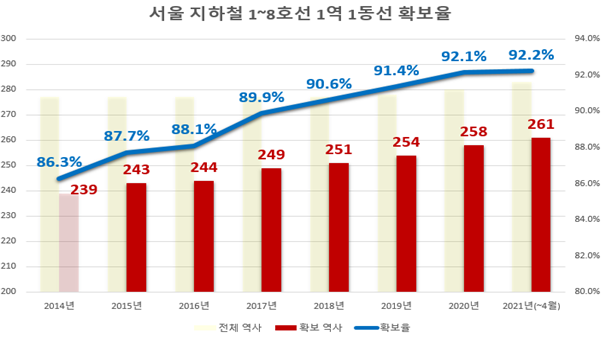
Additionally, the company is securing a ‘one station, one route’ system by expanding elevator installations. This year, boarding facilities will be installed at Sangsang Station on Line 6 and Chungmuro Station on Line 3. Since the 2015 Seoul City ‘Declaration on the Mobility Rights of Persons with Disabilities,’ Seoul Metro has continuously worked to increase the rate of boarding facility availability from 87.7% (240 out of 277 stations) to 92.2% (261 out of 283 stations) as of April this year.
In particular, for subway stations built in the 1970s without consideration for BF (Barrier Free) design, Seoul Metro plans to secure boarding facilities through station structure modifications, elevator specification adjustments, and related law revisions. Of the 22 stations currently lacking facilities, design work is underway for 12 stations, construction is ongoing at 6 stations, and 4 stations are under continuous review by the company.
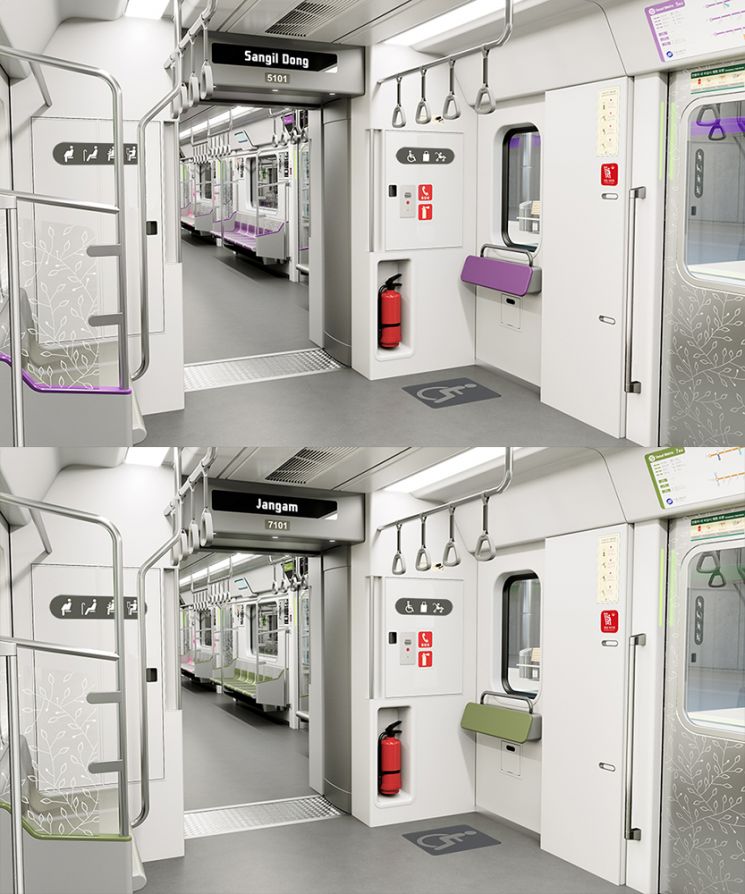
Furthermore, all newly introduced trains will obtain BF certification. They will incorporate structures considerate of transportation-vulnerable groups, such as wheelchair seats, priority seats, and vertical handrails. The trains operating on Lines 2 and 3, introduced in 2017 with 588 cars, received BF certification for the first time last December, and in March this year, the trains to be introduced on Lines 5 and 7 (336 cars) also received BF certification. Seoul Metro has installed video phones for the hearing and speech impaired at 45 subway stations including Seoul Station and Jamsil Station, providing sign language interpretation services. Through video calls, users can connect to institutions that offer assistance, such as the Sign Language Interpretation Center, the Hand and Speech Child Center, the Dasan Call Center, and the Government Civil Service Call Center.
Meanwhile, Seoul Metro is also conducting promotional campaigns to encourage consideration for transportation-vulnerable groups. On Disability Day, quiz events related to transportation-vulnerable groups will be held, and promotional content will be displayed on LCD screens inside stations and trains. Awareness campaigns about transportation-vulnerable groups will also be conducted at major transfer stations and stations with high passenger traffic.
In the second half of this year, ‘Donghaeng ZONE’ stickers will be attached to the floors of wheelchair seats inside trains on Line 8 to encourage passengers to give up space to wheelchair users, and multilingual pictograms will be pilot-installed above priority seats. Feedback from transportation-vulnerable groups will also be collected. In the first half of the year, a survey on awareness and satisfaction regarding current transportation-vulnerable services will be conducted. In the second half, an idea contest to promote mobility rights for transportation-vulnerable groups will be held, and excellent ideas will be incorporated into the services.
President Kim Sang-beom stated, “We will do our best to ensure that transportation-vulnerable groups can conveniently use the subway and have their mobility rights guaranteed,” adding, “Along with securing funding for facility installation, we ask for warm consideration and cooperation from citizens, as their kindness and willingness to give way are essential.”
© The Asia Business Daily(www.asiae.co.kr). All rights reserved.


















