JP Morgan "Savings, Vaccines, and Stimulus Will Lead Goldilocks"
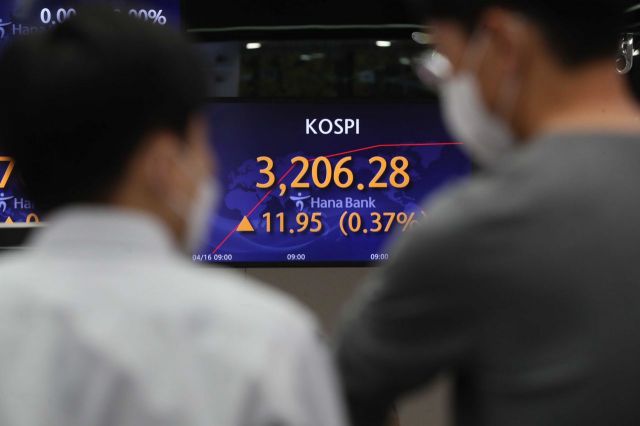 On the 16th, when the KOSPI index surpassed the 3,200 mark during the session, dealers were working in the dealing room of Hana Bank in Euljiro, Seoul. The KOSPI started at 3,194.08, down 0.25 points (-0.01%) from the previous close, and is showing an upward trend. Photo by Moon Honam munonam@
[Asia Economy Reporter Gong Byung-sun] There is a growing view that the economy is entering a 'Goldilocks economy' phase, where the economy improves while interest rates and exchange rates stabilize.
According to the Korea Exchange on the 18th, the KOSPI rose on 11 out of 12 trading days this month. As a result, the KOSPI, which was below 3000 as of the 24th of last month, rose to 3198.62 on the 16th, approaching the 3200 mark.
The KOSDAQ showed a similar trend. On the 12th, the KOSDAQ closed above 1000 for the first time in 20 years and 7 months. Since then, except for the 15th, it has been on an upward trend. As of the 16th, the KOSDAQ closed at 1021.62.
Foreign investors are leading the rise in the KOSPI index. Foreigners have net purchased 2.9327 trillion won in the KOSPI market this month. Consequently, the KOSPI200 volatility index fell to the 16-17 range last week, the lowest level since the end of January last year. The KOSPI200 volatility index is commonly known as the 'fear index.'
Bond yields have also calmed down. The 10-year U.S. Treasury yield, which was in the 0% range earlier this year, rose to 1.750% on the 19th of last month. However, since mid-last month, the upward trend has weakened, and it recently dropped to the 1.5% range. The dollar has shown relatively weak performance. The exchange rate, which rose to around 1140 won per dollar last month, has fallen to around 1120 won.
The U.S. stock market is also showing a strong trend. On the 16th (local time), the Dow Jones Industrial Average closed at 34,200.67, up 0.48% (164.68 points) from the previous trading day. The S&P 500 index also rose 0.36% (15.05 points) to 4185.47. Both are record highs.
As a result, there is an assessment inside and outside the financial sector that the recent financial market situation has entered a Goldilocks phase. Jamie Dimon, CEO of JP Morgan, the largest bank in the U.S., said in a recent letter to shareholders, "Strong consumer savings, expanded vaccine distribution, and the Biden administration's $2.3 trillion infrastructure bill (approximately 2569 trillion won) will lead the U.S. to a Goldilocks economy."
The U.S. Federal Reserve (Fed) also viewed the economic situation optimistically. According to the Fed's new Beige Book survey on the 14th, the Fed began to show optimism about the economic outlook as business activity accelerated across the U.S. The Beige Book survey serves as the basis for the Fed's U.S. interest rate discussions scheduled for the 27th-28th.
© The Asia Business Daily(www.asiae.co.kr). All rights reserved.

















