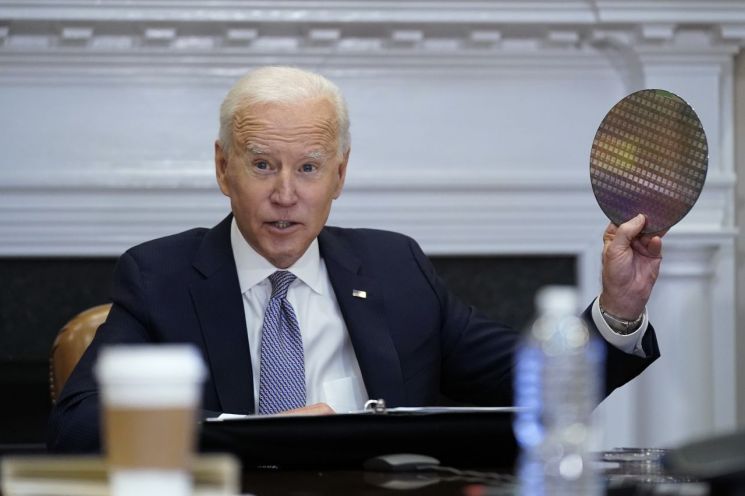
[Asia Economy Reporter Jeong Hyunjin] Amid the semiconductor shortage triggered by COVID-19 fueling the US-China hegemony conflict, Dutch equipment manufacturer ASML and Taiwan's TSMC, the number one foundry (semiconductor contract manufacturing) company, have expressed concerns about trade tensions. If US-China conflicts escalate, domestic semiconductor companies such as Samsung Electronics and SK Hynix are inevitably expected to suffer damage, drawing attention to whether geopolitical uncertainties will become a factor shaking the market this year.
According to Bloomberg and others on the 18th, TSMC explicitly stated for the first time in its annual report released on the 16th that US-China trade conflicts could hinder access to key production equipment and impact production. TSMC pointed out that ongoing trade conflicts or protectionist measures could cause price increases and eventually block access to critical equipment, mentioning the possibility of tariffs and various export controls.
The reason TSMC included this message in its annual report is due to its high dependence on equipment from US semiconductor equipment companies Applied Materials (AMAT) and Lam Research. As US-China conflicts intensify, the likelihood of sanctions increases, making it necessary to consider geopolitical uncertainty as a major factor from a business perspective. TSMC explained, "If one country's actions or regulations cause damage and another country responds with measures, it could lead to significant legal issues for multiple multinational companies including ourselves."
Concerns from the semiconductor industry about US-China conflicts have been increasing recently. ASML, which monopolizes the supply of extreme ultraviolet (EUV) lithography equipment, a core device for advanced semiconductor manufacturing processes, recently criticized the US's supply chain restructuring efforts. Peter Wennink, CEO of ASML, said at an online event on the 14th, "I do not think export controls are the right way to manage economic risks," adding, "Attempts to impose export restrictions on China will not be effective."
CEO Wennink pointed out, "Although it will take a long time for China to build its own semiconductor equipment and technology, eventually foreign companies will be pushed out of one of the largest semiconductor markets," warning, "Many jobs and revenues will disappear." Citing estimates from the US Department of Commerce, he estimated, "If the semiconductor industries between the US and China come to a halt, the US will lose 125,000 jobs and sales worth 80 to 100 billion dollars."
Domestic companies are no exception. Samsung Electronics currently operates NAND flash and semiconductor back-end (packaging) factories in Xi'an and Suzhou, China. SK Hynix also manufactures DRAM and NAND flash in Wuxi and Chongqing, China. With the US demanding expanded semiconductor investments domestically, it has become crucial to make strategic and balanced decisions, as losing the major market of China is not an option.
Some speculate that if the US, which holds a large market share in semiconductor equipment, blocks equipment from reaching China through sanctions, Korean companies' factories in China will inevitably be affected. A domestic semiconductor industry official said, "For our companies, China should be approached from a market perspective," adding, "However, when building manufacturing facilities, US equipment is essential, so we are dependent on US policies and indirectly have no choice but to follow them."
Earlier, on the 15th, President Moon Jae-in chaired an expanded economic ministers' meeting attended by CEOs of key industries such as semiconductors, automobiles, and shipping, stating, "The industry where global supply chain restructuring is most evident is semiconductors," and "We must continue to lead the global semiconductor supply chain. We will establish multifaceted support measures to maintain our number one position and widen the gap." The semiconductor industry has requested the government for tax benefits, workforce development, and the enactment of special laws.
© The Asia Business Daily(www.asiae.co.kr). All rights reserved.
![Clutching a Stolen Dior Bag, Saying "I Hate Being Poor but Real"... The Grotesque Con of a "Human Knockoff" [Slate]](https://cwcontent.asiae.co.kr/asiaresize/183/2026021902243444107_1771435474.jpg)
















