Public Housing Construction Project in Suwon High-Density Residential Environment Improvement
Exterior Wall Finishing Materials and Design Changed Due to Prospective Residents' Opposition
Dispute Between LH and Daewoo Construction Consortium Over Increased Construction Costs
Court Rules "Exterior Wall Modification Falls Within Private Contractor's Scope"
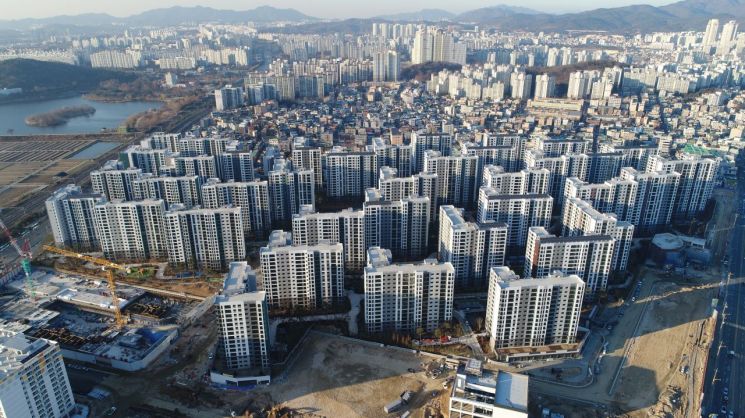 Korea Land and Housing Corporation (LH) and Daewoo Construction consortium signed a private participation project agreement and carried out public housing within the Suwon Godeung Residential Environment Project District [Image source: Prugio homepage]
[Asia Economy Reporter Seongpil Cho] Daewoo Construction, GS Construction, Kumho Construction, and Taeyoung Construction (hereinafter referred to as the Daewoo Construction Consortium) signed a private participation project agreement with the Korea Land and Housing Corporation (LH) in February 2017 for the construction of public housing within the Godeung Residential Environment Improvement Project District in Suwon, Gyeonggi Province. This project was originally designated with LH as the project implementer under the Urban Renewal Act in 2008. However, as LH faced management difficulties due to massive debt, private developers participated by bearing the project costs according to their equity shares. In the agreement at that time, both parties agreed that LH would contribute the land, and the Daewoo Construction Consortium would be responsible for constructing the public housing.
The public housing construction project was completed last February. What remained was the settlement of the project's profit and loss. However, conflicts arose between Daewoo Construction and LH during this process. Due to complaints from prospective apartment residents, the design was changed, increasing construction costs, which led to a legal dispute over how to bear these additional costs. The lawsuit debated whether the costs should be distributed according to the project equity shares or fully borne by the private developer responsible for housing construction. The court ruled in favor of LH. What was the reason?
According to the legal community on the 17th, the Seoul Central District Court Civil Division 24 (Presiding Judge Seokjae Lee) dismissed the plaintiff's claim in the lawsuit filed by the Daewoo Construction Consortium against LH, stating, "In the public housing construction project within the residential environment improvement district, construction costs increased due to design changes caused by opposition from prospective residents." The court ruled, "The exterior wall modification work is the responsibility of the Daewoo Construction Consortium," and "It is reasonable to consider that the increased project costs should be borne by the Daewoo Construction Consortium."
During the public housing construction project, the Daewoo Construction Consortium changed the finishing materials of the apartment exterior walls below the third floor from the original 'stone spray' to 'stone' and renewed the entire exterior wall design due to opposition from prospective residents. This change increased construction costs by 6,555.52 million KRW compared to the original project plan. The Daewoo Construction Consortium filed a settlement claim lawsuit against the joint project partner LH, arguing that the increased construction costs should be borne according to the project equity shares.
The court judged, based on the project agreement between the two parties, that the increased construction costs should be borne by the Daewoo Construction Consortium. Article 8 (Scope and Allocation of Work) of the project agreement defines the Daewoo Construction Consortium's responsibilities as "investment in construction costs" and "handling of complaints." Since the exterior wall modification was made in response to complaints from prospective residents, it was considered part of the Daewoo Construction Consortium's duties. The Daewoo Construction Consortium argued that the "handling of complaints" clause referred to complaints from surrounding residents, not prospective residents, but the court rejected this, stating, "There is no basis to interpret the handling of complaints narrowly."
The Daewoo Construction Consortium also claimed, based on another clause of the project agreement, that LH should share the increased construction costs. Article 20, Paragraph 4 of the project agreement states that project costs cannot be changed after the agreement is signed due to design changes, except in cases where adjustment is unavoidable and mutually agreed upon. They argued that the exterior wall change was an unavoidable design change due to complaints from prospective residents and thus fell under the mutually agreed exception. In fact, the Daewoo Construction Consortium and LH agreed in a working-level meeting in February last year to change the exterior wall finishing materials and design for construction.
However, the court did not accept this argument from the Daewoo Construction Consortium either. The court pointed out, "The Daewoo Construction Consortium and LH only agreed on the design changes regarding the finishing materials and design of the apartment exterior walls but did not reach an agreement on adjusting the project costs."
© The Asia Business Daily(www.asiae.co.kr). All rights reserved.

















