First Female Deputy Speaker Elected in the Constituent National Assembly
First Female Chairpersons of 5 Standing Committees
No Female Three-Term or More Members in the People Power Party
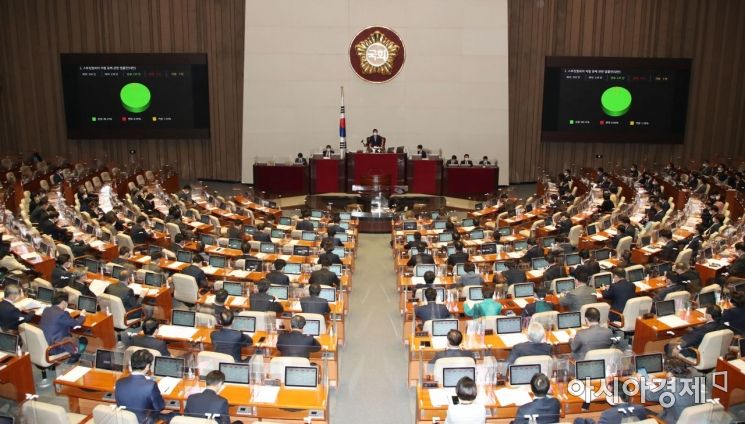
[Asia Economy Reporter Hyunju Lee] The 21st National Assembly recorded the highest proportion of female lawmakers in history at 19% (57 members). For the first time since the Constituent Assembly, a female lawmaker was elected as the Deputy Speaker of the National Assembly, and the proportion of female chairpersons of standing committees was also high. However, producing senior lawmakers who can play roles in the party leadership remains a challenge.
According to the National Assembly Research Service on the 17th, among the 17 standing committees in the first half of the 21st National Assembly, female lawmakers chaired five committees. The chairpersons of the Administrative Safety Committee, Health and Welfare Committee, Environment and Labor Committee, Land, Infrastructure and Transport Committee, and Gender Equality and Family Committee were all female lawmakers, marking the first time in the history of the National Assembly that women chaired five standing committees.
In May last year, Kim Sang-hee, a four-term lawmaker from the Democratic Party of Korea, was appointed as the first female Deputy Speaker in constitutional history. Kim founded the Korean Women’s Minwoo Association in 1987 and actively participated in the women’s movement as the executive representative of the Women’s Environmental Network and co-representative of the Civil Society Organizations Coalition. She entered politics in 2007 as a Supreme Council member of the United Democratic Party and stepped into the political arena as a proportional representative in the 18th general election. She then ran for the Bucheon Sosa District in Gyeonggi Province in the 19th, 20th, and 21st general elections and was consecutively elected. In the National Assembly, she served as chairperson of the Gender Equality and Family Committee and as a member of the Health and Welfare Committee.
Countries with a high proportion of female lawmakers include the United Kingdom, France, and Germany. In the UK, the House of Commons’ presiding officers consist of one Speaker and three Deputy Speakers. The three Deputy Speakers serve as Chairperson of the Committee of Selection, First Deputy Chairperson, and Second Deputy Chairperson of the Committee of Selection. Currently, female lawmakers hold the positions of Chairperson and First Deputy Chairperson of the Committee of Selection. Since two out of the four presiding officers are female lawmakers, 50% of the presiding officers are women. The French Constitution limits the standing committees of the National Assembly to eight, of which five are chaired by female lawmakers. These standing committees include the Foreign Affairs Committee, Social Issues Committee, Defense Committee, Sustainable Development, Spatial and Regional Planning Committee, and Constitution, Legislation, and General Administration Committee. The proportion of female chairpersons among standing committees is 62.5%, which is considerably higher compared to the 39.5% (228 out of 577) female lawmakers in the National Assembly.
Although the proportion of female lawmakers has significantly increased, there are concerns about the severe shortage of senior female lawmakers who can lead the party leadership. In the 21st National Assembly, there are 10 senior female lawmakers with three or more terms. Apart from Deputy Speaker Kim, there are only two four-term female lawmakers: Kim Young-joo of the Democratic Party and Shim Sang-jeong of the Justice Party. The six three-term lawmakers from the Democratic Party are Nam In-soon, Seo Young-kyo, In Jae-geun, Jeon Hye-sook, Jin Sun-mi, and Han Jeong-ae, along with Kwon Eun-hee from the People’s Party. The People Power Party has none.
© The Asia Business Daily(www.asiae.co.kr). All rights reserved.

















