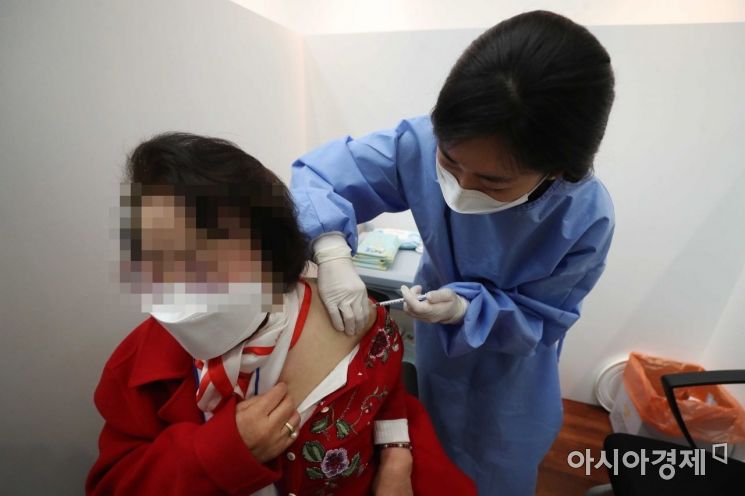
 On the 16th, as the spread of COVID-19 continues, seniors aged 75 and older are receiving the Pfizer vaccine at the vaccination center set up in Yongsan Art Hall, Yongsan-gu, Seoul. Photo by Mun Ho-nam munonam@
[Asia Economy Reporter Dongwoo Lee] Amid the continued spread of COVID-19 in South Korea, the number of new confirmed cases on the 17th recorded in the mid-600s. Although slightly lower than the previous day, the count remained in the 600s for the third consecutive day.
The Central Disease Control Headquarters (CDCH) announced that as of midnight on the day, 658 new COVID-19 cases were confirmed, bringing the total to 113,447. This is 15 fewer cases than the previous day.
Looking at recent trends, before the effects of the '3rd wave' that began in mid-November last year could subside, new confirmed cases surged again across the country, indicating the early stage of the '4th wave.'
From the 11th of this month to the 17th, the daily new confirmed cases over the past week were 614 → 587 → 542 → 731 → 698 → 673 → 658. During this period, there were two days in the 500s, four days in the 600s, and one day in the 700s.
With an average of 643 new cases per day over the week, the key indicator for adjusting social distancing levels, the daily average of locally transmitted cases, was about 621, which falls within the Level 2.5 range (nationwide 400?500 or more).
Regarding the infection routes of the new cases on the day, 630 were locally transmitted, and 28 were imported cases.
By region, the Seoul metropolitan area accounted for a total of 440 cases, with Seoul at 213, Gyeonggi at 204, and Incheon at 23, making up 69.8% of all local cases.
Non-metropolitan areas reported a total of 190 cases: Gyeongnam 36, Busan 33, Gyeongbuk 28, Ulsan 25, Jeonbuk 15, Gangwon and Chungbuk 11 each, Daegu 10, Chungnam and Jeonnam 6 each, Gwangju and Daejeon 4 each, and Jeju 1.
Major outbreak cases involved infections linked to family and acquaintances' gatherings, workplaces, and entertainment facilities.
Since the first confirmed case on the 14th related to a family and acquaintances' gathering in Damyang-gun, Jeonnam, nine people have tested positive, and eight cases were confirmed in a commercial acquaintance cluster in Gumi-si, Gyeongbuk.
In a workplace in Seocho-gu, Seoul, after the first case on the 4th, 15 additional cases were confirmed, and at a Hold'em pub in Seo-gu, Gwangju, six employees tested positive consecutively.
At the Ministry of Justice in the Government Complex Gwacheon, Gwacheon-si, Gyeonggi, the first confirmed case led to the closure of the entire Ministry of Justice space, and first-round contacts were quarantined.
There were 28 imported cases, seven more than the previous day (21). Among them, seven were identified during airport or port quarantine processes. The remaining 21 tested positive while in self-quarantine at their residences or temporary living facilities in regions including Gyeonggi (5), Seoul (4), Busan, Daegu, Gyeongnam (1 each), and Ulsan, Gangwon, Chungbuk, Chungnam, Jeonbuk, Gyeongbuk (1 each).
Combining local and imported cases (excluding quarantine), the Seoul metropolitan area had 449 cases: Seoul 213, Gyeonggi 204, and Incheon 23. Nationwide, new cases were reported in 16 cities and provinces except Sejong.
The death toll increased by four from the previous day, totaling 1,794. The domestic average fatality rate stands at 1.58%. The number of critically ill patients was 108, three fewer than the previous day (111).
© The Asia Business Daily(www.asiae.co.kr). All rights reserved.

















