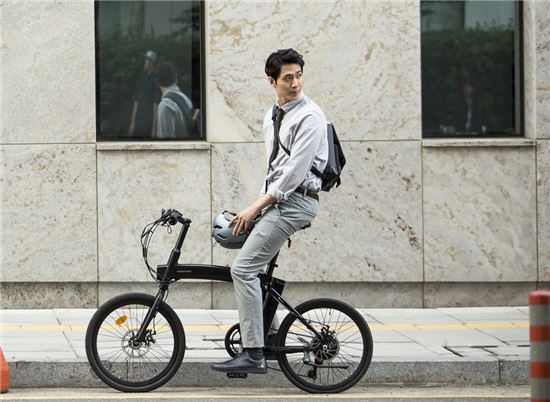
 Samchuly Bicycle's electric bike 'Phantom Zero.'
 Photo by Samchuly Bicycle
[Asia Economy Reporter Lee Jun-hyung] The top two bicycle companies in South Korea have emerged from a downcycle (business downturn) thanks to strong electric bicycle sales. Analysts say the companies are accelerating business diversification and are poised to transform into 'mobility companies.' The distribution of personal mobility devices (micro-mobility) is expected to steadily increase due to related legal revisions.
According to industry sources on the 17th, Samchuly Bicycle's electric bicycle sales last year reached 13.4 billion KRW, an 81% increase compared to the previous year (7.4 billion KRW). The company's electric bicycle brand 'Phantom' sold approximately 23,000 units last year. High growth is expected to continue this year. The securities industry predicts that Phantom will sell 28,000 units this year, with electric bicycle sales reaching 21.5 billion KRW.
Sales also increased. Samchuly Bicycle's total sales last year were 120.8 billion KRW, up 38.7% from 87.1 billion KRW the previous year. Considering the restrictions on outdoor activities due to COVID-19, this is a significant performance. A Samchuly Bicycle official stated, "We cannot disclose specific sales figures due to competitors, but it is true that (electric bicycle sales) are showing a clear growth trend."
Alton Sports ended its 'loss streak' and returned to profitability after six years. The company's sales last year were 44.9 billion KRW, a 44% increase from 31.2 billion KRW the previous year. Although it had been in the red for five years since 2015, it posted an operating profit of 5.3 billion KRW last year. According to NH Investment & Securities, Alton Sports' sales this year are expected to increase by 32% to 59.1 billion KRW compared to last year.
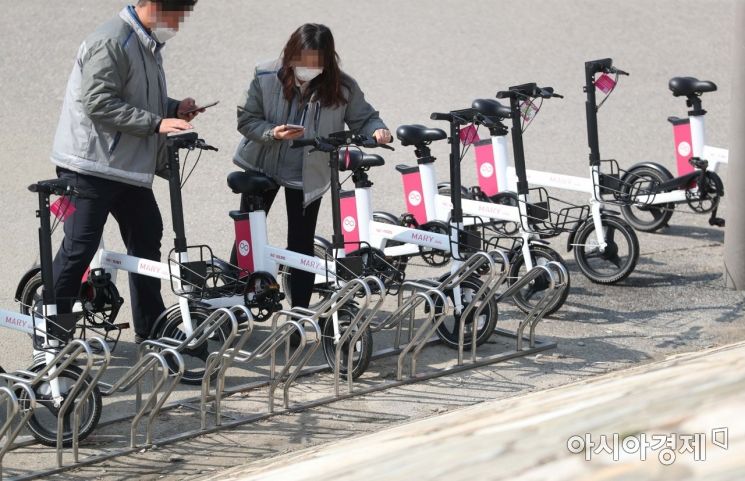 On the 5th, the solar term Gyeongchip, citizens are renting shared bicycles at Banpo Hangang Park in Seoul. Photo by Moon Honam munonam@
The bicycle industry had been struggling with a downturn until two years ago. This was due to increased fine dust inflow reducing outdoor activities and the spread of public shared bicycles. Demand for expensive foreign premium brands increased, causing domestic bicycle companies focusing on mid- to low-priced everyday bicycle models to be overlooked.
The industry found a way out as the micro-mobility market grew. Electric scooters and electric bicycles are examples of micro-mobility. Micro-mobility started to spread mainly in congested urban areas because it can avoid traffic congestion and is easy to park. It is also convenient for traveling distances within about 1 km after using public transportation. Accordingly, since 2019, Samchuly Bicycle has actively strengthened its mobility-related lineup by introducing electric scooters in addition to electric bicycles. Alton Sports has made 'strengthening the electric bicycle lineup' a key company strategy.
Expansion of B2B (business-to-business) operations also contributed to improved performance. In particular, Alton Sports is evaluated to have achieved profitability turnaround through B2B-focused structural improvements. The company supplies most of the electric bicycles for Kakao Mobility's electric bicycle sharing platform 'KakaoT Bike.' Seoul's shared bicycle service 'Ddareungi' is also a customer. Alton Sports delivered about 14,000 bicycles to Seoul last year alone.
The future of micro-mobility, which these companies are focusing on, is bright. The revision of the Road Traffic Act in December last year, which allowed electric bicycles to access bicycle lanes, raised expectations for the expansion of the B2C (business-to-consumer) market. The number of people using micro-mobility for deliveries on rapidly growing delivery platforms is also increasing. Shared services are also expanding. According to global consulting firm Boston Consulting Group (BCG), the market size for shared services using personal mobility devices is expected to reach 45 trillion to 56 trillion KRW by 2025.
© The Asia Business Daily(www.asiae.co.kr). All rights reserved.

















