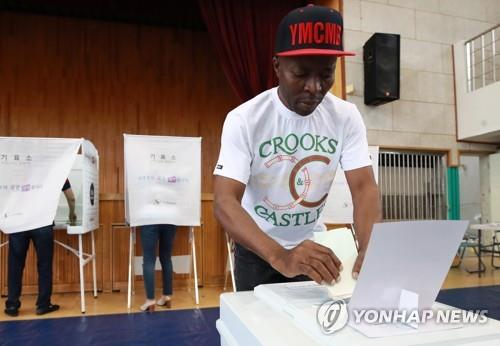
 A foreigner is voting in the nationwide local elections held simultaneously on June 13, 2018. [Image source=Yonhap News]
[Asia Economy Reporter Kim Choyoung] In the recent April 7 Seoul mayoral by-election, foreign nationals with voting rights accounted for only 38,126 people, which is 0.45% of the total electorate. However, voices opposing foreign voting rights were louder than ever. Election-related articles were flooded with comments such as "Why are foreigners interfering in our politics?" and "We must block foreign voting rights."
This phenomenon began to emerge during last year's general election. On March 2, about a month before the general election, a post titled "We must revoke local election voting rights from Chinese permanent residents" was posted on the Blue House's public petition board, garnering 215,646 signatures.
At that time, the Blue House cited other countries such as New Zealand, Denmark, and the Netherlands that grant voting rights to foreign permanent residents, responding that the purpose was to "realize the universality of democracy by allowing (foreigners) as local residents to participate in the basic political decision-making process of the local community."
South Korea has granted voting rights to foreign permanent residents since the 2006 local elections. The eligible individuals are foreigners who have obtained permanent residency and have lived in the country for more than three years. This is based on Article 5, Paragraph 2 of the Resident Referendum Act, which states that "foreigners aged 19 or older who have the qualification to reside continuously in Korea under immigration-related laws have the right to participate in resident referendums."
At the time of the 2006 local elections, there was hardly any public opposition to foreigners casting a vote in local government elections. However, amid growing anti-China sentiment due to repeated historical distortions by China, and the revelation that 80% of foreign voters hold Chinese nationality, opposition to foreign voting rights has intensified.
The issue of foreign voting rights in local elections first emerged as a major topic during the 16th National Assembly (2000?2004) under the Kim Dae-jung administration. The Kim Dae-jung government recognized "globalization" as a key challenge for the new millennium. Accordingly, in 2001, the National Assembly agreed to grant local election voting rights to foreigners who had stayed in Korea for a long time. However, a year later, the National Assembly deleted the foreign voting rights provision, citing Article 1 of the Constitution, which states, "Sovereignty resides in the people, and all state authority emanates from the people."
Later, in 2005, voices advocating for granting local election voting rights to foreigners resurfaced in the National Assembly, emphasizing the rights of Korean residents in Japan (Zainichi Koreans). Despite initial opposition, the Public Official Election Act was amended to establish foreign voting rights in local elections, as progressive parties held a majority at the time.
Cases where foreigners can participate in presidential and National Assembly elections are rare in other countries. However, some countries, like South Korea, allow foreign voting rights in local elections.
The European Union (EU), through the 1992 Maastricht Treaty, recognizes that citizens of EU member states have the right to vote and run as candidates in local elections under the same conditions as nationals, regardless of which EU member city they reside in.
In the United States, voting rights for foreigners vary by state, but the numbers are small, making it practically difficult to consider that foreigners have voting rights. Moreover, U.S. immigration law stipulates that foreigners who vote either accidentally or intentionally may be deported.
© The Asia Business Daily(www.asiae.co.kr). All rights reserved.
![User Who Sold Erroneously Deposited Bitcoins to Repay Debt and Fund Entertainment... What Did the Supreme Court Decide in 2021? [Legal Issue Check]](https://cwcontent.asiae.co.kr/asiaresize/183/2026020910431234020_1770601391.png)
















