Amid the government's continued strong regulations to stabilize the real estate market, the resulting balloon effect is growing even larger. Each time the regulated areas expand, previously relatively neglected regions benefit and become lively. A representative example is small and medium-sized cities in the provinces.
Since 2017, more than 20 real estate measures have been announced. As housing prices in Seoul, the metropolitan area, and major cities soared uncontrollably, the government designated regulated areas and implemented housing price brakes to stabilize the market. While announcing these measures, the government continuously expanded regulated areas centered on Seoul and the metropolitan area, and recently extended restrictions to major cities as well.
As the regulated areas increase, the number of beneficiary areas experiencing the balloon effect is also steadily rising. When Seoul was designated as a regulated area, nearby metropolitan regions greatly benefited, proving this through a learning effect, leading buyers to seek potential balloon effect locations.
In particular, following the December 17 real estate measures last year, some previously regulation-free small and medium-sized provincial cities were designated as regulated areas, prompting quick investors to look for remaining unregulated locations. Compared to the metropolitan area and major cities, undervalued key areas in the provinces have higher investment value and lower entry barriers due to smaller investment amounts.
As a result, the real estate market in small and medium-sized provincial cities is showing a favorable trend with each new real estate measure. These cities are proving their popularity by recording double-digit subscription competition rates in new housing complex pre-sale markets.
According to the Korea Real Estate Board, ‘The Sharp Ocean City Phase 2’ in Gunsan, Jeonbuk, which was offered in February, recorded an average competition rate of 58.77 to 1; ‘Gyeryong Xi’ in Gyeryong, Chungnam, offered in March, recorded 27.68 to 1; and ‘Gimhae Yulha The Sky City Zenith & Frau’ in Gimhae, Gyeongnam, offered in April, recorded 18.95 to 1.
Industry experts predict, “Subscription competition will be fierce mainly in non-regulated provincial areas with potential for price increases,” adding, “Since there are no restrictions on resale of pre-sale rights, demand from outside investors as well as local demand is expected to flood in, so a well-planned subscription strategy is necessary.”
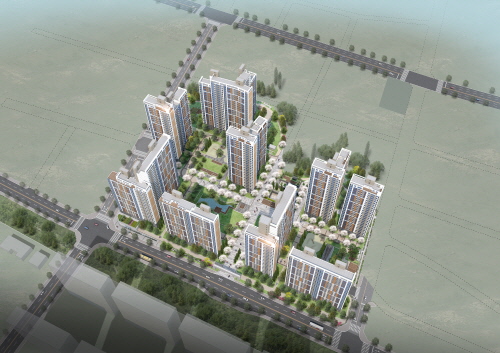
In May, HDC Hyundai Development Company will offer ‘Gyeongsan I-Park’ in Gyeongsan, Gyeongbuk, a new complex in a non-regulated area. As the first I-Park branded complex in Gyeongsan, it is expected to attract high interest from buyers.
Gyeongsan I-Park can be expected to benefit from the balloon effect in non-regulated areas. In December last year, the government designated the eastern area of Gyeongsan as a regulated area. However, Gyeongsan I-Park is located in Amlang-eup, which is classified as a non-regulated area and thus not subject to real estate regulations. Therefore, there is no restriction period on resale of pre-sale rights, and anyone aged 19 or older who has been subscribed to the Housing Subscription Savings for more than six months can apply regardless of household headship, household member status, or homeownership.
Its excellent location is another advantage. The complex is within walking distance to Gyeongsan Amlang Elementary School and Amlang Middle School, and elementary and high school sites are planned in the Amlang district, promising an even better educational environment in the future.
Convenient transportation is also a highlight. Yeongnam University Station on Daegu Subway Line 2 is located within 1.5 km radius, and it takes only 5 minutes from Yeongnam University Station to Sawol Station in Suseong-gu, Daegu. Additionally, access to road networks connecting all of Daegu, such as Gyeongsan IC, Hwarang-ro, and National Road No. 25, makes vehicle travel convenient.
Convenience facilities are well established. The Yeongnam University commercial district within 1.5 km radius and facilities in the Shindaebu-jeok district are easily accessible. Also, Homeplus Gyeongsan, a large supermarket, is located within 3 km, making shopping convenient.
The natural environment is excellent as well. Neighborhood parks such as Mawiji Park and Nammaeji Waterfront Park are developed around the complex, allowing residents to enjoy a pleasant natural environment and leisure activities. Additionally, a neighborhood park is planned within the Amlang district, promising abundant natural surroundings in the future.
‘Gyeongsan I-Park’ will consist of 9 buildings, ranging from 2 basement floors to 29 above-ground floors, with a total of 977 households and exclusive areas ranging from 84㎡ to 142㎡.
© The Asia Business Daily(www.asiae.co.kr). All rights reserved.

















