Excessive Confidence Can Backfire
"Most Promises Require Legal Amendments, Practically Difficult" Withdrawal
Reversal on Self-Test Kits and More
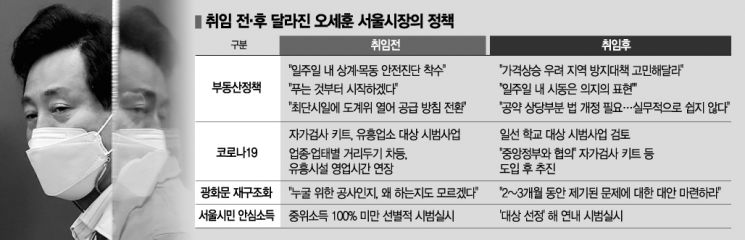
[Asia Economy Reporters Lim Cheol-young, Kim Hye-min] The major policies of Mayor Oh Se-hoon, who rose to lead the 10 million residents of Seoul by sharply criticizing existing government policies and emphasizing differentiation, are shaking less than ten days after his inauguration. The confidence to solve the housing supply problem through large-scale deregulation immediately after winning the election has disappeared, and there is an atmosphere of seeking a way out.
COVID-19 quarantine and major welfare policies also show subtle differences in tone before and after the election, appearing to follow a revised course. Since his term is just over a year and his authority is limited, there is an analysis that the key pledges he made during his candidacy are rather hindering Mayor Oh’s actions after taking office.
◆ Excessive Confidence? Are Real Estate Pledges Poisonous? = The most notable change in Mayor Oh’s policy moves, marking ten days since his inauguration on the 17th, is in real estate policy. Rather than bold deregulation, the emphasis is on ‘caution.’
This change in stance is also evident in his remarks. Before winning, Mayor Oh promoted easing the 35-floor height limit in residential areas as his first pledge and countered concerns about house price increases due to deregulation by saying, "You have to accept some parts of it. If you are afraid of maggots and don’t make jang (fermented sauce), you will never eat jang."
However, his actions after taking office are the exact opposite. By choosing a ‘mini reconstruction’ project site in the Gangbuk area as his first field visit, signs of policy change were detected. At the Housing and Architecture Headquarters briefing on the 12th, he said, "Please carefully consider how to establish preventive measures in areas where there are concerns about real estate price increases," placing policy weight on anti-speculation measures. Later, he said, "Saying I would start deregulation within a week was an expression of will," and "Many parts of the pledge require legal amendments, but since we have become a minority party, it is practically difficult," showing signs of retreat.
This reversal seems to be influenced by the burden of potentially being held fully responsible for house price increases as prices of reconstruction apartments in not only the Gangnam 3 districts but also outer areas like Nowon District fluctuated immediately after his inauguration. The practical barrier that deregulation is not easy without cooperation from the Seoul Metropolitan Council and the government also had an impact.
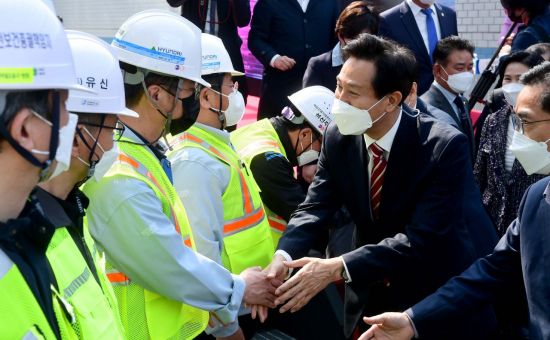
◆ Seoul-style Quarantine Also Takes a Step Back = There have also been successive reversals regarding Seoul-style coexistence quarantine, the introduction of self-test kits, and the suspension of the Gwanghwamun restructuring project.
In particular, the ‘Seoul-style coexistence quarantine’ initiative, which was ambitiously launched right after taking office, has been criticized for only increasing confusion. Mayor Oh proposed creating a differentiated social distancing system by industry and business type, advocating the introduction of disposable diagnostic kits and pilot application targeting entertainment facilities such as singing rooms.
However, as concerns from quarantine authorities increased due to the rise in COVID-19 cases, he stepped back, saying, "We will prepare a Seoul-style social distancing manual in consultation with the Central Disaster and Safety Countermeasures Headquarters." The direction of the pilot project and the term ‘disposable diagnostic kits,’ which had been used inconsistently, were also changed. Initially, Mayor Oh said he would apply ‘self-test kits’ to affected industries such as entertainment businesses and named singing rooms as pilot project targets, but the scope was expanded to schools and religious facilities, and the pilot project target was changed to schools. He also added that the media caused misunderstandings.
◆ Erasing Park Won-soon Also Put on Hold? = Attention is also drawn to the change in stance before and after inauguration regarding the Gwanghwamun restructuring project promoted by former Mayor Park Won-soon. Before taking office, he hinted at the possibility of scrapping it, saying, "I want to ask who this construction is for. I don’t know why it’s being done," but after taking office, he stepped back, saying the position has not been decided.
At the first briefing on the 12th, he ordered the preparation of alternatives to the issues raised so far over two to three months. The departmental briefings, originally scheduled to be completed by the 16th, were postponed to next week due to emergency expert advisory meetings related to the introduction of self-test kits. A Seoul city official explained, "We plan to create detailed guidelines on how to introduce and apply self-test kits," and "Seoul City plans to coordinate with the central government on the method and timing of the pilot project implementation."
Meanwhile, Mayor Oh took the first step toward ‘joint operation of Seoul City,’ agreed upon with Ahn Cheol-soo, leader of the People’s Party, by appointing Kim Do-sik, chief of staff to Ahn and considered his right-hand man, as Deputy Mayor for Political Affairs. It is also known that Jo In-dong, Director of Planning and Coordination Office, and Ryu Hoon, Director of Urban Regeneration Office, were nominated as Administrative Deputy Mayors 1 and 2 respectively, showing signs of accelerating the Oh Se-hoon style administration.
© The Asia Business Daily(www.asiae.co.kr). All rights reserved.


















