Will the US-China Thaw Transmit Warmth to the Domestic Economy?
US Retail Sales Surge 9.8% in March
Notable Increase in Apparel and Dining Sales
China's Q1 Exports Up 49%
Clear Signs of Economic Expansion
South Korea Sees Rising COVID-19 Cases
Concerns Persist Over Vaccine Supply Disruptions
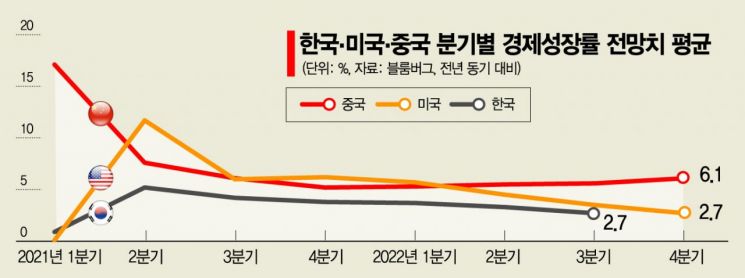
[Asia Economy Beijing=Special Correspondent Jo Young-shin, New York=Special Correspondent Baek Jong-min] The United States and China are showing rapid improvements this year, confirmed by various indicators, thanks to vaccine distribution and improvements in the COVID-19 situation. The economic recovery of the two major countries (G2) is expected to cause a global spillover effect. However, concerns are raised that South Korea may not fully feel this positive momentum due to vaccine supply controversies and the threat of a fourth wave of COVID-19.
◆Reviving US Consumption... China’s Q1 Exports Increase by 49% = On the evening of the 10th (local time), Saturday, the Garden State Plaza, the largest shopping mall near New York located in Paramus, New Jersey, was packed with shoppers. Popular stores such as Louis Vuitton, Apple, and Victoria's Secret were filled with crowds of customers.
On the 1st (local time), a duty-free shop on Hainan Island, known as the Hawaii of China, was bustling from early morning. With overseas travel impossible due to COVID-19, many Chinese flocked to Hainan to enjoy the Qingming Festival holiday. China also expects the Labor Day holiday (May 1?5) to boost its economy.
On the 15th (local time), the US Department of Commerce announced that retail sales in March increased by 9.8%. Compared to the same period last year, sales surged by a remarkable 27.7%. Considering that consumption accounts for over 60% of the US economy, this indicates a rapid economic recovery.
Consumption trends have also changed. Retail sales showed notable increases in apparel, sporting goods, and dining. With expanded vaccination and economic normalization, people preparing to return to work are purchasing clothing and dining out more. Restaurant sales in March rose by 13.4% compared to the previous month.
Investment strategist Kwon Oh-sung from Bank of America diagnosed at a video seminar hosted by Korea Investment Corporation (KIC) that "the US economy is currently entering a phase where economic recovery has begun and is transitioning into a mid-cycle."
Employment is also improving. The US Department of Labor announced that new unemployment claims last week were 576,000, the lowest since the COVID-19 outbreak in March last year. Consumption is also driving manufacturing growth. US industrial production in March increased by 2.7%.
Joseph Brusuelas, an economist at RSM, predicted, "Service sector sales closely linked to employment expansion will increase further by the end of the year if additional stimulus measures such as the expansion of child tax credits are implemented."
China’s economic growth announced on the 16th was already anticipated. Before the release of China’s Q1 GDP, major economic institutions forecasted growth ranging from 16% to 22%.
Exports are a representative example. According to the General Administration of Customs of China, Q1 exports increased by 49% year-on-year to $709.98 billion. Imports reached $593.62 billion, up 28.0% compared to the same period last year. This indicates that manufacturing and production are operating normally.
In fact, last month China’s manufacturing Purchasing Managers’ Index (PMI) rose 1.3 points from the previous month to 51.9, showing signs of economic expansion.
◆South Korea Not Benefiting from G2 Momentum= The recovery of the US and Chinese economies is expected to positively impact the global economy.
The International Monetary Fund (IMF) stated that if the US growth rate rises by 1 percentage point, 58.3% of that growth spills over to emerging markets.
Gita Gopinath, IMF Chief Economist, recently revised upward the global economic growth forecast, saying, "US fiscal spending has further improved the global economic growth outlook." The IMF expects the US to be the only advanced economy to surpass its pre-COVID-19 GDP this year. China’s economy is also expected to revitalize the global manufacturing industry. Additionally, the domestic market of 1.4 billion people is anticipated to have a significant impact on the global economic recovery.
© The Asia Business Daily(www.asiae.co.kr). All rights reserved.
![Clutching a Stolen Dior Bag, Saying "I Hate Being Poor but Real"... The Grotesque Con of a "Human Knockoff" [Slate]](https://cwcontent.asiae.co.kr/asiaresize/183/2026021902243444107_1771435474.jpg)
















