The main agenda was originally North Korea and China,
but US concerns led to inclusion of Japan-South Korea issues
China strongly counters ahead of the talks
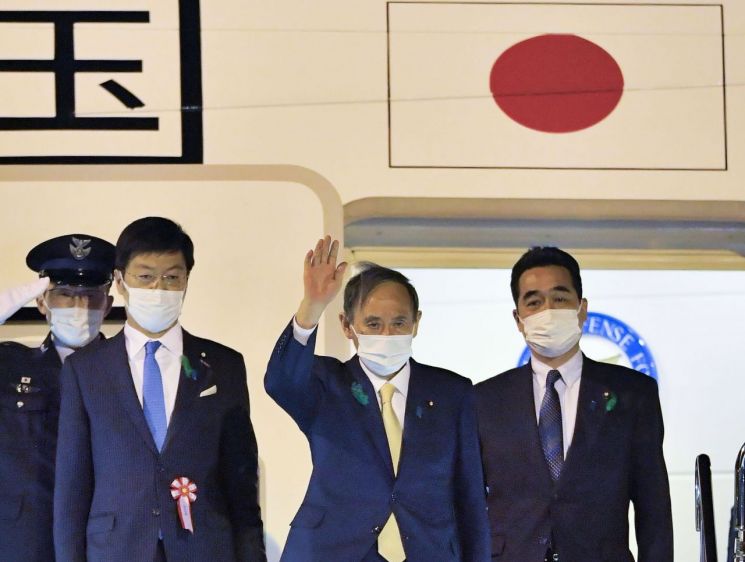 ▲ Yoshihide Suga, Prime Minister of Japan (center), arrived at Andrews Air Force Base near Washington DC on the 15th (local time) for a meeting with U.S. President Joe Biden. [Image source=AP Yonhap News]
[Asia Economy Reporter Kwon Jae-hee] In the early morning of the 17th (Korean time), the first face-to-face summit between U.S. President Joe Biden and Japanese Prime Minister Suga Yoshihide will take place, with South Korea-Japan relations expected to be on the agenda. This reflects U.S. concerns that the deterioration of South Korea-Japan relations could become a variable in the trilateral cooperation among South Korea, the U.S., and Japan on North Korea policy. China, anticipating that China containment will emerge as a major agenda of the U.S.-Japan summit, issued a stern warning message ahead of the meeting.
According to Japan's Kyodo News and China's state-run Global Times on the 16th, Prime Minister Suga will hold a summit with President Biden in the early morning of the 17th Korean time (afternoon of the 16th Eastern U.S. time).
Initially, the main agenda of this summit was known to be China and North Korea issues, but discussions on the deteriorated South Korea-Japan relations are also expected to be addressed.
According to major foreign media, a U.S. official described the worsening South Korea-Japan relations as "worrisome" and "painful," stating, "The issue of deteriorating South Korea-Japan relations will also be discussed at the U.S.-Japan summit."
Furthermore, at this summit, the two countries are expected to reaffirm that the Senkaku Islands (called Diaoyu Dao in Chinese), a territorial dispute area between China and Japan, fall under Article 5 of the U.S.-Japan Security Treaty, which stipulates the U.S. defense obligations to Japan. Amid rising tensions over the Senkaku Islands, the Japanese government hopes to achieve a China containment effect through this summit.
Additionally, the two countries are expected to discuss cooperation measures to respond to North Korea's nuclear and missile issues as well as the abduction of Japanese citizens by North Korea.
The Taiwan issue is also expected to be a major agenda item. Military tensions between the two countries have recently escalated in the Taiwan Strait amid intensifying U.S.-China conflicts. It is reported that the U.S. and Japan are coordinating to include content related to the Taiwan Strait in the joint document to be released after the summit. If realized, this would be the first time in about 52 years since the November 1969 summit between then U.S. President Richard Nixon and then Japanese Prime Minister Sato Eisaku that Taiwan is mentioned in a joint U.S.-Japan summit document.
China views the main agenda of the U.S.-Japan summit as measures to contain China and warned that if the U.S. and Japan cross the "red line" on issues such as Taiwan, Suga will face a test rather than diplomatic achievements.
The Global Times criticized, "Japan is forming an anti-China alliance dependent on the U.S. to contain China's rise, which is a foolish decision," adding, "In trade, China holds a much more important position than the U.S., and it is foolish for Japan, which needs economic stimulus, to stand on the opposite side of China."
It further stated, "Especially Japan's moves to 'flatter' the U.S. prove that the Suga administration is the weakest cabinet in Japanese history," and "Such actions by the Suga cabinet will likely face a backlash and be difficult to sustain."
Meanwhile, Prime Minister Suga is scheduled to return to Japan through Tokyo Haneda Airport on the 18th after completing his four-day visit to the U.S.
© The Asia Business Daily(www.asiae.co.kr). All rights reserved.
![Clutching a Stolen Dior Bag, Saying "I Hate Being Poor but Real"... The Grotesque Con of a "Human Knockoff" [Slate]](https://cwcontent.asiae.co.kr/asiaresize/183/2026021902243444107_1771435474.jpg)
















