KAIST Professor Lee Haesoo's Team Receives European Approval After Developing Mechanism
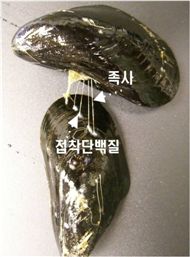 Byssus and adhesive proteins of mussels.
[Asia Economy Reporter Kim Bong-su] Domestic researchers have developed a hemostatic agent inspired by the powerful adhesive proteins produced by mussels when they attach to rocks, and it has been found to be effective in stopping bleeding in patients with blood coagulation disorders.
The Korea Advanced Institute of Science and Technology (KAIST) announced on the 16th that Professor Lee Hae-shin's research team in the Department of Chemistry successfully achieved effective hemostasis in patients with blood coagulation disorders using a mussel-mimicking adhesive hemostatic agent.
Since the first study on the underwater adhesive strength of the adhesive proteins produced by mussels to attach to rocks was published in 1981, scientists worldwide have conducted numerous studies to synthesize adhesives inspired by this mechanism, but no adhesive material has yet reached clinical trials involving humans.
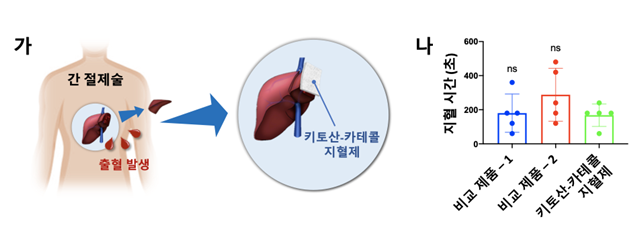 Hemostatic effect of chitosan-catechol in clinical trials involving patients with liver cirrhosis. Image courtesy of KAIST
The research team synthesized a polymer material, chitosan-catechol, mimicking the adhesive proteins of mussels in 2011 and patented it. They have been working to elucidate the mechanism of its actual hemostatic action. This time, they confirmed that it binds to blood proteins independently of blood coagulation factors and forms a fast and strong hemostatic membrane within seconds. It showed excellent hemostatic effects in animal experiments with blood coagulation disorders and demonstrated effectiveness in clinical trials involving liver transplant and liver resection patients.
Bleeding during surgery can threaten the patient's life and significantly affect postoperative outcomes. Especially for patients whose blood does not coagulate well due to hemophilia, chronic liver disease, or the use of anticoagulants such as aspirin and warfarin, more effective hemostasis is essential. The results of this study were published on the 24th of last month in the international journal Science Advances. Additionally, on the 30th of the same month, it obtained European approval (CE certification), making future global commercialization of the product possible.
© The Asia Business Daily(www.asiae.co.kr). All rights reserved.
![User Who Sold Erroneously Deposited Bitcoins to Repay Debt and Fund Entertainment... What Did the Supreme Court Decide in 2021? [Legal Issue Check]](https://cwcontent.asiae.co.kr/asiaresize/183/2026020910431234020_1770601391.png)
















