'Recovery' Diagnosis Still Uncertain Amid COVID-19 Surge
Inflation Concerns Rise with Petroleum and Agricultural Product Price Increases
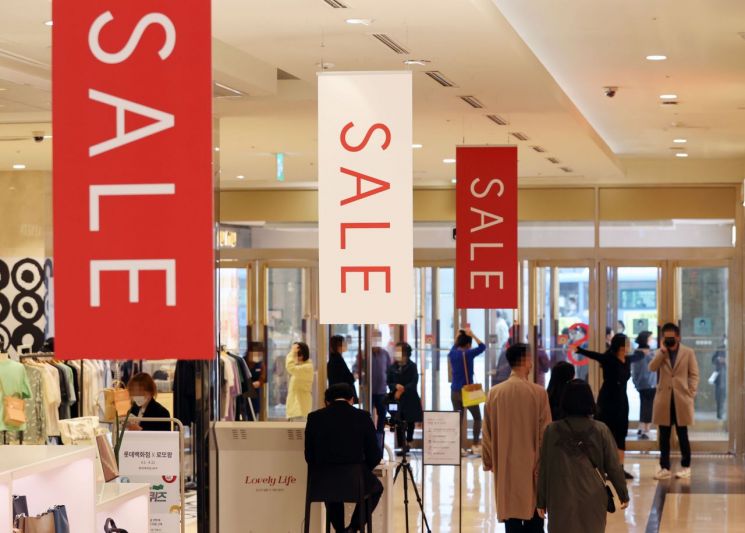
[Sejong=Asia Economy Reporter Kim Hyun-jung] Last month, department store sales increased at the largest rate in 16 years, leading the government to assess that the domestic demand slump in the Korean economy is easing following the recovery of exports and manufacturing. However, concerns were expressed about the recent continued spread of COVID-19 and inflation.
On the 16th, the Ministry of Economy and Finance published the 'Recent Economic Trends (Green Book) for April 2021,' stating, "While exports and manufacturing recovery continue, the domestic demand slump is gradually easing and employment is turning to an increase," and added, "Externally, expectations for global economic recovery are expanding due to vaccine and policy effects, but the spread of COVID-19 continues and inflation concerns remain."
The most notable indicator is the recovery in consumption. Last month, department store sales surged by 62.7% compared to the same period last year, marking the largest increase in 16 years since related monitoring began in 2005. This figure improved by 23.2 percentage points compared to February (39.5%), which had stopped a three-month decline and rebounded.
Domestic card approval amounts increased by 20.3% year-on-year, rising for two consecutive months following the previous month (8.6%). This is also the largest increase since comparable statistics began in January 2017. Additionally, discount store sales rose by 3.0% year-on-year, and online sales jumped by 21.1%, continuing the upward trend from the previous month. The consumer sentiment index recorded 100.5, recovering to pre-COVID-19 spread levels. This is evaluated as an effect of so-called 'revenge consumption,' where pent-up consumer desires temporarily explode. However, due to the base effect and other factors, domestic sales of Korean passenger cars decreased by 10.2% year-on-year.
The government used the term 'easing of slump' rather than 'recovery' for the overall trend, as consumer sentiment could shrink again at any time due to the recent continued spread of COVID-19. Kim Young-hoon, head of the Economic Analysis Division at the Ministry of Economy and Finance, said, "Retail sales and goods consumption have surpassed pre-COVID-19 levels, but face-to-face service sectors are still sluggish," and added, "Rather than a recovery, it should be seen as a gradual rise in the overall previously sluggish consumption trend." He especially noted, "Since the recent spread of COVID-19 continues, consumer sentiment could drop again at any time."
In March, consumer prices rose by 1.5% year-on-year due to increases in petroleum prices, expanding from the previous month’s (1.1%) rise. The number of employed persons in the same month increased by 314,000 compared to last year, ending a 12-month decline that continued until the previous month (-473,000). March exports rose by 16.6% year-on-year, supported by strong exports of key items such as semiconductors and petrochemicals. The average daily export value, considering working days, was $2.24 billion.
Division Chief Kim Young-hoon said, "To ensure a swift economic recovery and stabilize people’s livelihoods, we will steadily implement key policies to revitalize exports and domestic demand and strengthen management of internal and external risks."
© The Asia Business Daily(www.asiae.co.kr). All rights reserved.
!["The Woman Who Threw Herself into the Water Clutching a Stolen Dior Bag"...A Grotesque Success Story That Shakes the Korean Psyche [Slate]](https://cwcontent.asiae.co.kr/asiaresize/183/2026021902243444107_1771435474.jpg)
















