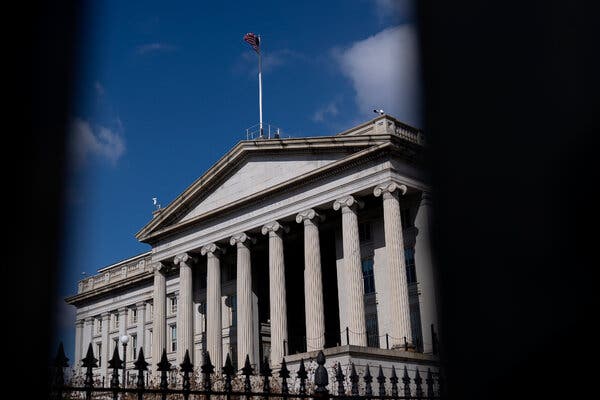
[Asia Economy Reporter Yujin Cho] On the 15th (local time), U.S. President Joe Biden issued an executive order implementing a series of measures, including prohibiting U.S. financial institutions from purchasing government bonds issued by the Russian central bank, treasury, and sovereign wealth fund starting June 14, due to allegations of interference in last year's U.S. presidential election. President Biden's goal with these sanctions is to increase borrowing costs for the Russian government and Russian companies, thereby limiting investment and growth.
Regarding this, The New York Times (NYT) analyzed that the actual threat of the U.S. sanctions on Russian government bond purchases announced by President Biden would be minimal. Since the scale of Russian-issued government bonds is very low and the proportion of Russian bonds held by U.S. investors is also minimal, it is expected that these sanctions will not be a "painful blow" from Russia's perspective.
According to Oxford Economics, the proportion of Russian government bonds held by U.S. investors is only about 7%. Currently, foreign-held Russian government bonds amount to approximately $41 billion, which is relatively small compared to the $274 billion in government bonds issued by the U.S. Treasury in the first quarter of this year.
Moreover, the main source of revenue for the Russian regime comes from the energy sector. Currently, the energy sector, including natural gas and crude oil, accounts for about 40% of Russia's fiscal revenue.
The NYT predicted that "the U.S. will implement strategies similar to those used to isolate the Iranian regime from the international community." However, it remains uncertain whether economic sanctions wielded with the dollar as a weapon will be effective in the Russian market. Russia's economic situation differs from that of Iran, Turkey, Venezuela, and North Korea, which have previously been targeted by U.S. economic sanctions.
The biggest difference lies in Russia's influence in the international energy market. Russia is a major energy supplier to Western Europe, and it is difficult to see complete alignment between the European Union (EU) and the U.S. regarding interests in Russian sanctions. Simon Miles, a Russia expert at Duke University, said, "This is merely shaking the edges of restricting access to Russian government bond trading," adding, "To inflict meaningful damage, the Western European natural gas market must be threatened."
Some speculate that the U.S. may prepare additional pressure tactics by leveraging Russia's economic structure, which is sensitive to external shocks due to its weak manufacturing base.
The NYT viewed, "This measure is symbolic, and stronger sanctions will be introduced in the future to gradually increase pressure." Adnan Mazarei, a senior fellow at the Peterson Institute for International Economics in Washington, said, "This measure will not be the Biden administration's final option."
James Nixey, head of the Russia-Eurasia program at the Royal Institute of International Affairs (Chatham House) in London, UK, also judged, "There are strong signs that the Biden administration wants to inflict more damage on Russia," adding, "These sanctions are just the beginning."
© The Asia Business Daily(www.asiae.co.kr). All rights reserved.

















