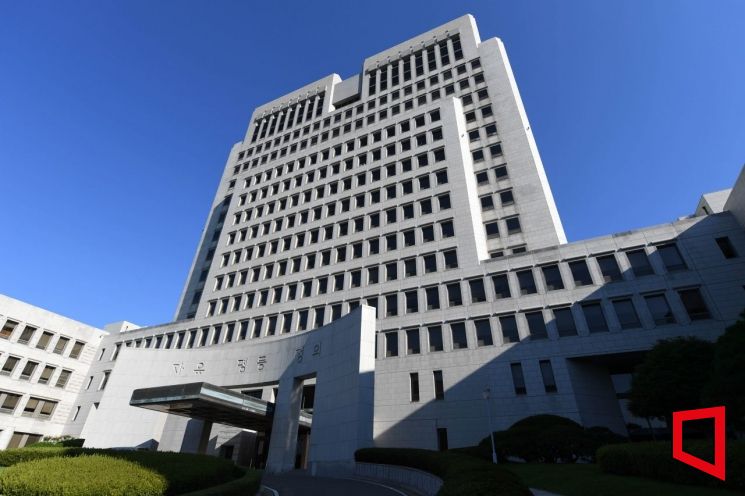
 Supreme Court in Seocho-dong, Seoul. Photo by Honam Moon munonam@
[Asia Economy Reporter Kim Daehyun] The Supreme Court has ruled that even if Chinese law applies in lawsuits filed by Chinese companies against Korean companies, domestic courts can recognize international jurisdiction.
On the 16th, the Supreme Court's 3rd Division (Presiding Justice Kim Jaehyung) announced that it overturned the lower court's dismissal of a claim for payment of goods filed by four Chinese companies against Korean corporation B and remanded the case to the Busan District Court Eastern Branch.
The Chinese companies, as plaintiffs, filed a lawsuit in a Korean court against Korean company B, which owns 100% of Chinese company A with whom they had a goods contract, after failing to receive payment from A. They argued that under Chinese corporate law, B should bear joint liability for the unpaid goods payment debt.
However, the first and second instance courts dismissed the lawsuit, stating that "international jurisdiction cannot be recognized for Korean courts," reasoning that international jurisdiction should be recognized for Chinese courts in terms of trial speed and efficiency.
The first trial court pointed out, "Due to China's unique legal provisions and interpretations, which differ significantly from our country's laws, it is inappropriate for our courts to interpret and apply them in this case where a Chinese company is suing a Korean company," and added, "Company B also claims that if Chinese law applies as the governing law in this case, it would be highly unfair to be tried in our courts." The second trial court agreed with this judgment and dismissed the plaintiff's appeal.
On the other hand, the Supreme Court recognized the international jurisdiction of Korean courts in this case. The court stated, "Just because Chinese law is the governing law applicable to this case does not mean the trial must be held in China, and the substantial connection between this case and Korean courts cannot be denied," adding, "The plaintiffs' intention to be tried in Korea, even at the cost of language and geographical disadvantages, should be respected."
© The Asia Business Daily(www.asiae.co.kr). All rights reserved.
![User Who Sold Erroneously Deposited Bitcoins to Repay Debt and Fund Entertainment... What Did the Supreme Court Decide in 2021? [Legal Issue Check]](https://cwcontent.asiae.co.kr/asiaresize/183/2026020910431234020_1770601391.png)















