US Congress Hearing on North Korea Leaflet Ban Law... Calls for Legal Revision in Korea
Unusual Hearing Focused on Korean Human Rights, Not North Korean Rights
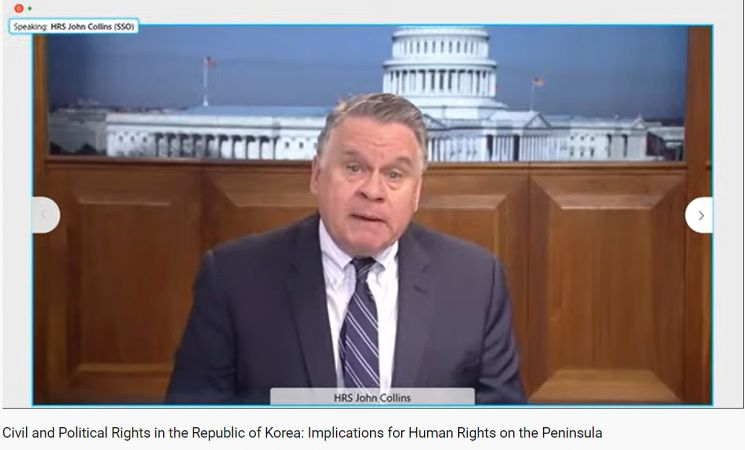 The Tom Lantos Human Rights Commission, a bipartisan body of the U.S. Congress, held a hearing on the night of the 15th (Korean time) on South Korea's law banning leaflets sent to North Korea, under the theme "Civil and Political Rights in South Korea: Implications for Human Rights on the Korean Peninsula." [Image source=Yonhap News]
[Asia Economy New York=Correspondent Baek Jong-min] The Tom Lantos Human Rights Commission (Human Rights Commission), a bipartisan body of the U.S. Congress, held a virtual hearing on the South Korean law banning anti-North Korea leaflets on the 15th (local time). The hearing was attended not only by opponents of the anti-North Korea leaflet ban but also by Korean-American members of the U.S. House of Representatives, who sharply criticized the Moon Jae-in administration's North Korea human rights policy. Since the event was held on the Day of the Sun, the birthday of former North Korean leader Kim Il-sung, North Korea's reaction is also drawing attention.
 Former Ambassador to Russia Lee In-ho is speaking at the US Congress hearing on North Korean leaflets.
The hearing was titled "Civil and Political Rights in South Korea: Implications for Human Rights on the Korean Peninsula," and was co-hosted by the commission's co-chairs, Democratic Representative James McGovern and Republican Representative Chris Smith.
The witnesses included former Ambassador to Russia Lee In-ho, Suzanne Scholte, president of the North Korea Freedom Coalition, John Sifton, Asia director of the human rights organization Human Rights Watch, China and North Korea expert Gordon Chang, Jessica Lee, senior researcher at the Quincy Institute, and attorney Jeon Su-mi. Republican Congresswoman Young Kim also attended.
Although commonly referred to as a hearing on the anti-North Korea leaflet law, the official title indicates an intention to address South Korea's human rights issues more broadly, making this an unusual situation. The South Korean government and some Korean-American groups in the U.S. tried to prevent the hearing, arguing that the leaflet ban law is a measure to protect residents in border areas, but the positions of hardline groups supporting North Korean defectors were largely reflected in the hearing.
Regarding the human rights situation in North Korea, both U.S. political parties have shown bipartisan criticism, which was reflected in the hearing.
James McGovern, Democratic co-chair of the Human Rights Commission, introduced human rights groups' claims of freedom of expression violations and evaluated the South Korean government's response efforts, but said, "Personally, I hope the National Assembly decides to amend the law."
He added, "International human rights law provides guidelines on what is acceptable and unacceptable when restricting freedom of expression for security reasons," and reiterated, "If this law can be reconsidered, I recommend that the South Korean National Assembly consider these guidelines."
Representative Smith also criticized the Moon Jae-in administration, which held an overwhelming majority in the National Assembly, for overstepping its authority, passing laws restricting freedom of expression, and politicizing prosecutorial power to harass civil society organizations involved in North Korean issues.
He also introduced the leaflet ban law as one that prohibits sending the Bible and BTS's music, calling it the "Anti-Bible and BTS Balloon Law."
Republican Congresswoman Young Kim, co-chair of the Congressional Study Group on Korea (CSGK), pressured, saying, "The U.S. and South Korea cannot reward (North Korea's) bad behavior by silencing freedom of expression and making unnecessary concessions," and "Many balloons flowing into North Korea are the only source of information from the outside world."
Gordon Chang, a conservative commentator and China-North Korea expert who testified as a witness, harshly criticized the Moon Jae-in administration using terms such as "attempts to make South Korean society like North Korea," "attacks on democratic institutions," and even used the phrase "rule of fear."
Former Ambassador to Russia Lee In-ho, who served as chairman of KBS during the Park Geun-hye administration, also harshly criticized the Moon administration's radical populism as maintaining a hollow representative democracy.
© The Asia Business Daily(www.asiae.co.kr). All rights reserved.
![Clutching a Stolen Dior Bag, Saying "I Hate Being Poor but Real"... The Grotesque Con of a "Human Knockoff" [Slate]](https://cwcontent.asiae.co.kr/asiaresize/183/2026021902243444107_1771435474.jpg)

















