Mechanized tunnel construction has been steadily increasing to ensure safety and minimize civil complaints, and TBM technology for more efficient mechanized construction is also advancing. Since construction is carried out beneath apartments where many people live, it is considered safer to bore tunnels with machines rather than using explosive blasting.
Mechanized construction focusing on safety assurance is deemed essential in the development of underground spaces such as deep underground tunnels including GTX under the government's SOC projects. Accordingly, TBM (Tunnel Boring Machine) excavation is continuously progressing in domestic tunnel construction, and TBM excavation technology is also evolving.
In Europe, significant technological advancements have been made in tunnel stability, minimizing ground subsidence, forward ground investigation for unexpected ground conditions, and improving excavation rates.
TBMs applied domestically are broadly classified into three types: Gripper TBM used in good rock conditions, Earth Pressure Balance (EPB) Shield TBM used in mixed ground with face pressures below 3 Bar, and Slurry TBM used in mixed ground with face pressures above 3 Bar such as marine and underwater conditions.
In particular, the Gripper TBM is known as a good example for use as an exploration tunnel for forward geological prediction during excavation and as an evacuation tunnel after completion, since it achieves much faster excavation speeds compared to the conventional NATM method that uses drilling and blasting.
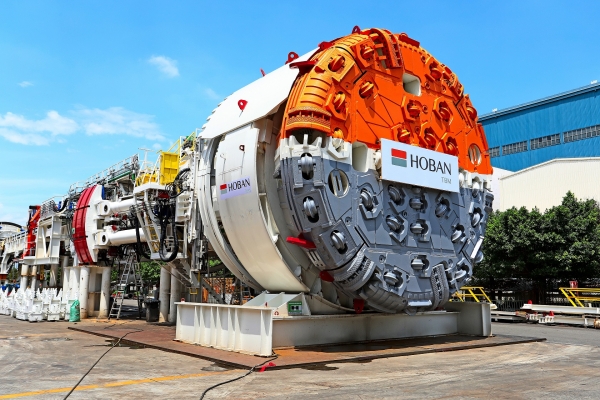
In Korea, Hoban Industrial and Hoban TBM of the Hoban Construction Group specialize in mechanized tunnel construction including Gripper TBM. Hoban Industrial has participated in projects such as the Han River Tunnel in the Gimpo-Paju Section 2, the Banpocheon Watershed Separation Tunnel completed last year, the Juam Dam Water Conduit Tunnel, and the Indeokwon-Dongtan Section 9. Hoban TBM is responsible for construction in the GTX-A Seoul urban section, Dobongsan-Okgjeong Section 2, and Unmun Dam Water Conduit Tunnel.
The Hoban Construction Group owns a wide range of TBM equipment from small diameter 2.6m TBMs to large diameter 11.6m TBMs, enabling construction of water conduits, power ducts, and traffic tunnels. Their tunnel excavation record of over 120 km is rare not only in Asia but worldwide.
Additionally, Hoban Construction Group and Hoban Industrial have civil engineering and geological engineers, which facilitates smooth identification of site issues and technical support. Especially, the Jincheon business office managing TBM equipment consists of electrical and mechanical experts with over 30 years of experience, and thorough maintenance of both completed and preparing equipment allows Hoban to demonstrate its unique construction know-how when deployed on site.
Senior Engineer Park Jin-su of Hoban Industrial said, “When people think of Hoban Construction Group, they often think of apartments, but in reality, in the civil engineering field, especially tunnels, we are a top domestic expert group with specialized technology playing a significant role in creating underground infrastructure.” He added, “Last year, we also made efforts to change perceptions by providing videos on the excavation principles of mechanized tunnels through YouTube.”
Meanwhile, experts point out that to further develop and activate domestic TBM construction, improvements in the ordering culture are necessary. The higher construction cost of TBM compared to NATM paradoxically reflects the excellent NATM technology and lower costs in Korea. If TBM and NATM are mixed in orders, except for special conditions, NATM is very likely to be applied, so a culture of ordering TBM alone is needed.
Senior Engineer Park said, “Research on standardizing cross-sections to enable TBM reuse is necessary, and since the circular cross-section of TBM tunnels creates unused space at the bottom, research on utilization methods for this space is also timely.”
He continued, “If such research is conducted along with comparative reviews of longer tunnel lengths and social and economic benefits, TBM construction in domestic tunnel projects will increase further.”
Hoban Construction Group has focused on the rock-type Gripper TBM market but is now on the verge of entering the shield TBM market. Considering the future of mechanized construction, entering the shield TBM market is a natural step, and Hoban has been steadily preparing for this. Accordingly, Hoban plans to expand into subway, railway, and road tunnels beyond the power duct market where TBM orders are continuously ongoing.
© The Asia Business Daily(www.asiae.co.kr). All rights reserved.

















