International Comet Research Team Including Korea Astronomy and Space Science Institute Captures Images Using Telescopes from 19 Observatories in 32 Countries Worldwide
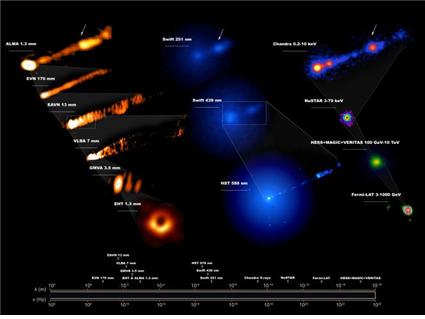
[Asia Economy Reporter Kim Bong-su] The Korea Astronomy and Space Science Institute (KASI) announced on the 15th that, together with an international collaborative research team, it has successfully conducted multi-wavelength observations of the center of the M87 galaxy, where a supermassive black hole is emitting powerful jets.
KASI, in collaboration with the Event Horizon Telescope (EHT) international research team, utilized a large-scale simultaneous observation network comprising telescopes from 19 observatories across 32 countries worldwide. Through simultaneous multi-wavelength observations covering the entire electromagnetic spectrum?including radio, optical, infrared, X-ray, and gamma-ray bands?they captured images of the supermassive black hole emitting jets larger than the size of the M87 galaxy itself.
This footage is the result of data collected and analyzed simultaneously by approximately 760 researchers from over 200 research institutions worldwide over about a month starting in March 2017. The total operational time of the telescopes used in the observations sums to over 300 years’ worth of data. The EHT research team has made this observational data publicly available online, allowing anyone worldwide to freely access the materials.
Darryl Haggard, a co-author of the paper and professor at McGill University in Canada, stated, “Numerous black hole research groups worldwide now have the opportunity to use the newly released M87 multi-wavelength simultaneous observation data to verify their theoretical models. This data will be highly beneficial not only to the astronomy community but also to various research groups in different fields seeking to clarify the relationship between black holes and jets.”
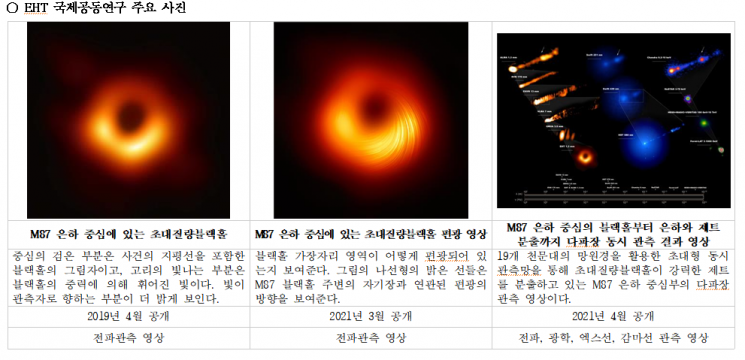
In addition to the radio images released by the EHT team in 2019, simultaneous observations across various wavelength bands captured the shape of the supermassive black hole at the center of the M87 galaxy, located 55 million light-years from Earth, with a mass 6.5 billion times that of the Sun. They also observed the accretion disk and jets where high-energy material is inflowing and outflowing.
Dr. Kazuhiro Hada of the National Astronomical Observatory of Japan said, “The first black hole image observed by the EHT was a remarkable result, but to analyze it scientifically to the fullest extent, it was necessary to analyze the black hole’s physical activity at the time through simultaneous observations across the entire electromagnetic spectrum.”
The spectacular images of M87 revealed through the newly added multi-wavelength observations are expected to be a decisive key to identifying the optimal model that can explain both the black hole’s shadow and its jets.
Until now, observations of black holes?considered experimental grounds for general relativity?have been challenging due to the accretion disk and jet-emitting materials surrounding the black hole. However, the current observations revealed that the M87 supermassive black hole was in a very low activity state during the 2017 observations, meaning the jet emission was minimal, or the inflow of material being pulled inside the event horizon from the black hole’s vicinity was low.
This indicates that the current multi-wavelength simultaneous observation data provides an optimal state where the scale of jets extending from near the black hole to thousands of light-years can be clearly distinguished. Since the data is publicly available worldwide, it is expected that active follow-up research will produce new results for precise verification of general relativity.
Notably, the M87 multi-wavelength simultaneous observations included data from the Korean VLBI Network (KVN) operated by KASI, which conducted simultaneous observations in four channels within the millimeter radio band. Additionally, the East Asian VLBI Correlation Center, operated by KASI, played a key role in processing observational data from the East Asian VLBI Network (EAVN), which connects radio telescopes in Korea (KVN), Japan, China, and other East Asian regions. This contributed to measuring and imaging the jet intensity during the M87 black hole observations.
Dr. Kim Jae-young of KASI said, “Thanks to the performance of KVN, the world’s first multi-wavelength simultaneous observation system, we were able to provide vast M87 observation data across a wide frequency band in a short period, making a crucial contribution to this research. We expect the interferometer performance of KVN to improve further with the addition of the fourth radio telescope to be constructed this year in Pyeongchang, Gangwon Province, which will enable KVN to play a central role in future black hole follow-up studies.”
The research results were published in the June 14 issue of The Astrophysical Journal Letters.
Below are explanations of key terms.
◇ EHT Project
When one thinks of a “black hole,” a dark hole is imagined. No one has ever seen a black hole directly, nor can it be seen directly because black holes absorb even light, making direct observation impossible. The images of black holes seen in videos or papers are all theoretical constructs based on models. The Event Horizon Telescope (EHT) refers to a “horizon” telescope, where the “event horizon” is the broad boundary connecting the inside and outside of a black hole. When some matter passes through the event horizon and is pulled into the black hole, part of it is emitted as energy, so with high-resolution observational equipment, it is possible to observe the edge of the event horizon.
The region near the event horizon experiences phenomena caused by strong gravitational effects. A representative example is the black hole’s shadow (Black Shadow). Matter in the disk around the black hole that approaches near the event horizon orbits the black hole at speeds close to the speed of light and is pulled into the black hole. To an observer, the edge of the rotating disk moving toward the observer appears brighter than the edge moving away. Observations of these extreme environments around black holes provide strong evidence for general relativity and understanding supermassive black holes. Such observations require massive observational equipment. Therefore, radio astronomers worldwide linked eight radio telescopes to function as a giant telescope the size of Earth.
◇ Supermassive Black Hole
This is the largest type of black hole, with masses ranging from hundreds of thousands to billions of times the mass of the Sun. It is believed that almost all galaxies have a supermassive black hole at their centers. However, supermassive black holes are relatively small celestial objects, making direct observation impossible until now. The size of a black hole’s shadow is proportional to its mass, so heavier black holes have larger shadows. The black hole in M87, due to its enormous mass and relatively close distance, was predicted to be one of the largest black hole shadows visible from Earth, making it an ideal target for EHT observations.
◇ Very Long Baseline Interferometry (VLBI)
To observe a vast area, large radio telescopes must be linked together. VLBI technology uses simultaneous observations of the same celestial object by cutting-edge radio telescopes worldwide to increase resolution (the ability to distinguish two separate objects). By observing the same object simultaneously with multiple radio telescopes separated by hundreds to thousands of kilometers, a giant virtual telescope with an aperture equivalent to the distance between the telescopes is created. The farther apart the telescopes are, the more the radio signals can be amplified, resulting in higher resolution. Eight radio telescopes each capture radio signals, and when these signals are combined at a “virtual telescope focus,” the effect is equivalent to a radio telescope the size of Earth.
◇ Korean VLBI Network (KVN)
Operated by the Korea Astronomy and Space Science Institute, KVN consists of three 21-meter radio telescopes installed at Yonsei University in Seoul, Ulsan University in Ulsan, and Jungmun in Jeju. The distances between the telescopes range from 305 km to 478 km. KVN is the only network in the world capable of simultaneously observing four frequency bands in the millimeter wavelength range. KVN can be used both as an interferometer connecting the three telescopes and as individual single telescopes. The East Asian VLBI Network (EAVN) connects 21 telescopes across three countries?Korea’s KVN, Japan’s VERA, and China’s CVN?forming a large-scale observation network spanning up to approximately 5,000 km.
© The Asia Business Daily(www.asiae.co.kr). All rights reserved.
![User Who Sold Erroneously Deposited Bitcoins to Repay Debt and Fund Entertainment... What Did the Supreme Court Decide in 2021? [Legal Issue Check]](https://cwcontent.asiae.co.kr/asiaresize/183/2026020910431234020_1770601391.png)

















