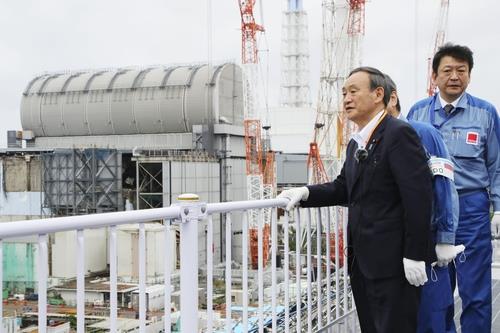
[Asia Economy Reporter Lee Ji-eun] The government is adopting a two-track diplomatic strategy of international cooperation and legal action to block Japan's discharge of contaminated water from the Fukushima nuclear power plant. However, there is concern that this issue could be perceived as a U.S.-Japan versus Korea-China conflict, given the close ties between the U.S. and Japan. Experts point out that achieving the desired outcome through legal action is not easy.
On the 14th, the Ministry of Foreign Affairs held the first "Korea-China Maritime Cooperation Dialogue" via video conference with the Chinese Ministry of Foreign Affairs, reaffirming their opposition to the unconsulted discharge of contaminated water from the Fukushima nuclear power plant into the ocean. The Ministry stated, "Both sides shared strong regret and serious concerns over Japan's decision to discharge contaminated water without sufficient consultation with neighboring countries directly affected." The Ministry plans to strengthen diplomatic efforts with countries concerned about the discharge damage in response to the Fukushima contaminated water discharge decision. Foreign Minister Chung Eui-yong also shared serious concerns regarding this decision during a foreign ministerial meeting with Singapore on the 13th. The Ministry intends to continue urging attention to the Fukushima contaminated water discharge issue in future foreign ministerial meetings with related countries.
The Ministry of Foreign Affairs is also considering international judicial action. On the 14th, President Moon Jae-in met with Koichi Aiboshi, the Japanese Ambassador to Korea, to express concerns and instructed the Ministry to consider filing a case against Japan’s discharge of contaminated water at the International Tribunal for the Law of the Sea (ITLOS). ITLOS is an international legal body established under the United Nations Convention on the Law of the Sea (1982) responsible for judicial settlement of disputes under the convention.
While the government aims to pressure Japan through a two-track approach of international public opinion and legal action, it appears difficult to gather voices from the international community beyond China, as the U.S. and the International Atomic Energy Agency (IAEA) support Japan’s decision. This coincides with the U.S.-Japan summit scheduled on the 15th (local time). If the U.S. and Japan reaffirm their agreement on the contaminated water discharge issue at this summit, the Korean government’s position may be somewhat weakened. It is reported that the two leaders will exchange views on the nuclear power plant contaminated water discharge issue during the summit.
Experts foresee that it will be difficult to achieve satisfactory results legally, as direct and concrete damage caused by the discharge has not been proven. Shin Beom-chul, head of the Foreign and Security Center at the Korea Institute for Industrial Economics and Trade, said, "President Moon’s instruction to review legal measures is effective in blocking Japan’s further actions," but added, "Legal resolution will be difficult due to the issue of proving damage." Lee Myeon-woo, deputy director of the Sejong Institute, also analyzed, "Even if legal action is taken, it is highly likely that the two countries will ultimately resolve the issue through consultation."
© The Asia Business Daily(www.asiae.co.kr). All rights reserved.
![Clutching a Stolen Dior Bag, Saying "I Hate Being Poor but Real"... The Grotesque Con of a "Human Knockoff" [Slate]](https://cwcontent.asiae.co.kr/asiaresize/183/2026021902243444107_1771435474.jpg)










