Possibility of Early Interest Rate Hikes During COVID-19 Recovery
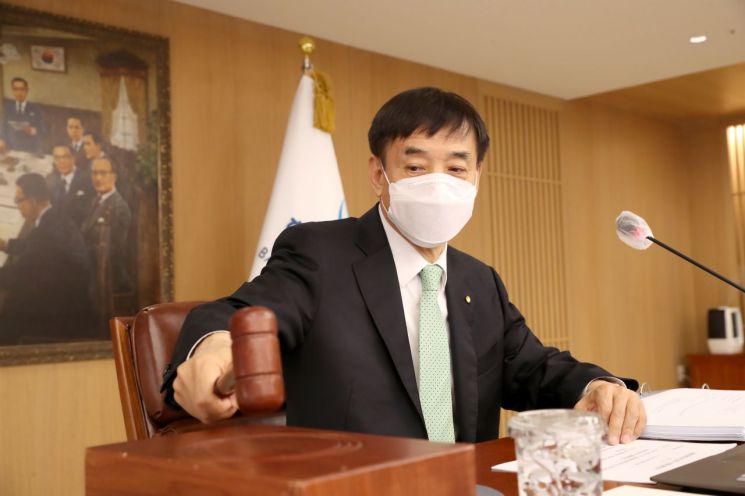 On the morning of the 15th, Lee Ju-yeol, Governor of the Bank of Korea, presided over the Monetary Policy Committee's plenary meeting held at the Bank of Korea in Jung-gu, Seoul, and struck the gavel.
[Asia Economy Reporter Jang Sehee] The Bank of Korea's Monetary Policy Committee decided on the 15th to keep the base interest rate unchanged at the current annual rate of 0.50%. This marks the 11th consecutive month of holding steady since the rate was lowered by 0.25 percentage points in May last year.
On the 15th, the Bank of Korea held a Monetary Policy Committee meeting at its headquarters in Seoul and announced that the base interest rate would be maintained at 0.50% per annum. Although the domestic economy is showing signs of recovery centered on exports and investment, it appears that the decision took into account the need to monitor the future developments of COVID-19.
In particular, recent signs of a resurgence of COVID-19 across various regions nationwide have raised concerns about additional damage to the real economy. Furthermore, with the announcement of some loan regulation easing measures for low-income and young people without homes imminent, there is a judgment that the increased liquidity could drive up housing prices.
Bank of Korea Governor Lee Ju-yeol has repeatedly stated that the current accommodative monetary policy will continue. At a press conference immediately following the Monetary Policy Committee meeting on February 25, Governor Lee said, "Because the uncertainty of the economic flow is very high, at this point, it is not a situation to mention raising the base interest rate or fully normalizing it." This is interpreted as meaning that the accommodative stance will be maintained until the COVID-19 recovery becomes visible.
If ultra-low interest rates continue, prices of real estate and stocks could be driven even higher. This is because more people tend to take out loans at low interest rates to invest in asset markets. According to the 'Financial Market Trends in March 2021' released by the Bank of Korea on the 14th, as of the end of March, the outstanding household loans in the banking sector amounted to 1,009.5 trillion won, an increase of 6.5 trillion won compared to the previous month. In particular, mortgage loans increased by 5.7 trillion won, accelerating the overall growth rate of household loans.
Meanwhile, experts predict that as expectations for economic recovery rise, the pace of interest rate normalization will accelerate further. Professor Andonghyun of Seoul National University's Department of Economics explained, "Although the Federal Reserve has announced a zero interest rate policy until 2023, the U.S. market expects the timing to be brought forward to late 2022 to early 2023," adding, "There is a sufficient possibility that the timing of our interest rate hikes will also be brought forward."
© The Asia Business Daily(www.asiae.co.kr). All rights reserved.

















