Bank of Korea Monetary Policy Committee
holds base rate at 0.50%... 7th consecutive freeze
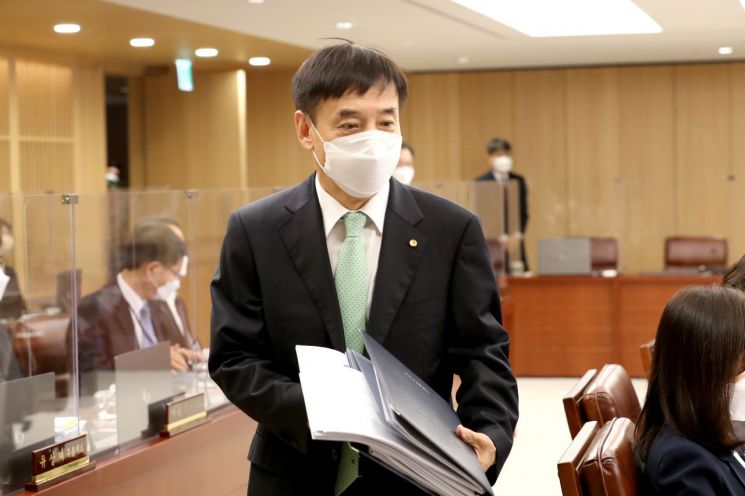
[Asia Economy Reporters Eunbyeol Kim and Sehee Jang] The Bank of Korea expects this year's gross domestic product (GDP) growth rate to exceed the February forecast of 3.0%, supported by a recovery in exports and facility investment. The consumer price inflation rate is expected to fluctuate around 2% for the time being. While anticipating a rapid economic recovery and inflation reaching 2%, the central bank decided to keep the base interest rate unchanged, citing high uncertainty related to the COVID-19 developments.
On the 15th, the Monetary Policy Board of the Bank of Korea held a monetary policy meeting at the Bank's headquarters in Jung-gu, Seoul, and decided to maintain the base interest rate at 0.50% per annum. Since lowering the base rate to a historic low in May last year, the Monetary Policy Board has kept it unchanged for seven consecutive times (11 months).
In the monetary policy decision statement, the board said, "This year's growth rate is expected to exceed the level forecasted in February (3.0%). Exports have continued to perform well, facility investment has maintained a steady recovery, and private consumption has eased its sluggishness, leading to a somewhat expanded recovery in the domestic economy." Regarding employment, it also noted, "There were signs of some improvement, such as a turnaround in the number of employed persons."
By signaling an upward revision of the growth forecast, the Bank of Korea has effectively confirmed expectations that South Korea's growth rate will reach the mid-3% range this year. The International Monetary Fund (IMF) recently raised South Korea's growth forecast from 3.1% to 3.6%, and the Organization for Economic Cooperation and Development (OECD) forecast is 3.3%. The government expects 3.2%, and the Korea Development Institute (KDI) projects 3.1% growth. LG Economic Research Institute has a positive outlook, forecasting a 4.0% growth rate this year, while the average forecast from foreign investment banks (IBs) is 3.8%.
The rapid rebound in growth is influenced by the U.S. economy's recovery, driven by continuous monetary easing and rapid vaccination. Given South Korea's economic structure with a high export ratio, it is heavily affected by the global economy. However, the extent of domestic economic revival remains to be seen. While some forecasts suggest that pent-up consumption is boosting the domestic economy, contrasting views point out that South Korea's vaccination rate is low at 2.3%, and employment recovery is slow, indicating a sluggish internal economic recovery.
Professor Donghyun Ahn of Seoul National University's Department of Economics said, "Both external (exports) and internal (consumption) factors contribute to the positive growth outlook. Not only exports but also pent-up consumption is increasing, and people tired of quarantine rules are engaging in outdoor activities, improving consumption." However, Professor Ahn added, "Given South Korea's very low vaccination rate, there is a variable risk that while other countries achieve herd immunity, we may not return to pre-COVID-19 production activities and thus fail to participate fully in the global economic recovery."
The Bank of Korea also raised its inflation forecast on the day. Governor Lee Ju-yeol said, "The consumer price inflation rate will exceed the February forecast path and fluctuate around 2% for the time being before slightly declining." He added, "In the second quarter, inflation will fluctuate around 2%, then decline somewhat in the second half, with the annual inflation rate expected to be in the mid-to-high 1% range." Previously, in February, the Bank had projected this year's inflation rate at 1.3%, indicating it will be higher. Already, the March consumer price inflation rate rose to 1.5% year-on-year, up from 1.1% in the previous month. The general public's expected inflation rate also increased to the low 2% range. The Monetary Policy Board expects core inflation to gradually rise to the 1% range as well.
Despite the rapid rise in growth and inflation and the prolonged ultra-low interest rate environment causing a surge in household debt, it is difficult to raise interest rates hastily. Increasing the burden on existing borrowers could hamper economic recovery. Professor Tae-yoon Sung of Yonsei University's Department of Economics said, "Since face-to-face consumption is delayed, there is a burden in adjusting the current interest rate."
The Monetary Policy Board stated, "Although the domestic economic recovery is expected to gradually expand, uncertainty remains high, and demand-side inflationary pressures are not expected to be significant. We will maintain an accommodative monetary policy stance." It added, "We will closely monitor the COVID-19 developments, the effects of policy responses, and pay attention to changes in financial stability, such as capital flows into asset markets and the accumulation of household debt." As of the end of March, bank household loan balances stood at 1,009.5 trillion won, increasing by 6.5 trillion won from the previous month. In particular, mortgage loans increased by 5.7 trillion won, accelerating the overall household loan growth.
Regarding the timing of future base rate hikes, the consensus is that the rise in market interest rates due to U.S. economic overheating and the Federal Reserve's (Fed) response will be crucial. The Fed has clearly stated its intention to keep the base rate unchanged through the end of 2023 and maintain asset purchases until significant economic recovery is confirmed. However, if the economy recovers faster than expected and market interest rates rise first, it may be difficult for the Fed to hold out until 2023. Professor Donghyun Ahn said, "Although the Fed has announced a zero interest rate policy until 2023, the U.S. market expects the timing to be brought forward to late 2022 or early 2023. There is a sufficient possibility that our rate hike timing will also be advanced." Professor Tae-yoon Sung advised, "If U.S. market interest rates rise rapidly, it is necessary to prepare for how to respond."
© The Asia Business Daily(www.asiae.co.kr). All rights reserved.

















