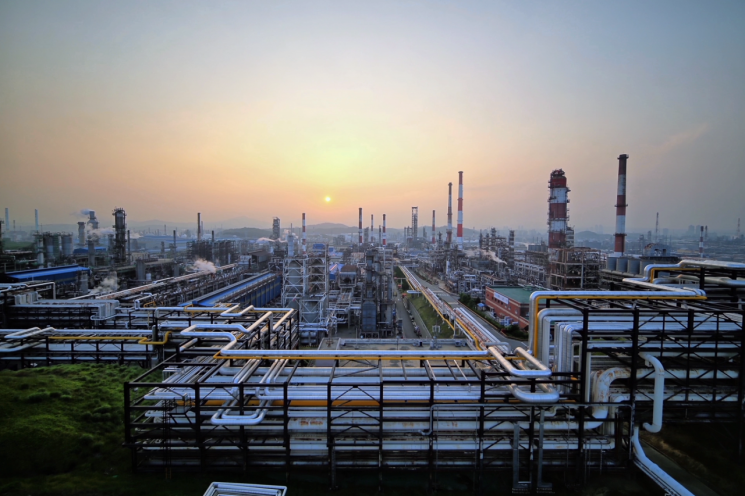
[Asia Economy Reporter Choi Dae-yeol] SK Innovation announced on the 14th that starting from July, it will operate eight power boilers at the Ulsan Complex (CLX) using liquefied natural gas (LNG).
The Ulsan Complex is home to SK Energy, the largest refining company in Korea, as well as integrated chemical and lubricants businesses. It is considered the country's first petroleum production facility, established in 1962. Power boilers are essential operational equipment that produce and supply steam needed for petroleum refining processes. Since beginning operation in the early 1970s, they have been running on bunker C oil for nearly 50 years.
Previously, in November 2019, the company invested 69 billion KRW to fully replace the bunker C oil boilers at Ulsan CLX. This included replacing gas burners, improving the LNG supply lines to the boilers, installing prevention facilities, and constructing new denitrification equipment. Since the combustion facilities were originally designed to use bunker C oil, the entire system was redesigned to address various constraints.
A company official stated, "The boilers, which played a hidden but crucial role in Korea's energy security and petroleum industry exports, have now become part of history," adding, "This decision reflects our commitment to applying the most environmentally friendly methods in production processes."
The power boilers here produce and supply approximately 500 to 1000 tons of steam per hour. Although the existing bunker C oil boilers continuously received facility investments to meet environmental standards, the company replaced them as part of its ESG (Environmental, Social, and Governance) management efforts. During the replacement process, detailed operational and work schedules were planned for each boiler to ensure uninterrupted operation of Ulsan CLX, which required continuous steam supply.
By operating the plant with LNG boilers going forward, the company expects an annual reduction of 160,000 tons of carbon dioxide emissions, about a 25% decrease compared to before. This is equivalent to planting 64,000 trees each year. Nitrogen oxide emissions are expected to decrease by approximately 858 tons, a 72% reduction. Sulfur oxides and fine dust will not be generated at all. LNG also improves boiler efficiency, reducing fuel consumption, and lowers costs by eliminating the need for bunker C oil transportation, storage, and desulfurization facilities.
Park Jae-hong, head of the Ulsan CLX power plant at SK Energy, said, "Under the goal that the site producing petrochemical products itself must become an ESG site, we decided to stop operating the bunker C oil boilers that have been running with SK for over 50 years," adding, "We will strive to become a model for ESG in petrochemical complexes worldwide."
© The Asia Business Daily(www.asiae.co.kr). All rights reserved.
![Clutching a Stolen Dior Bag, Saying "I Hate Being Poor but Real"... The Grotesque Con of a "Human Knockoff" [Slate]](https://cwcontent.asiae.co.kr/asiaresize/183/2026021902243444107_1771435474.jpg)











